
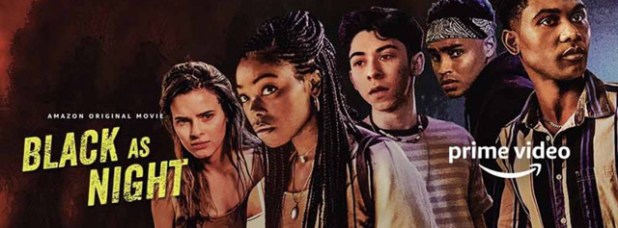
Black as Night

Vampire Owl: I thought this would be dark as night.

Vampire Bat: I am sure that they meant the exact same thing.

Vampire Owl: Yet, night is not black. It is just dark due to the absence of light.

Vampire Bat: I didn’t know that you were that interested in being exact.

Vampire Owl: Well, the are going to deal with the vampires. So they better be.

Vampire Bat: These are not really our type of vampires.

Vampire Owl: When they talk about real vampires, it has to be about us.

Vampire Bat: They are preferring variations these days.

Vampire Owl: Such a ridiculous human world. No wonder they have the virus.

Vampire Bat: Maybe they did create the virus. We cannot be sure.

[Gets a chicken puffs and three cups of iced tea].

What is the movie about? :: In the beginning, it is seen that a homeless man who is searching for cans is attacked by a group of three vampires who show no mercy. At the same time, in the same city of New Orleans, Shawna (Asjha Cooper), a teenage girl lives with her father Steven (Derek Roberts) and her big brother Jamal (Frankie Smith) as the mother Denise (Kenneisha Thompson) is living apart after becoming a drug addict. At the same time, there are many things going on the streets, including protests, with the distant possibility of riots too. Pedro (Frabizio Guido) who is her best friend forces her to be close to Chris (Mason Beauchamp) on whom she has a big crush, but that doesn’t seem to be a good idea, with her not being of his interest, and she also coming up against vampires who attacks her, but leaves when a car comes to the area. That leaves her scared as she feels that she would turn into a bat or a vampire. Along with the disappointment of not getting the attention of Chris after a talk, she is not afraid of noy being human anymore.

So, what happens with the events here as we just keep looking? :: In the morning, she sees that she is not affected by sunlight, unlike what she had read about. She feels that there is something vampiric about the place where her mother was staying, and when she reaches there with a doubting Pedro, they find out that Denise was bitten too. But unlike her, Denise is quick to transform into a vampire, leading to the curtains being taken off, only to have her burnt till death. As New Orleans is full of strange beliefs, and a lot of spiritual and magical stuff, she decides to get the help of some people who have some expertise in the same – the police have no idea about what has happened. Instead of going to the usual voodoo and hoodoo practitioners, they go to Granya (Abbie Gayle) who is supposed to be the great vampire expert. They still base their assumptions on vampire fiction, but they do feel that there is some idea about the same, and a sympathetic Chris also joins the team. But are they enough?

The defence of Black as Night :: We do have another addition to the vampire tales, and this does add up when we look at it that way. The first scene does add some power, and that adds the scary feeling that something interesting is surely going to happen soon enough – the film’s strength seems to be the beginning rather than the rest. The setting of New Orleans is all very good, and it keeps us interested enough, with the feeling that something could happen at any particular point. It could be suitable for the teenage audience more, like Twilight was largely successful with them, even though not with those who have traditionally liked the vampires through great works of fiction brought to us as classics from history. The ending provides us with a chance to have another sequel, and the same can keep us hoping for a better film to come later, without the extra nonsense social commentary added in between. If you are looking for one more vampire film in a world which seems to have moved away from the earlier vampire interest, this one will be a reminder.

The claws of flaw :: The emotional side is rather too weak, and we often have nothing to care about here, not just the protagonist, but also the remaining ones. There is also a lot more to care about when you are making a vampire movie – it is not like coming up with a creature movie with demons or aliens. It doesn’t have that vampire power which a movie like this should have possessed. When vampire terror should have been effectively, it does struggle to do the same, and often holds back without any particular reason. The opportunity to make this a horror comedy is not used well enough either. The movie is indeed a master in making the opportunities go missing. The chance to add some message about inequality and race in there also goes missing, and the usual good use of history in vampire works also falls flat. You cannot use social commentary where it doesn’t fit, and this one keeps pouring that at all places without success. It is also very quick to have us tired of all these things repeating, and has no big action happen unlike expectations.

Performers of the soul :: Asjha Cooper leads the way here as the leading lady, and happens to be okay in her work. Then there is also Mason Beauchamp and Frabizio Guido who seems to be leading the film together. But the one who seems to be more suitable to this situation is Abbie Gayle, with a character who is very much into the vampires. The others do have more screen time, but she seems to play the role of more relevance in comparison. The one face which seems to be somewhat familiar might be that of Keith David, who plays one of the major character really well, and so does Craig Tate, both of them being memorable people of darkness in the film. Sammy Nagi Njuguna and Tunde Laleye also have some notable roles around here, even though they are of significance only in the last moments of the film. Frankie Smith and Derek Roberts adds on with some less utilized characters, all of them seemingly reduced as the movie lasts less than one and half hours, rather too less for a film which seems to try to look back into some turbulent history – it is a shame.

How it finishes :: Here we have another vampire tale, even though the focus here is not that strong, and it is not the regular vampire thing as we usually know it. If there was better innovation, this could have been one fine vampire movie. Throughout the film, you know that vampires deserve better – films like Interview with the Vampire and Byzantium has already gone through the vampire world with class, and the Underworld series had the right vampire action. This one never really gets strong enough. Black as Night, despite seemingly having something in store, doesn’t really have the same. As we are going through the Corona virus pandemic which never seems to end, and all the natural disasters which never seems to move way, we do need some movies to fill up, and this one might do just fine for some people. After all, theatres have not opened in this part of the world yet, and you know that all the things that we are to fear will stay long enough, we have the intuition.

Release date: 1st October 2021 (Amazon Prime Video)
Running time: 87 minutes
Directed by: Maritte Lee Go
Starring: Mason Beauchamp, Asjha Cooper, Theodus Crane, Keith David, Abbie Gayle, Frabizio Guido, Tunde Laleye, Al Mitchell, Sammy Nagi Njuguna, Andrew Penrow, Nicole Barre, Derek Roberts, Joseph Singletary, Frankie Smith, Tim J Smith, Craig Tate, Kenneisha Thompson

<— Click here to go to the previous review.

<— Click here to go to the previous English film review.

<— Click here to go to the previous Amazon Prime horror release.

@ Cemetery Watch
✠ The Vampire Bat.

Cloud Atlas

cloudatlas (4)

If Cloud Atlas could be termed an anthology movie, it should be my all-time favourite in that genre, but it follows that path which moves the film back and forth through centuries and through different stories of this world. At one moment, you identify with one person, and the next moment, you see another world, one might be of the early nineteenth century, and the next one of a post-apocalyptic future which goes further beyond this century. I would prefer this method more than the typical anthology method which has even made an impact in Malayalam movies with Kerala Cafe and 5 Sundarikal, as this is more intellectually effective, as we moves through the minds and souls of all these characters at the same moment, and they are with us until the end of the whole movie-watching experience. All characters and locations stay with us together, like a mixture which resembles the real life. It is adapted from a 2004 novel by David Mitchell of the same name. The movie features multiple stories set across six different ages when the mankind has to face entirely different things, and faces them individually, and still most of them resemble each other with each action which was done in one century has indirectly affected the other, even as there is no direct relation between all these.

✠ Segment I: @South Pacific Ocean, in the year of Our Lord, 1849: This tells the story of Adam Ewing, a man with a powerful conscience who witnesses the whipping of a slave, Autua with digust. The slave later sneaks aboard Ewing’s ship in an attempt to escape from the world of pain and torture and attain freedom. Ewing helps him out, but not without doubts in his mind. Meanwhile, Doctor Henry Goose, his physician, slowly poisons Ewing, claiming that he is treating the man for a parasitic worm ever since he had collapsed seeing the whipping of the slave. He aims to steal Ewing’s valuables one by one. ***[Spoiler Warning for the next two lines]*** But when the doctor is about to finish the man with a fatal dose of poison, Autua intervens at the exact moment and saves Ewing. Returning to the United States as a changed man and with a clear idea in his mind, Ewing with the support of his wife Tilda, denounce her father’s involvement in slavery and leave San Francisco to join the movement against slavery. It is quite touching as a story, but the effect is limited – still works fine as a story which will inspire what is to follow. I wouldn’t go on to rate these stories considering them as part of an anthology though, and therefore you shall see none here. Still, this movie has the most clear message of them all, with no piece of ambiguity added at any point.

✠ Segment II: @Cambridge, England and Edinburgh, Scotland, United Kingdom, in the year of Our Lord, 1936: Robert Frobisher, a bisexual English musician, finds some work with composer Vyvyan Ayrsand after leading a life of high immorality and the worst possible scandals if discovered during the Victorian Age in Britain. He helps him to compose his own masterpiece, which is refered to as “The Cloud Atlas Sextet”. He is also attracted to the composer’s wife, a feeling which is mutual and has a relationship with her too. But Ayrs wishes to take credit for the work as his own, and threatens to expose Robert’s scandalous and immoral background if he tries to stop him. ***[Spoiler Warning for the next two lines]*** Robert who has read a partial copy of Ewing’s journal, shoots Ayrs and flees to a hotel, where he finishes the musical work. He then shoots himself and commits suicide just before his lover arrives. This is a story of lesser, or may be the least effectiveness, and I would consider this the weakest of them all. This one doesn’t even have a worthy character who could make an impact, and thus works as the story which prevents this movie from becoming the masterpiece, still holding itself together to prevent falling into that abyss.

✠ Segment III: @San Francisco, California, in the year of Our Lord, 1973: Here, a journalist Luisa Rey meets an old man, Rufus Sixsmith who was the lover of Robert Frobisher in the earlier segment of 1936. He is now a nuclear physicist who tells Rey about a hidden conspiracy regarding the safety of a new nuclear reactor run by a powerful man named Lloyd Hooks. He is assassinated by a hitman Bill Smoke before he can give her a report that could prove the same. But she is helped by another scientist at the power plant. But she is chased by the assassins and involves herself in a life or death situation. There would be no spoiler spoiled in this paragraph, and what connects this story to the first one is that common factor of lineage which goes back to the slavery and its abolishment, as well as “The Cloud Atlas Sextet” which makes its entry here too. This story is more of a continuation and the carrier of the earlier legacy of the two segments even as most of these things remain indirect and not easily noticeable. This is also Halle Berry’s best performance throughout the movie as she appears in entirely different roles in the segments.

✠ Segment IV: @England/Scotland, United Kingdom, in the year of Our Lord, 2012: Timothy Cavendish has his own problems when Dermot Hoggins, a gangster author whose book he has published, murders a critic and is sent to prison, and the gangster’s brothers threaten him regularly to get his share of the profits. Cavendish turns to his brother Denholme for help even as they don’t like each other that much and were not on good terms, but the brother tricks him into hiding in a nursing home, and it turns into a kind of prison for him, as he is held against his will, but he escapes with a number of inmates who shared his vision of freedom. The connection is established when Cavendish receives a manuscript of a novel based on Rey’s life. This is a touching, as well as funny story, which starts off slowly, but by the end, it leaves a profound influence on the viewers. This can be considered as the only story which has that lighter side in the serious world which tries to tickle the intellect throughout. The terms cute and sweet can also be linked to this one by the end of the segment.

✠ Segment V: @Neo Seoul, Korea, in the year of Our Lord, 2144: Sonmi-451 is a genetically-engineered clone server at a restaurant who is interviewed just before her execution. She tells the story of her release from her life of servitude and modernized slavery by Commander Hae-Joo Chang, a leading member of a rebel movement known as Union. While they are hiding from the troops, she watches a film based on Cavendish’s adventure thus making a connection to the previous segment. It is revealed to her that the clones like her are killed and “recycled” into food for future clones who becomes the server in the restaurants later without themselves knowing anything about it. Just like the people of 1849, she also decides that the system of such a dystopian society based on slavery and exploitation of other living beings is evil and not to be tolerated, and how she changes the world or at least make it aware of what is happening under the mask of a righteous and perfect world forms this story of revolution, an element which has existed throughout the segments. She is a representative of all ages, and she is that vision of the past that future has upheld with pride.

✠ Segment VI: @The Big Island, in the year of Our Lord, 2321: Zachry is just another random person who lives with his sister and niece Catkin in a primitive society after most of the humanity has died in an apocalyptic event which is not mentioned, but a possible nuclear warfare and related massive destruction can be guessed. Sonmi-451 of the previous segment is worshiped as a goddess and her broadcast is part of their sacred texts. Zachry is plagued by strange visions of a figure who creates fear in him, and leads to him running away from problems all the time, something which haunts him throughout his life, as he couldn’t save his own people from death due to his fear and hallucinations. They are also attacked by a fierce cannibalistic group regularly. One day, his village is visited by a more modern individual, part of the society which had more access to the technology during te apocalypse, and this changes his life forever. There is also an epilogue in which more of who tells these stories and from where – all these are revealed to the viewers. Tom Hanks and Halle Berry are there for all the segments, and have done a great job in fitting in. The same can be said about Hugo Weaving, and Doona Bae is highly impressive in Segment V. The movie is not for everybody, but it is a wonderfully crafted work of art made from a work which was near impossible to adapt on screen, as something which inspires one continuously as long as he or she is able to stay with it, and there are good intentions related to this one, and the viewers can’t simply deny that.

Release date: 26th October 2012
Running time: 172 minutes
Directed by: The Wachowskis – Laurence Wachowski and Andrew Paul Wachowski [segments 1849, 2144, 2321], Tom Tykwer [segments 1936, 1973, 2012]
Starring: Tom Hanks, Halle Berry, Hugo Weaving, Doona Bae, Jim Broadbent, Jim Sturgess, Ben Whishaw, James D’Arcy, Zhou Xun, Keith David, David Gyasi, Susan Sarandon, Hugh Grant

cloudatlas copy

@ Cemetery Watch
✠ The Vampire Bat.