Oru Indian Pranaya Katha

oruindianpranayakatha (1)

An Indian Love Story :: Now, that is the direct Malayalam to English translation of the title of this movie, but let it not make you think about this as a romantic love story full of melodious songs and a hero and heroine looking at each other, the sky, the beach, or the river. This is partially a political satire and otherwise a drama concerning family relations. Coming from the director who never disappoints us (except for may be No. 1 Snehatheeram Banglore North), as the man with such a fine record, this movie was always going to be watchable whatever be the content, and even as it turned out to be kind of usual, this movie also doesn’t disappoint (yes, I do think well of his last venture Puthiya Theerangal too). His best of this century was Manassinakkare, and before that we know it has always been NadodikkattuOru Indian Pranaya Katha fits among the good movies, not at the higher level though. But be assured that the love between the lead pair happens just because the movie ends, and that is where the romance should begin.

What is it about? :: Ayamanam Sidharthan (Fahad Fazil) is the leader of the local youth wing of a party who hopes to become an M.L.A. soon by being the candidate in the upcoming by-election. He is supported by Uthup Vallikkadan (Innocent) who is the district head of the party always making an attempt to show his face on television. But his hopes are crashed when the national leaders choose another person who has no political background to contest in the elections instead of him, just because she is the daughter of a big shot politician. As Sidharthan is fed up and decides to take a break, he comes across Irene Gardner (Amala Paul) from Canada who is attempting to shoot a documentary and needs someone to help her, for which she can provide rupees two thousand per day. He feels that this could be a nice opportunity for him to keep away from politics as well as gain some much needed money, and he takes that offer. But he realizes that there is something about her that is much more than what meets the eye. So why is Irene in India and what is she looking for, and how can our hero help her? There remain the questions.

The defence of Oru Indian Pranaya Katha :: The movie has a wonderful first half, and it is a gem that shines and takes all the claps with grace. There are lots of moments of fun, and in each of them, Fahadh Faasil scores, and Innocent provides good support. There is the humble and yet beautiful beginning to the story which is carried on towards the interval. The moment when the hero takes up the job for the heroine is hilarious, and most of the moments involving politics are times of laughter. It remains clean throughout the movie, and there are no unnecessary vulgar jokes which has been plaguing Malayalam movie industry and keeping the audience away. There is basically nothing which is bad for kids, and there is no stupid romance getting in the way of the movie flow. There was obviously the chance for bad jokes on many occasions, and at a time when even movies like Sringaravelan become family entertainers, this effort to keep the dirty things away has to be appreciated. To add to it, the goodness and social message that the movie delivers is worth some applause.

Claws of flaw :: The movie fails to keep the momentum going in the second half, and right after the first half, the world starts twisting and breaking apart. Even as the latter half also has some good jokes, it seems to suffer from a big curse which hinders its movement, and it drags and gets converted into a family drama from the political satire which it was in the first half. There is lot of emotional undercurrents going on, and none of them romantic in character. The leading lady’s search for her roots lacks in both strength and innovation and the flashback story is too much off the dusty old books. The songs stay below average, and there is nothing that can pounce in our hearts. There is a void left in our desire to follow the satirical side, and our need for things which are left behind can be felt by the end of the movie. It has a happy and a righteous ending for sure, but surely not an effective one. The people who are looking for the romantic side will be disappointed, as the love between the leading characters blossoms only in the last few moments of the movie, or rather the last few seconds before the movie ends.

Performers of the soul :: As expected, Sathyan Anthikkad’s style rescues another movie yet again. But Fahadh Faasil is the man who leads the show yet again, just like he did in North 24 Kaatham without even speaking much, and in Amen with simplicity. He has portrayed a different character yet again, and his comic side in this movie is something that takes over. He once again transforms to a character who rules the first half of the movie and stays good in the second half. Innocent’s support is as good as usual, and there is no boring moment when he is around. Amala Paul looks even better than ever in this movie, and it is good to see that her presence is there right from the moment she is introduced. Her character seems to have been rightly portrayed, right from the moment she appears with a video camera in an orphanage. Her characteristics of a lady searching roots as well as a fun loving girl are rightly captured and reflected to the audience. Shafna and Lakshmi Gopalaswamy are also there with significant roles which catches attention, but the latter could have had more screen time.

Soul exploration :: The movie does leave us with many messages, one of them being the core of them all, not to take politics as a job, but as a means to serve people along with working. The real ambition is to be serving people rather than to be at the top, but that will rather be a need. Well, ambition is the root of all evil, and as Doctor Faustus did prove long ago as in the lives of Lucifer and Mephistopheles, there is nothing like ambition that makes a man evil. The leading characters do undergo significant changes in their journey, but not something as huge as North 24 Kaatham, as they were both this good right from the beginning to the end. Even as a movie which is considered as a romantic comedy, there is no glorification of romance or similar stuff, and that is another bonus. The useless nature of exaggerated love is made known to us throughout the movie, and the stress is more on family values, along with helping others at the same time. The movie also stresses on the importance of roots and the need to know them thoroughly. Whatever be the situation, or however the world changes, there is nothing like our parents, as the movie shows.

How it finishes :: When the hero says “There is beef in the scene” – that was a hilarious moment, and so was the dialogues in the library – the movie drops such laughter bombs regularly to keep the movie in the hunt in a weekend powered by two other big releases, Jeethu Joseph’s Mohanlal starrer Dryshyam and Lal Jose’s Dileep starrer Ezhu Sundara Rathrikal along with the Bollywood’s own Dhoom 3 and Hollywood’s only release Cloudy with a Chance of Meatballs 2. There is also the Tamil movie Biriyani, which means that there is a lot going on in the theatres this weekend – I have already booked tickets for Dryshyam, and I am looking forward to watching Ezhu Sundara Rathrikal on the same day. There is a lot to be done for me this Christmas, that is for sure, and as far as Oru Indian Pranaya Katha is concerned, it is a good choice for a family outing, and there is not much rush for it due to the less hype – you can go for it soon enough. Forgive the movie for its weaknesses in the second half, and do give it a chance to be that love story that scores without that much of romance. This is a small movie of goodness, that can do with a lot of support from the audience.

Release date: 20th December 2013
Running time: 150 minutes (estimate)
Directed by: Sathyan Anthikad
Starring: Fahadh Faasil, Amala Paul, Innocent, Shafna, Lakshmi Gopalaswamy, Krishna Prabha, Muthumani
oruindianpranayakatha copy

@ Cemetery Watch
✠ The Vampire Bat.

Thattathin Marayathu

thattathinmarayathu (1)

The case of love :: The stories of love has been exaggerated for centuries, and we are not strangers to how William Shakespeare described a lot of things in his Sonnets. The better qualities which are needed for this world including brotherly and sisterly love or the love for the down-trodden or the subaltern would always have to make way for a kind of love which is based on the outside beauty and powerfully fixed on infatuation and lust. Then they can ask “Shall I compare thee to a summer’s day?” but does all the immortalizing of such love make any sense? How someone can fall in love for another just by looking at his or her is one of the weirdest things in the world. That is undoubtedly a case of infatuation and lust, however one tries to support the theory of love at first sight. But it is such a story that we are going to talk about, and it is the same thing that this movie is about, and as this turned out to be a good movie even without the “truth of love” in it, this case of love is to be left to the audience who made this one a hit, and as a film, it deserved it.

Love in the South :: Malayalam movies have had that incredible strength to come up with successful love stories which stay on our minds for long. One of the earliest movies of that kind after the early age of the legendary Chemmeen should be Nakhashathangal, but the trend came back stronger than ever with two movies Aniyathipraavu and Niram, both starring Kunchako Boban and Shalini who established themselves as the perfect star pair for love stories. The specialty of these two movies was that there was so much goodness in them, and on both occasions, the pair chooses not to disobey their parents, and such sacrifice should be at the base of love, and not carnal desire. But about the pathetic nonsense which came as pseudo-love stories, like Annayum Rasoolum, one shouldn’t bother – it was a pathetic case of looking at each other in an extended version of love at first sight moments, and that movie will do more bad than good for the romantic movies which are to follow including Oru Indian Pranayakadha. Meanwhile, Dr. Love was a superior story of love with sacrifice involved in it, just like Dhosth.

What is it about? :: This movie written and directed by Vineeth Sreenivasan as his second venture as the captain of the ship, has the story of a ordinary Hindu Nair boy falling in love with a rich Muslim girl. Vinod Nair (Nivin Pauly) has fallen for Aisha Rahman (Isha Talwar) with an incredible moment of falling in love as he hits her while running and she falls down the stairs to land in a hospital. Supported Abdu (Aju Varghese), Hamsa (Bhagath Manuel) and Mustafa (Ahmed Siddhique), he goes on a mission to win her love despite the problems caused due to religion and social status, and that fact that he belongs to the party which is fighting against her family’s business. After doing some strange and stupid things, he finally gets a chance to talk to the girl, and soon he tells her about his love to get a positive response. His supporters grow, as S.I. Prem Kumar (Manoj K. Jayan) helps further in his cause as he leaves his house. So, will this love story succeed, or does it have to become another Romeo and Juliet? Almost everyone in Kerala knows the answer.

The defence of Thattathin Marayathu :: The movie has everything which is needed for a perfect love story of exaggerated character. It is also the best love story in Malayalam since Niram, with all the possible additions of the age, including the witty dialogues, “when she replied, I felt like Sreesanth who got the wicket of Andrew Symonds” or “why should boys of Kerala need six-pack?”, and another one “you can think before making decision about my love and tell me that you do love me”. Despite the popular thoughts about this being a powerful love story, I would say that this movie is never serious – it is incredibly light and always on the humorous side; even when it tries to get serious, there is that feeling of “all’s well that ends well”, and as there is no real dark shade to the movie, this is a perfect love story which is nothing less than a fairy tale, and if we think that way, the movie is the perfection of exaggerated love, rightly presented on screen, and therefore flawless in its core.

Claws of flaw :: Despite having the best songs of the year and the great cinematography and direction, the movie is nowhere near perfection in a natural world. It clearly lacks logic and fails to make sense on multiple occasions, a flaw which can be forgiven just because of the reason for its existence. It follows the old style tradition of a boy from one religion marrying a girl of another faith, and to add to it, here one is poor and the other is rich, another stereotype explored. The boy feels the usual love at first sight for the girl and starts dreaming about her as if his life depended on her. He forgets his duties and even his parents and becomes the stupid guy, while the girl remains just the opposite, not breaking traditions or disrespecting her parents or relatives. The exchange letters through a messenger, sings songs in dreamy sequences, and hopes for being together. In that case, the movie has nothing new or innovative in its base. it is not intense, and it has no real villain except for one man who just objects to the marriage.

Thattathin Marayathu and love :: The world of the movie is strange, as the hero sells helmets after making police catch people for not wearing a helmet, and with the cash he earns, he begins a pardah shop – and that is an act of love. This movie’s definition of love is being infatuated by a random girl at a random place just because she is good-looking. Is this love or some strange feeling which has been created a girl in veil, and without that what would be she to him? Well, who cares about what should have got all the attention, as she might have been a horrible creature in soul, but the only thing that matters in this love is that she is beautiful and has a fair complexion. Thattathin Marayathu is never a story of true love, and most of the people might agree, but it is unrealistic love of exaggerated love, presented in a beautiful manner. Well, the real life can never be this simple as a whole, and it is also not this complicated in many other things that they show. Well, as long as the new bottle where you put the old wine is pretty good, how can one complain? The leaks are there, but there are provisions to make sure that the wine don’t get lost on the ground.

How it finishes :: In this visually awesome movie, another thing that catches our attention is the performance of Aju Varghese as he has done a perfect comic supporting stand there. Manoj K. Jayan and Bhagath Manuel are also nice support. Nivin Pauly comes up with a side which wasn’t there to be expected from him, and establishes himself as the romantic hero of this age. But as far as Isha Talwar is concerned, her character is a real disappointment, not talking much or doing much even as she has the most righteous character in the whole movie. The result is that he has created more of a statue image, which affected her in the movie I Love Me. She will always be remembered as a beautiful sculpture rather than a character, and the fact that she was perfect for the role doesn’t come as a positive. The movie has successfully presented its world with the support of most of its cast, and as the image it shows is of innocence and goodness even as it is covered is stupid love of exaggerated nature. It is a magnet, and it will attract viewers even after being shown on television multiple times unlike dark creatures of pathetic romance like Annayum Rasoolum.

Release date: 6th July 2012
Running time: 127 minutes
Directed by: Vineeth Sreenivasan
Starring: Nivin Pauly, Isha Talwar, Aju Varghese, Bhagath Manuel, Aparna Nair, Manoj K. Jayan, Sreenivasan, Sunny Wayne, Niveda Thomas, Ahmed Sidhique, Manikuttan, Sreeram Ramachandran

thattathinmarayathu copy

@ Cemetery Watch
✠The Vampire Bat.

Punyalan Agarbathis

punyalan (1)

The time of the saints :: It is the time for the saints, and it was proved by one of the best satirical movies in Malayalam belonging to this century. There was indeed a saint in that movie, and it was Pranchiyettan and the Saint. Now, with the word “punyalan” translated as the saint, this movie also tries to take on the saint + trichur slang which shaped that wonderful satire. The saint is for sale this time, as our hero sells “Saint Incense Sticks” which is how “Punyalan Agarbathis” would get translated, and also if we consider it in another way, it is the sale of a useful saint imagery that happens here, now just as a Christian saint, but rather as the saintly figure in the centre which gets explored so many times, mostly remembered by this year’s movie Immanuel with its title character and Pranchiyettan was himself nothing less than a saint. There is still a lot of interest for the saintly figures among our usual audience, even as the hero who beats up people and says vulgar dialogues might come back any time now – I just hope they stay dead.

What is it about? :: Hailing from Trichur, Joy Thakkolkaran (Jayasurya) is a man who keeps trying his luck in many business ventures, but none of them really working. His latest attempt is on creating incense sticks from elephant dung, and it is named Punyalan Agarbathis hoping that Saint George will help him in his attempt to make it big. He wanders around looking for collecting what he calls “raw materials”. His wife, Anu (Nyla Usha) supports him with a regular job, but it is often insufficient for what he has to spend for his business. He is helped by his long time friend and assistant Greenu Sharma (Aju Varghese) and a driver Abhaya Kumar (Sreejith Ravi) as well as two workers who rarely works. But he has to fight a lot of narrow minded people, politicians and after all, fate which means that his troubles might never end. He is forced to spend most of his time in the court seeking justice, and his ideas keep getting struck down by destiny’s lightning, as he begins to feel that the whole world is against him. The story deals with how he finally survives in his battle.

The defence of Punyalan Agarbathis :: Well, the defence of Punyalan Agarbathis is easy up-to an extent. Other than its social relevance which is mostly about the tragic situation of the common man and the social evil which is harthal, the whole thing is about fun. The simplicity of the movie is worth appreciating. There are lots of funny dialogues stored in between. The beginning credits scene itself is well-crafted with scenes from Trichur. Most of the characters are interesting, and the movie has successfully built up a very good first half after its interesting beginnings. It has moments which makes one wonder how more awesome it can get, and keeps the audience asking for more. The movie’s biggest advantage might be its name, and its trailer which keeps the audience interested, and once the movie starts, there is also the ability to keep close to that standard till the end of first half. The songs are fine and the cinematography is admirable. The saint hasn’t avoided this movie, that is for sure.

Claws of flaw :: The movie seems to create the idea that there is a saint in most of the common man who suffers due to the rich, corrupt hands of the same society, but that kind of fades a few minutes after the first half. By that time, movie had deviated from its wonderful world to an abyss of incapacitated story with the undercurrents of that logic which decided that it is better to leave the flick and go to Mars and stay with Martians. There was always the chance to go astray right from the beginning, but it happened only in the second half, and the way they tried to finish it quickly almost as if a limited offer deus ex machina is used, is a real blemish on the movie. It was more like a cargo ship with great items on board going adrift and losing its good cargo by the time it reaches the destination. Why this sudden disorientation? Even if there was no happy ending to the story, may be if they had just let the leading character miss out and leave his business, it wouldn’t have been a lesser level second half or ending.

Performers of the soul :: If I have to tell who is the performer of the day, that would be a surprise, as Jayasurya is the man in form yet again. He transforms into another interesting character with ease, and Aju Varghese is a wonderful support to him. Sreejith Ravi also contributes to the fun in an avatar he is not usually seen in. Nyla Usha joins the party with charm, and Rachana Narayanankutty does a great job, both serious and funny sides handled with care. Innocent and Tesni Khan also contributes with their relatively small presence, even as we would have liked to see a lot more from the former. T.G. Ravi was there for the last Trichur based satirical comedy and he is there to impress us yet again. Idavela Babu is here as a villain for a change and doing a wonderful job, even as the evil face doesn’t just belong to him, but to so many forces of the society. You have to like Sunil Sukhada in his job. The acting department is so close to perfection, and the other areas of the movies are well supported, yes Mala Aravindan’s funny KAPA character included.

Social relevance :: We have had many movies of social relevance, with Sandesam, Varavelpu and Vellanakalude Naadu quite a long time ago, and Arabikkatha, Passenger and Pranchiyettan and the Saint not too far away from the present. Punyalan Agarbathis falls behind all these movies, but is the next movie which comes to the list. The movie takes on harthal as a social disturbance right from the beginning stages itself. The assertion on the harthal stands tall among others, and another focus is on the corrupt politics and the plight of the common man, and also about how difficult it is to begin an industry in Kerala. But the use of elephant dung there might be strange, but still okay enough as the movie is not to be taken that seriously, and the use of such an insignificant and free thing means that one can’t even try little things in a world of corruption and among influential people who are there to create trouble. If it was presented a little differently, with a better second half and a much better climax, the movie would have been remembered for a very long time.

How it finishes :: Ranjith Sankar has given us messages through his movies, and his best shall yet remain Passenger, a fine Molly Aunty Rocks and a below average Arjunan Saakshi. All of them had something other than the story to tell us, and this one is not different either. The elephant dung thing gets irritating after some time, and you know at which point the movie losses focus. Otherwise, this is the right Malayalam movie for the weekend, if we consider the reports. As the title Bicycle Thieves hurts my feelings about Vittorio De Sica’s neorealist drama and the name Escape from Uganda makes one feel worse, with the only thing further strange being the name Namboothiri Yuvavu @ 43 – this movie is a winner right from the title. The reports also seem to suggest that there is something in the title that is carried into the movie. Still, if you are not fixed on watching a Malayalam movie, I would suggest Frozen as the movie of the week. Meanwhile, our desire to watch another Pranchiyettan and the Saint remains unfulfilled.

PS: The leading character in Pranchiyettan and the Saint was Francis, and here we have the character as Joy. Something tells me that next satires based on Trichur might having the protagonists, as Jos and Paul, and you can make a guess why I predict so! 😀

Release date: 29h November 2013
Running time: 160 minutes (estimate)
Directed by: Ranjith Sankar
Starring: Jayasurya, Nyla Usha, Aju Varghese, Innocent, Rachana Narayanankutty, Sreejith Ravi, T.G. Ravi, Tesni Khan, Mala Aravindan, Idavela Babu, Sunil Sukhada, Shivaji Guruvayur

punyalan copy

@ Cemetery Watch
✠The Vampire Bat.

Monkey Pen

monkeypen (2)

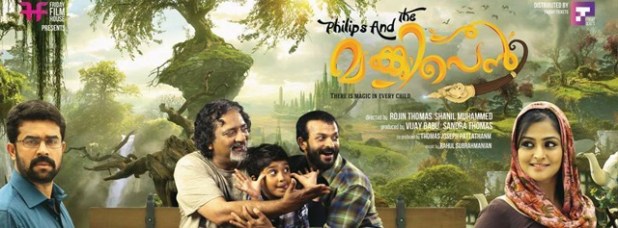
I can still remember looking at one of those advertisement boards set up for this movie on the side of the road. It was quite big and it made me wonder what it is actually about and what can it do with such a title which is strange but not weird for the new generation Malayalam movies. It was the time when I had just watched Captain Phillips, and I wondered what this title Philips and the Monkey Pen was about. Yes, it was strange indeed for a Malayalam movie – it did have the picture of a kid and Jayasurya who plays his father. Another poster had Remya Nambeesan and also Vijay Babu, there was one more which had Joy Mathew in it with them. Yet the question would remain what was it all about? There have been many pathetic children’s movies in this part of the world, none of which was close to being interesting, and now they have come up with a strange title too. But how did it turn out? Now thats a surprise, not just the regular one, but a cute, sweet and more interesting than any fake films which are projected as family movies. I now give you with something from the movie – “I thought the truth would pain you”; reply: “The truth isn’t bitter; its just that the lies are excessively sweet”.

So here you welcome the first real family movie of the year, and it is indeed what they have projected; the all generation movie of the age, and it is a shame that it had to be postponed for movies of other languages; Arrambam, and more tragically Krrish 3. If any movie is to be shifted for such a fake hero movie like Krrish 3, it shows how messed up our audience is. Let me tell you that I am glad to see the number of audience even for the morning show during a working day, and I am happy to see the response of the viewers. I would be surprised if it didn’t them in one way or the other, and the claps in the end signified the same. I can only hope that it won’t lose the battle and give up early to the bigger movies which are to come this weekend, Geethanjali, Thira and may be Salaam Kashmir, plus the movies from other languages about which we can’t be sure now. Well, it is the duty of all the good movie watchers to make movies like this success, instead of going for movies like Krrish 3, Besharam and Boss. Please do support this movie! Show it to your kids for sure.

I begin talking about this movie by introducing you to the antagonist, the evil villain who is the manifestation of the wretched demon from hell, Mephisto-maths, or rather Mathematics which lived in the capital of hell, Pandemonium before its arrival to Earth. Pardon my use of language, as I have been as much troubled by this third rate piece of junk known as Mathematics as much as our protagonist Ryan Philip (Master Sanoop). Without that subject, world would have been awesome, I know it and so does Ryan. He has started his battle in the fifth standard as he tries to find a way to find a way past his class teacher Pappan (Vijay Babu) who teaches the most loathed subject of the school. He is not alone in this battle against Satan Maths and his helpers, the Maths teacher and the Maths expert of the class. There are four of them in total, as they are the freaks of the class who come late in dirty clothes and fails to do the home work. They are always thinking about how to send this demon back to hell.

The first idea is to find a girlfriend who can help him in Maths, but as Ryan is not that much of a popular kid in the class and neither is he studious or good at sports, that doesn’t really work out. Ryan is the son of a Christian father Roy Philip (Jayasurya) and a Muslim mother Sameera Roy(Remya Nambeesan), and none of the families are in touch which the couple after they married against the wishes of their parents. The only contact they later come across is Richard Philip (Joy Mathew), Roy’s father and a former captain of a ship. It is from him that Ryan gets a pen called monkeypen which is said to have helped in achieving impossible things. For Ryan, there are not many impossible things which should be possible – as it is just about the bloodsucking monster from the other dimension, which has surrounded his life in a python form – the evil Mathematics. The story deals with how Ryan overcomes all the problems of his life which starts and ends with Anaconda Maths with the help of a pen. Well, there is no real supernatural or magic involved in this one, and don’t let such thoughts stop you. Meanwhile, did I feel shades of existentialism? I doubt that.

There are lots of lessons to be learnt from this movie, and it is more of a morality tale wearing the visage of a children’s story, and with its veneer of simple childhood talks and experiences, the movie explores themes like love, truth, faith and duty. But the movie rarely preaches, as it shows rather than try to teach; it inspires rather than try to put something on the viewers heads. On one side, it tells the story of a kid who is hoping to do well, but is a mannerless boy who doesn’t respect elders, comes late to the class in terrible uniform and obviously doesn’t want to study. With the disrespect to authority and the elders, he is a sample of the bad next generation which is to come with no respect for values and traditions. On the other side, it is the story of the change that faith, love and care from parents can bring upon children. Ryan’s transformation is the major theme of the story, and most of the questions of this age comes up within the same. As a whole, this is not just the story of Ryan, or it shouldn’t be so, as its goodness prevails. The other characters of the movie are not avoided too, and in that case, it is further interesting.

Master Sanoop plays the protagonist of the movie, the man with the monkeypen. His performance is something which has to be judged just by viewing and not by talking about it. The same can be said about the other kids too, from his partners in crime to his arch nemesis in studies as well as the one of unattainable love. Jayasurya makes an awesome father in this movie, and this is another one of different, yet fantastic performances. Almost the same can be said about Remya Nambeesan who plays the mother who herself is immatured to an extent, but stands for his son when in need. Joy Mathew doesn’t lag in his role but rather scores when needed, and Vijay Babu is very good as the teacher, one of the most dynamic characters in a children’s film. Innocent has a small role as the boy’s imaginary friend whom he calls God, and joins him in his pains and agonies, removing his doubts and making him confidence, and the wisdom from this divine one adds, but is underused and pales in comparison to the pen. It might remind us of the character of Saint Francis of Assisi in Pranchiyettan and the Saint, in a lesser manner. Mukesh’s Principal is funny, and well done. To add, there is the beauty of cinematography!

I was highly impressed by how the story-line progresses. I thought this was a children’s story and I might get disappointed, but wow! They even managed to put a background story to the legend of monkeypen with the records of the construction of Willingdon Island, the first man-made island in India. The scenes involving the pen and Sir Robert Bristow is brilliantly taken, with no scope for any questioning. There is some brilliant writing behind this one, there is indeed magic of some sort involved with this one rather than inside it. When nostalgia calls, I have wondered about the Maths side of this story, and thought if I could have loved Maths if I had better teachers? By the time I got to the end of eighth standard, I had almost completely hated the subject even as I scored well enough for the board exams, and finally lost touch with it intentionally due to my lack of interest. Then, how did my love for English Literature come up? That was due to two of the English teachers whom I admired – such is the story of most of us, as good teachers make students love their subjects and score better in most of the cases except for some who are beyond hope. Meanwhile, the name of the grandfather Richard Philip, captain of the ship – ring any bells? 😀

Release date: 7th November 2013
Running time: 140 minutes (estimate)
Directed by: Rojin Philip, Shanil Muhammed
Starring: Master Sanoop, Jayasurya, Remya Nambeesan, Innocent, Joy Mathew, Mukesh, Vijay Babu

monkeypen copy

@ Cemetery Watch
✠The Vampire Bat.

North 24 Kaatham

north24kaatham (1)

This is one of the gifts from Kerala State Electricity Board (KSEB) as I am concerned. No, they didn’t produce this ticket, but a powercut had me going to the theatres. If you wonder if it was the first time, the answer should be no.  And yes, I liked the movie, and there was no reason not to. If any of you don’t like it, I have to say that I don’t write for you. Yes, I write what I find and what I feel; now that wasn’t really a surprise. Well, unlike the fanboys’ stuff like Neelakasham Pachakadal Chuvanna Bhoomi, North 24 Kaatham has more soul than most of those movies out there, yes this blog itself is about the movies of the soul, and if you do not possess a soul or intellect enough to respect others’ opinions, why bother reading reviews when you know that you shall come up with a different opinion than the reviewer? Except for the fans whose opinions are fixed, I would like to believe that there is hope for Malayalam movies. Well, there is no bigger evil than people who do not respect the opinions of others, and I have to say that some of them don’t even know what an opinion means, and it is disappointing in this world.

You evil ones are lesser in number this time, as the critics as well as each and every one in the theatre liked this movie and clapped. So, I am going to be very clear about this one. I have more reasons to like this one than a leading actor and a leading actress who can act. Before that, let me tell the good people among you and the others motivated by self-interest with willing distrust of human (or bat) sincerity, on what goes on in this movie. It is the story of Hari (Fahadh Faasil), a genius computer programmer who is hated by his colleagues due to his lack of social interaction, over-cleanliness and the seemingly hostile attitude to most of the things. He is that kind of a person who hasn’t even gone outside his city, living with a fear of travel. But he is forced to go on a journey as part of his job, and on a day of harthal, he is caught in the middle of a world which he is not familiar with. He is caught up with two other people (Nedumudi Venu and Swati Reddy) and he joins them on their journey, and on the way, he changes his attitude towards life and by the end of the journey, he is a changed man.

I know what kind of questions the evil world can come up with. It might be about the change in the protagonist, but I would say it is clearly a believable change, if not incredibly perfect to the core, but even that wouldn’t be acceptable to the new generation fans. Our protagonist was never a bad man, and nothing has changed in his soul if we look at him. He surely might have had his share of psychological problems, but as a good person, through a few incidents, he realizes his mistakes. Remember how one major psychological problem was solved by one major incident in Manichitrathazhu? This is actually not that much of a problem, for Hari had the right to live in his world as much as anybody else, which is why I say that change is a change only on the surface, and therefore it is nothing for which you have to push a huge stone to the top of a mountain and jump into water with the same stone tied around your neck. Neelakasham Pacha Kadal Chuvanna Bhoomi was based on selfishness, just like Annayum Rasoolum. But this movie has a lot of goodness in it, and therefore try to enjoy the little things which give the good people happiness rather than be evil and go on a meaningless trip leaving your family behind, for life is reclaimed by goodness and the joy of art and literature alone, and not by having fun, sorry hedonists.

Fahadh Faasil gives a brilliant performance yet again, and yes I was so disappointed with his Olipporu that I couldn’t watch his critically well-received movie Artist, and D Company again let me down. But even with so much less dialogues, he scores and raises the level of this movie with his co-star from one of the movies of the year Amen. Yes, I am talking about the wonderfully talented, charming lady lead that we have got here, Swati Reddy. She plays a modern social worker, wearing a hood and shortening her name Narayani as Nani. She continues her good run in the Malayalam movie industry even as this is an entirely different role from her earlier debut in Malayalam this year. Even as Fahadh is the centre of attraction in this movie, she is charm, and the way in which both of them contradict each other brightens each other, as much as the black and white compliments each other, like no grey character could have ever did, and please note that this black and white doesn’t stand for evil and good, for that age has disappeared. Like Solomon and Sosanna, here is Hari and Narayani, but I would wonder myself if such a romantic side was forced, still a better love story than Annayum Rasoolum and a better travel story than Neelakasham Pacha Kadal Chuvanna Bhoomi.

The performance by our own veteran actor Nedumudi Venu is another highlight, for he plays the third person in their gang of lost people on the day of harthal. How can I praise someone who is beyond the same? That leaves us with the factor that lies under what seems to be an ordinary plot. It is the social message which worked just the opposite in Neelakasham Pacha Kadal Chuvanna Bhoomi. Here, it is perfectly done. It is a powerful message against harthal and labelling people as not belonging to the group. There is the trouble of harthal and the condition of the roads that are alluded in the movie. Well, the question remains if Hari needed to change, for he was always good, hardworking and doing what he felt was right. Who would know the minds of the others who surrounded them? Well, it shows how important it is to display your inner goodness or pretend to be caring like some of those devils with human masks do, or the society shall keep you at a pterosaur’s wings apart. It shows how society doesn’t like people who are different, but Hari’s difference in the end is the kind of change that society likes – there lies the biggest paradox of man as a social animal.

As Fahadh plays a much misunderstood man with no heroic quality in him other than goodness, there is that deconstruction of the hero image which the fans would love to identify with. Swati’s character take over some traits of that heroism, and I would guess that a few wouldn’t like this reversal of roles. As Swati’s character makes it her responsiblity to get the old man home safe, Fahadh’s character take the smaller role of accompanying them. The heroism is attributed to the lady here, and in that case, Swati Reddy plays another Sosanna of Amen who fights for her aim, instead of Solomon. She helps the old man out of the train and Hari into the bus, a moment of visible shock in the faces of both. She leads the journey even when Hari keeps moving on the front. The people they meet on the way are presented with their own shades of grey, some of them closer to white and the others close enough to black. They are all down to earth just like the plot of the movie. This feel good movie doesn’t have that new generation add-ons and neither does it has any action sequence; therefore it is a good movie which reflects the goodness of Onam and the right movie for the season.

In a life which is consistently plagued by death, our celebration of life should come from doing the right thing from within our limitations, and not by the unruly “Carpe diem” behaviour. We have such a short life, that is for sure; but living that with a selfish motive of maximum pleasure being the only intrinsic good is not something to be recommended. North 24 Kaatham nullifies the “travel for pleasure philosophy” of Neelakasham Pacha Kadal Chuvanna Bhoomi and uses the “goodness of a travel philosophy” which is much needed in our age. Why do I talk like this?  Because I have travelled with someone, a stranger who didn’t know the local language and made sure that he got home, not this much of a long and interesting story, but I have done what I could on multiple occasions even as I am becoming more skeptic every day – this is our own story, with its own add-ons.  Well, the movie is funny, innovative and thought provoking all at the same time. What more do you need? What more should a debutant director provide you with? If it still, doesn’t touch our heart enough, we are not human enough, and we have no soul within us. It is not old, but it still glitters like gold, and entertains us with its righteousness and the realization like in the 2007 Hollywood movie Evan Almighty, that “the way to change the world is by doing one Act of Random Kindness”. By the end of the day, we are all heroes, not just someone who is born heroic or rises to heroism due to his nobility; thank you dear director.

Release date: 15th September 2013
Running time: 125 minutes
Directed by: Anil Radhakrishnan Menon
Starring: Fahadh Faasil, Swati Reddy, Nedumudi Venu, Sreenath Bhasi, Premgi Amaren, Srinda Ashab, Chemban Vinod Jose, Salaam Bukhari

north24kaatham copy

@ Cemetery Watch
✠ The Vampire Bat.

God’s Own Cleetus

cleetus (3)

I have taken the liberty to anglicize Daivathinte Swantham Cleetus into God’s Own Cleetus just like how Daivathinte Swantham Naadu becomes God’s Own Country. No, this is not that much of a lovable character to be baptised twice, but it is the effort of the actor behind the character and the way in which he has done justice to that character which makes Cleetus our own. Yes, you might find the world of this movie asking for a better treatment, but for a debutant director and the background which has been used, this is a very good recovery for a movie which didn’t impress the audience by its trailer nor with the brief storyline which was shared. Let me be clear about one thing; this movie could have gone either way, to the depths of abyss or to the heights of the lost paradise regained. If there is a question about where it stands at the moment, it is a long way from that abyss. Yes, Daivathinte Swantham Cleetus has survived, and did use its survival instincts well enough to add on to that survival guide new stories of goodness and faith. If you don’t like this movie, that is still understandable, but it can never stoop low enough to deserve hatred, that is where this movie plays safe, and it is how this movie shall hold on to its audience during this Onam vacation.

It will be facing a tough competition from the most awaited movie of the Onam, Dileep’s Sringaravelan, a possible surprise in the form of Indrajith Sukumaran’s Ezhamathe Varavu, and an interest-seeking Fahadh flick North 24 Kaatham, as we leave D Company out of that list. The Hollywood’s challenge in the form of Grown Ups 2 has self-destructed, and Bollywood’s John Day along with Horror Story are too much limited in shows with an adult-rated Grand Masti not to be an Onam favourite for sure. With pretty much a good competition in store, Daivathinte Swantham Cleetus might not be expected to do that good, but the verdict for the other Malayalam movies are not really out yet. Why would we still need movies like this to survive? Because it has tried its luck in an unfamiliar territory even if the fuel is a familiar one. It has a little bit of Chamayam, Pranchiyettan and The Saint and Amen in it, hidden well, but not from the eyes of experienced movie watchers. But, has the movie relentlessly tried to dig these movies out? The answer is no. There is nothing in common as a whole, and our movie has successfully brought out a legacy of its own, not from the ashes, but out of the most valuable sparks which could give rise to a phoenix.

The story tells the story of Cleetus (Mammootty), a feared criminal who causes problems wherever he goes. He is an alcoholic and always ready to do anything for money. As a parish priest Sunny Vadakkumthala (Siddique) chooses him to act as Jesus Christ in a drama as part of a church programme without knowing his true identity, something he does after rejecting a lot of people, chaos breaks loose among the theatre artists. The priest decides to persist with him and his sidekick (Aju Varghese) despite knowing his true identity, in the belief that the experience of being a character such as Jesus Christ might reform him, thus taking a huge risk considering the massive show which is going to happen and the audience expected. If Cleetus changes or makes the people around him change, whether the drama happens or Cleetus makes a clear mess out of it is left to be seen. Will Jesus Christ’s life change Cleetus or will his life change the fate of the drama in a horrible way? The movie answers the question very late, as every time, he would seem to get a little better, the world around him changes needing him to make those adjustments he is not used to make.

The whole movie undoubtedly rests on Mammootty, and as once again he rises to occasion, it is a treat to all the fans and neutral audience alike. No, Cleetus is not Immanuel, Kunjananthan, Bavutty or Mathukkutty, for he is a gunda, and he is surely nowhere near Pranchiyettan. A long list of characters of goodness is teared apart here, as our protagonist starts as the sinner who is not even set on the path to redemption. Unlike the others, Cleetus is a man who rises and takes the chalice of goodness, finishing it with relative ease. There is no denying that the image gets some self-imposed backlashes, but nothing that will not contribute to Cleetus being more and more human, with the shades of grey rather than pitch black – after all who can deny some mood-swings? Do we love Cleetus? The answer would be no. But he gets as close to being lovable as possible for a man seeking redemption, and he seemed to have attained some of it by the end. He comes that far by keeping himself far away from a superhuman image which could come across this time, even as there is no denying the fact that our protagonist beats up a lot of people, something which was expected right from the beginning.

Even as the movie belongs to Mammootty in an undisputed manner, Aju Varghese, Suraj Venjaramoodu and Thesni Khan handles the humour department quite effectively. Suraj remains the strong link of humour in this flick. Rejith Menon has made his presence felt, as the one and only Romeo character in the movie. Honey Rose is very good in her role, and it a matured character that we see this time. Sanam Shetty has that beautiful presence, something which she carries over from what we saw in Cinema Company, that grace and beauty which was talked about as that of a Greek goddess in that movie; for there is no denying who is the Aphrodite as well as the Juliet in this movie. Vijayaraghavan leaves a mark as one of the villain characters, and so does Kailash. Siddique was at his best, doing a character which he seemed to perfect. It is impossible to keep him out of this world where he once again does a fantastic job. There is a tremendous energy in his character, and also that much needed serenity, the two things which seemed to suit each other very well. One of our favourite comedy stars on television, Ullas Pandalam also makes good mark in the movie.

So, can the worst of people change and go back to God? Daivathinte Swantham Cleetus shows us that all hope is not lost. As the character goes through playing the life of Jesus Christ, his attitude towards life changes too, as a lot of the events in the life of Christ seems to be reflecting in his own world in a small and slightly similar manner. We have a man who has no previous acting experience, like Manoj K. Jayan in Chamayam. No, I am not really comparing, for that one would make it to my all-time favourite list, or may be more than one list. As that monologue in William Shakespeare’s As You Like It, “All the world’s a stage, and all the men and women merely players: they have their exits and their entrances; and one man in his time plays many parts” – here Cleetus plays one, and plays it fine and it replaces his real life as his new role, and it didn’t just go away as one of the parts which he played, as it stayed on with him. It is “Quod fere totus mundus exerceat histrionem” (Because almost the whole world are actors) as Petronius is supposed to have given us. Some of us live our part and others play our roles, and in both cases, the path is similar and leading to the same destination.

Well, we know that it is never late to turn to God. It is the faith, belief and hope that is supposed to guide us rather than materialism. Daivathinte Swantham Cleetus comes up with a great spectacle of divinity by the end, something which is comparable to Amen’s final battle of music, even as this one is less about music and more about the scenes. Is there a hidden magic realism in it? Does it have the magic touch of Pranchiyettan and The Saint helping the movie on moving forward? These are questions which can have more than one answers. But for now, this movie has done its part, but not living upto its potential. The life of Cleetus and his transformation could have been a lot more interesting. It was so close to achieving that balance that a little Icarus-sun battle might have brought it closer to its current rating. It is still your choice if you are to choose one man, who is both the saint and the sinner, saviour and the punisher, redeemer and the destroyer, moving from the path of evil to the way of goodness paved by angels and showered by blessings. This is another Pilgrim’s Progress from the City of Destruction to the Celestial City. The destiny of Cleetus now stands in the hands of the viewers, and its final fate is yet to be decided.

Release date: 12th September 2013
Running time: 140 minutes (estimate)
Directed by: Marthandan
Starring: Mammootty, Honey Rose, Aju Varghese, Sanam Shetty, Rejith Menon, Kailash, Siddique, Suraj Venjaramoodu, Thesni Khan, Vinayakan, Vijayaraghavan, Anoop Chandran, P. Balachandran, Ullas Pandalam

cleetu copy

@ Cemetery Watch
✠The Vampire Bat.

Diamond Necklace

diamondnecklace (4)

As they say in the movie Neram, there are two types of time, the good time and the bad time, and the good time of Fahadh Faasil had started from Chaappa Kurishu, with no disasters at the box office moving on to Immanuel. I didn’t really like what came later though, but as we know already, another thing about our versatile actor is that we can often identify his career with the quote from Charles Dickens’ A Tale of Two Cities too; “it was the best of times, it was the worst of times” and I would identify the same with his other movies, Annayum Rasoolum and Natholi Oru Cheriya Meenalla. Yes, Diamond Necklace was part of the good time, or the best of times, and it was the best from Lal Jose, no real doubt about that unless you bring Achanurangatha Veedu, Classmates or Arabikkatha into the picture with a handful of logic. Does any of these movies have this simple a plot set in too simple a world, and still come up with such an intriguing situation on screen? No, they were movies of incidents, revolving around one major incident or decision which set the events running while Diamond Necklace belongs to everyday life, and a collection of life; its celebration as the worlds of ups and downs which flows through our life, supported by beautiful songs, “Nilamalare”, “Thottu Thottu” and “Nenjinullil”.

Arun Kumar (Fahadh Faasil) is a docor who lives in Dubai and leads a life of luxury, supported by his wallet full of credit cards. He has no regret about the past or worries about the future, as he lives in the present, spending money lavishly with nobody to stop him from doing the same. His friends belong to higher league, and he shares apartment with his friend in the tallest buildig in the middle east and the world, Burj Khalifa. Savithri (Rohini), his boss in the hospital also seems to spoil him with her sisterly affection, but she is also unaware of how much of a debt Arun is putting himself into. He has acquaintances with labourers from Kerala, especially Venu (Sreenivasan) whom he tries to avoid in his stylish, high quality life which has no place for the lesser people of lower social status, even as he is still friendly with all on the outside. Driving the latest cars and enjoying life to the maximum, he meets Lakshmi(Gauthami Nair), a newly recruited Tamil nurse in his department. She is the first girl to whom he is seriously attracted. She had come to the middle east with a dream of making enough money for building a hospital in their village, so that no more people have to die there for having no facilities or money. Arun is impressed by her wits, attitude and dedication towards work.

Even as their relation blossoms, his chances of going through with it receives a serious blow, as he runs out of money and his car is towed away by the creditors. He is left with no way to go home and see his sick mother as the credits keep him in the country. He is helped by an influential man, Narayana Menon (Maniyanpilla Raju) who makes it possible for him to go back to Kerala, but at the same time, he is tricked into marriage with Narayanan’s niece, Rajasree (Anusree) who is a simple village girl who has absolutely no clue about city life nor life outside Kerala. Even as they are thought to be a rich family, Rajasree’s world is later known to be a small and simple one, not enough to pay back even a percent of Arun’s credits. When he comes back to Dubai, he is left with no place to stay, and as he doesn’t have enough advance to pay for any place, he stays in the labor camp with Venu. Lakshmi who comes to know about his marriage, ends their relationship and refuses to talk to him. Maya (Samvrutha Sunil), a relative of Savithri, is a fashion designer who was diagnosed with cancer, with a wish to start a boutique in Dubai. Her fiancee had left her due to her illness which had left her highly depressed. Arun ends up sharing her apartment and becomes very close to her.

Later, when she sees Rajasree with him, she is shocked as she didn’t know that he was married, and is admitted in the hospital. It leaves Savithri with lesser affection towards him. As he gathers her possessions, he notices a diamond necklace that she keeps with her, something which can save him from his problems. He decides to replace it with a fake one and does the same successfully. This is where the whole situation revolving around a necklace arises, as his wife finds the original necklace and wears it thinking that it is a birthday gift from him. Meanwhile, Maya almost dies due to an overdose of medicine. He is unable to get the necklace back from his wife who has shown the same to almost everyone including her foul-mouthed relatives of vanity. He often feels that he should return it to Maya and he can’t, and neither can he sell it. Caught between the worlds of greed, remorse and helpless, the only people who are with him consists of the simple labourers whom he once avoided. So, the plot still revolves around the ladies in his life, and how Arun comes out of this problem, not with any deus ex machina or a huge twist of fate, but rather with the simple things being the result of everyday happenings and common feelings makes the whole of the story. The artificial stuff has been kept out for good.

So, here is Fahadh Faasil showing his abilities as a versatile actor, moving away from the new generation trends of Chaappa Kurishu and 22 Female Kottayam, but coming up strong as an energetic youth who symbolizes the common young man of the century, with the usual attitude of “I will drink Life to the lees” which was said by the protagonist, the Ithacan king and the Greek hero, in the poem titled with his own name, Ulysses, by Alfred Lord Tennyson. That suspected hedonism in the face of our inescapable mortality found in The Rubáiyát of Omar Khayyám, the Edward FitzGerald translation, going back to the eleventh and the twelfth centuries has found ever increasing rhythm in this generation, but without the octopus hand of death and the ultimate end. “Carpe diem” as they can still say, from our own most mentioned ancient poet, Quintus Horatius Flaccus, known to most of us as Horace – “Seize the Day, putting as little trust as possible in the next day”, an idea which has developed into a liefstyle with loose morals leading to a life of unimaginable pleasure among the new generation. Epicureanism has made a more powerful entry to the new world, and as a kind of hedonism finding pleasure as the only intrinsic good, there is a new environment which is powerful and fast spreading. These, as I have already mentioned in my review of Spring Breakers, symbolizes the character Fahadh is playing in this movie.

But what does this hedonism, the power of “Carpe diem” bring to him? Does this help him to seize the day? Yes it does, but those days become long gone. I agree to the fact that we are all kind of hedonists in one way or the other, varying only in the degree. But considering the current world and the environment to which we are exposed, something which stays within the limits can rarely be interpreted as hedonism. But our protagonist belongs to the higher degree of “Carpe diem” as he puts as little trust as possible in the next day, as a man who is exposed to all the luxuries of the magical world of the city of Dubai, powered by oil, and highly influenced by modernity and science rather than antiquity, history or literature. For a man who comes the humble backgrounds of a small village, this might have been a big moment for him, being in Dubai and earning so much. It is evident in his relations with the labourers whom he consider as lesser people. But soon he realizes that they are the ones who are there to help him without asking anything in return, and it is his time to live like a common man rather than a hedonist, and live his life of responsibilities. Such a realization is supported by a beautiful ending which makes sure that his world remains one of beauty and goodness rather than crookedness and money. The movie itself is a message against irresponsible hedonism, and a support for unconditional love, responsibility and equality.

Once again, Fahadh Faasil is the man to watch out for, and I guess there is not much need to talk about the same, as it nothing unexpected. Samvrutha Sunil has a powerful role and she has done it with lots of life. Gauthami Nair makes a strong impact as the determined, powerful character. Anusree’s role is worth a lot of acclaim, and the funny moments come from her character’s stupidity, and still the goodness and love that the character exhibits makes this one quite a beautiful portrayal. Rohini and Sreenivasan have to play the roles of two seniors in the life of the protagonist who lends him advice and helping hand, and they form the world of light and goodness in his life. Diamond Necklace relates to its viewer with its tenderness and its high dose of objective correlative; with a reigning simplicity and reflections of the common incidents and random life events. It is the Malayalam movie of the year 2012, no matter how much anybody tries to prove that it isn’t. Also look out for the cinematography by Sameer Thahir; about our director Lal Jose, there is nothing more to say other than making a call to watch the movie. This was a movie which came into the theatres, disappeared, and came back again; such is awesomeness of this movie, even as only a few people recognized it during its first run, and myself came across the same during its comeback run in the local theatre.

Release date: 4th May 2012
Running time: 157 minutes
Directed by: Lal Jose
Starring: Fahadh Faasil, Samvrutha Sunil, Gauthami Nair, Anusree, Rohini, Sreenivasan, Maniyanpilla Raju, Kailash, Sukumari, Thesni Khan

diamondnecklce copy

@ Cemetery Watch
✠The Vampire Bat.

Pullipulikal and Aattinkutti

pullipulikalum aattinkuttiyum )

This is the season of the Malayalam movies, and what these movies have done with the help of Chennai Express, to keep the English movies away from the theatre is quite dissappointing, to be honest. The typhoon of Malayalam movies started off with Kadal Kadannu Oru Mathukutty, followed by Neelaakasam Pachakadal Chuvanna Bhoomi, Memories and Pullipulikalum Aattinkuttiyum. I am not in favour of such a week boasting the absence of the new English movie releases, at a time when they do get released in other countries. But as I know that there can be a great next week, and all the Malayalam movie titles are interesting enough, that should solve the problem up-to an extent. There is no surprise about so many movies releasing during the Eid after a long season of drought, as the people have already rushed to the multiplexes as well as the local theatres for these movies, and the malls, or at least some of them are so crowded that the Vampire Bat had doubts if there were free Blood Biriyani being supplied there. There is also the signs of the local theatres taking the effect of these new multiplexes, as the difference in the rates of tickets has become considerably small. We had such an option, and we had to choose the multiplex – there is the shift of the balance of power.

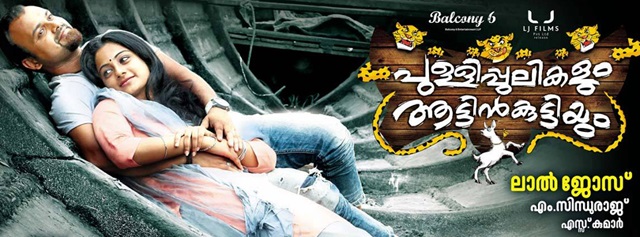
Literally translated as “Leopards and the Little Goat” had the first signs of vulnerability and a display of what kind of audience they were targeting, with their first promo in the theatres, which had a cartoon involving three leopards, one goat and a bull. Who are the people representing these characters, is something which should be revealed with ease as one watches the movie. Its target of the family audiences has surely been achieved with this one, but the question remains if it has achieved exactly what the movie lovers wished for, and another doubt would be about its power to match the other movies from Lal Jose – in that case, this should be closer in significance to Immanuel. Otherwise, this is a little bit of what should be termed as Elsamma Enna Aankutty meets Marykkundoru Kunjaadu at Kuttand setting, with a weaker second half and a forced ending. But it is not to be denied that the movie is fun, and the first half is close enough to a laugh riot. With the beautiful settings at Kuttanadu second only to Amen, and the melodious songs score to make all the absences transform into some kind of presence, and keep the viewers attached to the world of backwaters.

The movie set in the rural area of Kuttanad centers around one hardworking youth who tries in vain to pay off his loan to the bank by running a houseboat which he might lose in case of a failure to pay the same. Chakkattutharayil Gopan (Kunchako Boban), in short – Chakka Gopan a.k.a Aadu Gopan, is the goat-man as he is widely considered to be for his beard resembling a goat. There was that character in the movie Nee Ko Njaa Cha, and an allusion to that one with a background sound of the goat might help to figure out this appearance of our hero. This is the protagonist who gets beaten up almost every day due to the bad deeds of his three big brothers, as well as his own little problems. There comes the similarities with Marykkundoru Kunjaadu, and its just that this time, the protagonist is not lazy, and can beat a few people up rather than getting beaten up all the time. He has to feed three of his brothers and mother, as well as make sure that he earns enough to keep his houseboat floating. The three brothers are the type of people who takes money even from him to keep him safe, and they never miss an opportunity to take money from others or even lie, cheat and steal. The feeling of Elsamma Enna Aankutty also runs through, but more as an invisible force. But the fact remains that all the three movies were those which I liked, and therefore, there is nothing negative out there other than a little absence of innovation.

Along with dealing with his own lazy bully brothers and attempting to pay off his loans, Gopan faces the problem of not being able to attract enough tourists to his comparatively inferior houseboat, and asks the help of Mamachan (Suraj Venjaramoodu) for some attraction which could bring in more foreign tourists. The result comes in the form of Kainakari Jayasree (Namitha Pramod), a Mohiniyattam artist. With her assistance and also with the help of Suseelan (Harisree Asokan), his problems seem to get solved until his path crosses with that of Kavalykal Kuriyachan (Shammi Thilakan). While attempting to deal with his brothers’ unruly life and his love with Jayasree, he also has to deal with the rich businessman who seeks revenge on Gopan. At the same time, he comes up with some plans to deal with his brothers as well as to keep his love with Jayasree. Even as his and Kuriyachan’s path rarely crosses each other directly, there is always the unexpected harm that he would seem to give the man who would go on to become the villain whom he himself has to deal with, not as the goat which runs away, but as the super-goat-man if such a thing exists.

Kunchako Boban has come up with the comedy avatar again, and that should satisfy most of the fans. With his new looks and style, he has done complete justice to his role, and carries the whole world on screen with his shoulders. Namitha Pramod is also that good as Kainakari Jayasree, and never manages to move away from the character. It was nice to see her character, the other dynamic lovable one along with the character of the protagonist. Suraj Venjaramoodu and Harisree Asokan handles their own familiar territory with so much ease. We have been missing this Suraj for sometime, and the latter uses his home base of comedy to the efficiency of the movie. The three brothers might have carried on the legacy of Marykkundoru Kunjaadu‘s brother, but one might still miss Biju Menon. Shammi Thilakan’s Kavalykal Kuriyachan is a fine villain indeed, but not the scary, evil Satan or the one who sold his soul to the Devil, for he is the villain of circumstances, and the result of the people knowing about his own villainy. But the fact remains that he rises to this discovered throne of bad guy, and continues to do what he did with a mask, without any visage of artificially created vanity.

The movie’s success as a comedy movie is beyond doubt, and even with its lack of flow in the script, and an ending which was rather thrown into the middle of things, there is the beauty in simplicity, and the eventual victory of goodness portrayed without being preachy or pretending to be highly virtuous. There is the beautiful portrayal of nature which joins with the melodious songs to keep it working towards the end. The messages about the importance of goodness, hardwork and belief in oneself is asserted throughout the film in one way or the other. Marykkundoru Kunjaadu had the same, but some people just noticed the fear element in it. This movie is more logical in that case, making an attempt to touch the soul with a central character who is more useful to the family as well as the society, caring less about himself. He is another Elsamma in that case, and even his love interest is not of less significance in many ways. There has been an overflow of similar themes in the past, and this movie also reflects the same in such a way as to make an impact in a path more travelled. Whether it has made a difference or not is a question yet to be answered, and until now, the future looks bright enough for this goat-man and his own leopard people of the family.

This is recommended for those who loved Elsamma Enna Aankutty and even more recommended for those who loved Marykkundoru Kunjaadu, and even those viewers who loved both of these movies a little, might find this one impossible to run away from. Nature has been a great redeemer, and for some, there is music; for the missing laughter, the others need comedy. This movie has got them all, but while looking for the logically awesome movie with a great bowl of completeness delivered as a result of the horn of plenty, there is that awkward movie of detest. But, it is highly advised that such a cornucopia is not expected in the case of this movie – Amalthea, goat and nature; something should relate, but the release of Plenty might have served as nothing less than a Pandora’s box in the case of such a movie. Therefore, lets forget the little strange things which might give the indigestion of logic fed to your brain, and enjoy this movie for the little beautiful things it got, and flies directly to the heart. The movie shall win its battle with the titles which got bigger names associated with the cast, not by much, but by what is enough to make the lamb-sheep-goat-characters live on with their goodness, lack of violence and a certain amount of love which takes its own toll on the characters.  Meanwhile, the title of this review has been adjusted to make it short – kindly don’t feel strange, for it is Pullipulikalum Aattinkuttiyum indeed.

Release date: 9th August 2013
Running time: 140 minutes (estimate)
Directed by: Lal Jose
Starring: Kunchako Boban, Namitha Pramod, Shammi Thilakan, Suraj Venjaramoodu, Harisree Asokan, Shivaji Guruvayoor, Anusree, Irshad, K. P. A. C. Lalitha, Bindu Panicker, Reena Bhasheer, Thesni Khan, Seema G. Nair, Ponnamma Babu

PullipulikalumAattinkuttiyum copy

@ Cemetery Watch
✠ The Vampire Bat.

Amen

amen0

There are few movies which the Vampire Bat would watch a few thousand times other than the horror flicks and the Malayalam movies of the 1980s. The end of this movie was that moment when the Vampire Bat actually felt the same – that moment when he was light enough to fly. It was the moment this bat felt that he was that feather which felt the wind lifting one’s self towards the starry sky. It is not exactly the feeling he had after watching Celluloid, as it is more comparable to that status where he was, after watching Pranchiyettan and the Saint. This rarely happens to the Vampire Bat, for this one has the status of being the second. With its visual beauty of nature, it is comparable to Ordinary, as this one highlights the backwaters while the Kunchako starrer had concentrated on the hills, mountains and the related greenery with fog. There is thunder, dark clouds, water bodies in its maximum body – how can one person do justice to this movie with a subjective review is a question which might remain answered; but what would an objective review do other than being too scientific and technical? This soul would keep closer to the former as possible, and in that way find himself in the process. Here, we have the story of an ancient church parish and the people, a love story and a band’s struggle for survival. The whole story can be read better from the beautiful characterization rather than as a plot.

Swati Reddy as Sosanna – such a character and so much of wonder in that performance! I can’t remember seeing such a female character on screen in any Malayalam movie. One has to wonder who she really is! The first guess would be that of a Keralite Juliet who comes out to the balcony (here, as the house is more of a traditional style, looking through the window) listening to the divine music by the artist that is Solomon (Fahadh Fazil). Well, they don’t die and so lets leave the tragic side of Romeo and Juliet behind. They can still have the title in the name of divine love, but on second thoughts, Sosanna is more of Rapunzel, imprisoned in a tower by the evil ones; her use of frying pan even bring the memory of the newer Rapunzel of Tangled (please avoid the hair details). Her character is the centre, around which the whole movie is built, even if our heroes get more screentime. Each and every second of her presence indicates something which is to happen, and the whole divinity rests on herself and the music. She, the angel in white dress, the absence of black and greyness. She is complexity in simplicity – all in one; more than one simple village damsel – lovable and admirable with all her positives and negatives.

She is no different from the Rapunzel of Tangled on most of the occasions – she pushes the kapyar into water and asks her lover if he wants to be the Father in a church or her children’s father; she pours chicken curry over a gunda and hits him with a frying pan; she eats “naranga mittayi” with that happiness which William Wordsworth might have felt after seeing Daffodils; she uses paper rockets as love letters; she reads only from Solomon’s Song of Songs when asked to read the Bible; she talks about love in a cemetery (the Vampire Bat’s recommndation for this one) – the saga continues for Sosanna is not the weaker one to be subdued; for she is the frying pan fighter striking fear in the minds of the most powerful gundas. She is the passionate lover, the advisor, the fighter, the damsel in distress and still in lesser distress than her lover who is the man in distress. She is our blessed damozel; of this world and not the other, not the one Dante Gabriel Rossetti pictured in heaven, but the one person who continues to bless this movie with her presence. How can one not consider this one as a non-animated character at any stage? The words describe less and the scenes visualize more.

Fahadh Faasil as Solomon – he has done it again, and I might end up using this same sentence for the same actor for so many occasions that I would lose count of it. This is not brilliance unexpected, and I would always keep the expectations high on one actor. Fahadh in that Christ costume for the festival was something which made divinity come down from heaven. All the jokes related to his character and Sosanna are so genuine and wonderful – or even beautiful, if jokes could be termed “beautiful” with all its aspects. Here is a character of simplicity, lack of self-confidence and unparallel love. He is the new Romeo in many aspects, and he is the Jack of his ever-sinking Titanic that is a life of poverty which can only be made to be of any hope by getting himself into the music band sponsored by the local parish church. This character’s life surely is a divine comedy as it is subtitled, as the title character travels through his own inferno, purgatorio & finally the paradiso achieved by his merit. He is our own Dante Alighieri. Hell, purgatory, and heaven – they are all in this world for Solomon, the ultimate underdog. If Sosanna is more of an unpredictable character than her lover, Solomon steals the show by being predictable and still rising to the occasion. This might be Fahadh’s best performance ever, even as I am sure that I will be forced to say that again on another occasion.

Indrajith Sukumaran as Father Vincent Vattolli – always been in my list of favourite actors, and I am short of words for talking about this one – no do not bring me the dictionary, for I have word substitutes working for me. He is the exact opposite of the Vicar Father Abraham Ottaplakal (Joy Mathew). While the former tries to save the band, unite the two lovers and keep the church as the ancient structure, the latter tries to dismantle the band, separate the two lovers and rebuild the church. Both have brought the levels to new heights as one becomes so likable and the other detestable – the two characters are played with such perfection that one can’t resist believing them as what they are. There are times when one has to wonder how close to evil and away from the neutrality of the beginning, the Vicar happens to be as the second half progresses. The big paradox here is that the revolutionary new entrant is the stronger believer and the traditional, orthodox Vicar is the lesser believer who has his own agenda. Their church at Kumaramkari is not just a simple old structure, as they say that the legend is that Saint George had made Tipu Sultan’s attempt to raze the church a failure. This belief is what runs in the veins of the parishers and this is where Father Vattolli has reached – this is also where Father Ottaplakal makes his own decisions with no divine intervention; not a desired situation for sure. But there is more to Father Vattoli than it would seem to be, as the end twist would create that dream climax.

Saint George and the church are more like characters in the movie, but more shall not be talked about that divinity. Kalabhavan Mani’s Looyi pappan is a very powerful character throughout the movie; someone who fails to accept defeat – the man who wins the war even as he loses most of the battles. He seeks redemption after the death of his best friend who was the soul of the band – a music band which has been continuously on the losing side for a long time after the tragedy. Rachana Narayanankutty as Solomon’s sister and Natasha Sahgal was Father Vattoli’s admirer, joins the cast’s beautiful performance. Makarand Deshpande’s nemesis character is immensely powerful and Sunil Sukhada’s Kapyar works in more than one way. Lijo Jose Pellissery has given the viewers an early Easter gift, and it might be the best in the theatres right now. What else could be said about such a performance? But it is surely not free from the slightest of negatives – even among the best of jokes, lie the totally unnecessary, ridiculous jokes which tends to take away some of its beauty. But they could be avoided and the movie could be continued to be watched as the divine comedy as it is, for there is more to it than just the usual stuff. No, this is not the typical new generation either – for this is typical divinity, if one could call it so.

This exuberance is magic, and that is just to give the movie its due. But the truth is much better; for exuberance is just a word and so is magic. Amen is something which has dropped from the firmament, not like the fallen angel Lucifer, but as the medium of divinity which the world of the upper level has provided us with. Can you find faults within the story? If yes, isn’t there the flurry of intelligence and brilliance to cover them all? That would be a clear yes for an answer. No, the movie still doesn’t pretend, and it never needed to. It never needed to wear a mask like Annayum Rasoolum; a mask of goodness and reality which that one dragging movie has been wearing! But this one wears its own skin as a mask – no fake faces to cover its simplicity. Everyone has been incredibly good at what they were doing with this movie, both outside and inside – even the songs and the movie posters have contributed in such a way as to make this movie one of its kind – something which can lead and not follow; bring that thunder of wonderful change. I felt the magic realism and dream visions as well as its re-assertion of faith, belief and hope with divine intervention. Oh beauty of a movie, thy name is Amen – anything else would be so inappropriate right now. If I am to die after watching a movie, this might be one of them worth dying for!

Release date: 22nd March 2013
Running time: 160 minutes (estimate)
Directed by: Lijo Jose Pellissery
Starring: Fahadh Faasil, Indrajith Sukumaran, Swati Reddy, Rachana Narayanankutty, Natasha Sahgal, Joy Mathew, Kalabhavan Mani, Makarand Deshpande, Sunil Sukhada

amen copy

@ Cemetery Watch
✠The Vampire Bat.

Lucky Star

luck

The Vampire Bat had to fight off many bad omens before watching this movie. There were so many souls talking in his dreams that this is going to be a bad movie. To add to it, when the Vampire Bat was travelling on his medieval machine which ran at ten kilometres per hour, the fastest ever invented by a non-human, and there were traffic problems. In the end, the Vampire Bat reached the theatre thirty two seconds late – not too impressive for a creature well known for punctuality. I guess this reveals another thing about the Vampire Bat. He can’t fly – to be frank, it is more like he won’t fly. It is mainly because he is against it, not because he is like that bird in the movie Rio. He has decided not to fly, even if he is pushed off a cliff with non-vampire crocodiles underneath. He is so adamant, but he is no Meursault, for he is as much as a believer as any living soul in Noah’s Arc. Back to the omens, the vampire bat happened to see so much reckless driving and breaking of traffic rules; but if that is to be considered an omen, the Vampire Bat would have seen no other movie.

So the movie has Deepu Anthikkad in his directorial debut, starring Jayaram and Rachana Narayanankutty. It is the story of a small family of Ranjith, Janaki and their daughter Megha. Our hero is a man who always dreams of becoming rich, and the family as a whole has quite huge dreams, and there is a little boasting which results in no big evil. The hero is a tailor who stitches dresses mostly for movies – a random person who got stuck in the city of Chennai after coming there with big movie dreams which he still cherishes. As the couple had love marriage, they live far away from their relatives, both physically and mentally. Ranjith is looking forward to a big enterprise which he plans to start with a bank loan which seems too difficult to get. His desire to send his daughter to one of the best schools in the area, makes the financial situation even worse. He ends up facing an incredible shortage of cash for his liking, which has to be met one way or the other. This has no movement in the Swapna Sanchari direction, that is for sure, but a comparison at certain points might be worthwhile.

Continuing the sotry, the next important character, Doctor John comes up with an offer of ten lakhs for a surrogate mother for the child of an American based Indian couple who wants the mother to be good-looking. But he fails to find a woman of their liking. Janaki herself takes a decision to go for the money despite the initial refusal from her husband. The American couple pays them half the amount as advance and agrees to return to pay the remaining five lakhs after the birth of their child. But after the birth of the child, Ranjith and Janaki find that the parents of the new-born baby will not return as they have already divorced and started to live their own life. They could no longer be expected to have any interest in a child which belongs to both of them. The initial reaction was to abandon the child, but later the kid grows up as their son and their financial situation also improves – meanwhile, an incident causes the original mother of the boy to return and ask for her son – something which changes the situation completely.

The movie might bring back the memories of 1989 Malayalam movie Dasaratham and 2012 Hindi movie Vicky Donor, the former which was a classic and the latter the Vampire Bat knows not too much about other than what he heard from his noturnal allies. But the known facts tell the Vampire Bat to leave the second one further away. Well, this one is less emotional than the 1989 movie for sure, and they are surely not the same. This is more funny and without doubt, quite enjoyable, as they first half is not short of its funny moments. There might have not been many positive reviews about this one, but I would say that this is a highly under-rated movie. It has a debutant director and a debutant leading actress along with the supporting actress, but it never really losses its footing. The two leading actress and Jayaram has had a firm hold in the movie. There are moments where the story might have lost the soil under its feet, but it never really does – from what the Vampire Bat knows of the soil, he never really liked falling head first into the soil, something which happened only three or four times in his life time. In the end, the movie has strong pillars and is a job well done with its limited resources.

A good story presented in a nice package, which should be very attractive to the family audience, but still not so sure about the new generation lovers looking a continuous supply of that word which starts with the first letter of Fan, Freak, Frog prince, Fanny Browne, Faustus the doctor, Frozen dessert and Fool. For your need for everything evil and not-so-nice, find some other movie. There are enough of them with lip-locks, alchohol, drugs, cigarettes and sex; and leave this one alone, for this has goodness and it cherishes on it. The movie goes on and banks on its goodness and cast performances in a balanced manner. There is no overdose of anything, but simple dose of what would make a family-comedy-drama a success. The biggest advantage of this movie might be that it is light hearted and centred on family, the type of role in which we always wished to see Jayaram – like Veendum Chila Veetukaaryangal, Njangal Santhushtaraanu, Bhagyadevatha, Manasinakkare, Georgootty C/O Georgootty, Ayalathe Adheham, Meleparambil Aanveedu, Aadyathe Kanmani, Veruthe Oru Bharya and so many others.

T. G. Ravi and Mamukkoya have smaller, but noticeable roles to play in the movie. Even as there not that much power in any department to strengthen the movie, there is not much flaws around. To be frank, what might have affected the movie more might be the prejudices; the most significant of them might be based on the name – for a name like “Lucky Star” is a little unattractive for movie; a little closer to the first name of the Indian Premier League Cricket team from Cochin, IndiCommandos Kerala, and not that far away from the names like Chennai SuperKings and Sunrisers Hyderabad. Not that these names can be considered horrible, for they are all subjective – a name like “Lucky Star” would create less interest in Kerala than most of the other names. Its like when I say the name of the movie which I am going to watch, and people are like, what in this world is that? That is surely a cause of repulsion. If it also reminds you of the 2011 Malayalam movie, Lucky Jokers, does that help? Not for me to say.

The movie has the right cast and there is nothing wrong in the movie to have this much less reception, and the hope is for it to do better than how it is performing in the theatre right now. Family audience, this is your chance to bring goodness back to Malayalam movies. A must for anyone who wants to see a good world on the screen and the display of the power of family values compared to the world of separation and intolerance. Isn’t this more of humanity than random people wandering around having drugs, sex, alcohol and cigarettes? Isn’t humanity more of being good rather than gaining attention? Even the ambitions and desires which might have existed in the earlier parts of this movie makes way for the big sacrifice in the end. This is how righteousness should be running, not on a cart made of stone wheels created out of a heart of stone, but based on that delicacy which should be worth a whole human life.

Release date: 8th March 2013
Running time: 130 minutes (estimate)
Directed by: Deepu Anthikkad
Starring: Jayaram, Rachana Narayanankutty, Pooja Ramachandran, Mukesh, T. G. Ravi, Mamukkoya

luckystar

@ Cemetery Watch
✠The Vampire Bat.