


Vampire Owl: I was once called the Calendar Vampire.
Vampire Bat: It is quite an absurd name for a vampire.
Vampire Owl: I am an owl who has a calendar collection. So, that works.
Vampire Bat: What does a centuries-old vampire who lost track of time do with a calendar?
Vampire Owl: I am aware of the passage of time and dates.
Vampire Bat: I would always doubt your awareness.
Vampire Owl: Is it because I admire the work of Dr. Frankenstein?
Vampire Bat: What Mr. Frankenstein is doing is more like the lack of work.
Vampire Owl: I would appreciate Frankenstein the scientist all the time.
Vampire Bat: As someone who keeps killing dead people through experiments.
[Gets a sweet samosa and three cups of Darjeeling tea].
What is the movie about? :: Jules Tannenberg (Sabin Tambrea) works at a telephone helpline service which has the limited duty of talking to people walking home alone, especially women, and help them to go on and make sure that they reach home or their immediate destination safely. He is someone who was only recently widowed, after his wife committed suicide and had also lost two of his three children at the same wretched hour. He has successfully completely a good number of walks through phone with possible victims, saving many from harassment. One day, he gets distressed call from Klara Vernet (Luise Heyer) who seems to be in a lot of panic. Klara tells him that she was targeted by a psychotic murderer known only by the media-provided pseudonym, Calendar Killer. This particular killer who had risen to a celebrity status through social media and new channels is known to mark his victims’ death dates in advance on the walls of their homes with a horrifying ultimatum, “Him or You” which means that one among the husband and wife will be murdered, unless one partner kills the other.
So, what happens with the events here as we just keep looking? :: As Jules attempts to keep her calm and guide her through phone, he suspects that there is domestic violence involved, and more details about her is revealed. She tells him that her husband Martin Vernet (Friedrich Mücke), a high-ranking state official has been subjecting her to years of domestic violence, some of them psychological in nature, which has led her already struggling mental health to get worse. Klara was running away from him as Martin had tied her up in the middle of a secret club and punished her in front of everyone else on the day of their wedding anniversary. She had left her six-year-old daughter Amelie (Romy Miesner) with a young babysitter named Vigo (Shadi Eck) and was afraid that she would loss custody of her daughter as her declining mental health had led to her being admitted to psychiatric institutions. Now with a killer also on her back and with her husband refusing to believe that there is a psychopath, she has no hope – but can this hope be revived through that phone call or will the killer take a life?
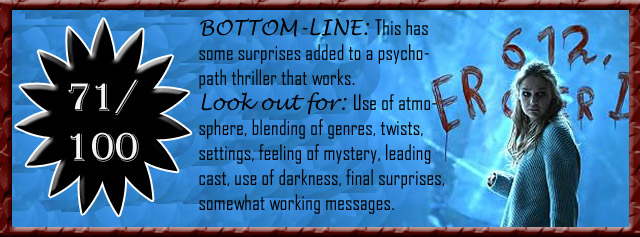
The defence of The Calendar Killer :: The run-time of a little above one and half hours is very much favourable to the movie which keeps the pace going. The cold and wintery aesthetic paired with the midnight deadline facing murder or death, creates some genuine suspense in the first half, as there is uncertainty, haunting and some surprise waiting to arrive for the viewer. The camera work by Christian Huck plays a big role in making the whole thing captivating – the settings and darkness had become allies of the movie from the early stages itself, and we are aware that there is something unexpected and sinister not just with the psychopathic killer, but also about other people. The scenes in the club comes as big revealing moments about the characters and that becomes the first surprise delivered. The final twist related to the murder is quite a big surprise for the audience who might not have guessed that multiple shocks were coming that way as people seem to be someone else in unexpected masks. The strong emotional performance of the leading lady adds to the overall quality of the movie and keeps us further interested in the proceedings.
The claws of flaw :: The movie does seem to lose its way at times, seemingly deviating from its most important elements. The focus which should have been on the psycho killer often wanders here and there as if never sure about which direction it should be heading. We can see a number of far-fetched coincidences which seems to be forced into the proceedings and then there are those illogical character choices which keeps the movie further confused. The exaggerations are also there, and we wonder if the leading protagonist is really crazy due to some of her choices and actions. Then there is the attempt to balance a usual serial killer with a psychopath on the hunt with a serious domestic abuse trauma narrative, which gives both sides some struggle. The exaggeration of domestic struggle flashback into the intentionally weakened psycho killer tale will have the audience in peril on many occasions in between, and if it was not for the performance of the lady in the lead, would have never connected well like we have here. Then there are also some characters that never gets the due.
The performers of the soul :: Luise Heyer clearly leads the way and plays the victim to a state of near-perfection. The excels in those moments of sadness and pain, and shows the pain of being under a dominant and influential partner who takes advantage of her. At the same time, she shows the determination that such a character gains when facing even bigger trouble, and fights herself to keep her soul instead of having her revenge. The emotional weight of the terrified, exhausted mother stays at full strength with her – we can feel her anguish at her present and the past as flashback works even better. At the same time, Sabin Tambrea comes up with a dual-layered performance which shows a higher level of calibre. There is a certain emotional side to him and the journey through multiple layers has our attention. Martin Vernet’s work also brings a certain impact as we never see the performance getting any weaker. Rainer Bock also remains solid throughout the run-time. Andreas Döhler also has a memorable quick role here.
How it finishes :: The movie in based on a German novel, Sebastian Fitzek’s Der Heimweg, and any comparison to the same can only be done by those who have actually read it. This psychological thriller makes the most of its small runtime and claustrophobic premise even while maintaining a little too many flaws than one would want it to have. The message about domestic violence keeps struggling and often pulls the psychopath down with, but in the end, it manages to come out strong enough to make the whole thing better. The final surprise saves the movie despite the ending just happening with ease. Anchored by Luise Heyer’s memorable vulnerability and emotional side as well as Sabin Tambrea’s surprise strength that takes a divergent path, the film nicely uses the real-time tension against a bleak and wintery setting. The usual phone-helpline narrative with a twist keeps this unsettling world interesting for us. The struggles in between can be often forgotten as the world holds together. The movie is available on Amazon Prime Video to take your free time.
Release date: 16 January 2025
Running time: 97 minutes
Directed by: Adolfo J Kolmerer
Starring: Luise Heyer, Sabin Tambrea, Friedrich Mücke, Rainer Bock, Andreas Döhler, and Romy Miesner
<<< Click here to go to the previous review.
<<< Click here to go to the biggest movie of last year.
<<< Click here to go to the most awaited sequel of the year.
@ Cemetery Watch
✠ The Vampire Bat.

