Oru Indian Pranaya Katha

oruindianpranayakatha (1)

An Indian Love Story :: Now, that is the direct Malayalam to English translation of the title of this movie, but let it not make you think about this as a romantic love story full of melodious songs and a hero and heroine looking at each other, the sky, the beach, or the river. This is partially a political satire and otherwise a drama concerning family relations. Coming from the director who never disappoints us (except for may be No. 1 Snehatheeram Banglore North), as the man with such a fine record, this movie was always going to be watchable whatever be the content, and even as it turned out to be kind of usual, this movie also doesn’t disappoint (yes, I do think well of his last venture Puthiya Theerangal too). His best of this century was Manassinakkare, and before that we know it has always been NadodikkattuOru Indian Pranaya Katha fits among the good movies, not at the higher level though. But be assured that the love between the lead pair happens just because the movie ends, and that is where the romance should begin.

What is it about? :: Ayamanam Sidharthan (Fahad Fazil) is the leader of the local youth wing of a party who hopes to become an M.L.A. soon by being the candidate in the upcoming by-election. He is supported by Uthup Vallikkadan (Innocent) who is the district head of the party always making an attempt to show his face on television. But his hopes are crashed when the national leaders choose another person who has no political background to contest in the elections instead of him, just because she is the daughter of a big shot politician. As Sidharthan is fed up and decides to take a break, he comes across Irene Gardner (Amala Paul) from Canada who is attempting to shoot a documentary and needs someone to help her, for which she can provide rupees two thousand per day. He feels that this could be a nice opportunity for him to keep away from politics as well as gain some much needed money, and he takes that offer. But he realizes that there is something about her that is much more than what meets the eye. So why is Irene in India and what is she looking for, and how can our hero help her? There remain the questions.

The defence of Oru Indian Pranaya Katha :: The movie has a wonderful first half, and it is a gem that shines and takes all the claps with grace. There are lots of moments of fun, and in each of them, Fahadh Faasil scores, and Innocent provides good support. There is the humble and yet beautiful beginning to the story which is carried on towards the interval. The moment when the hero takes up the job for the heroine is hilarious, and most of the moments involving politics are times of laughter. It remains clean throughout the movie, and there are no unnecessary vulgar jokes which has been plaguing Malayalam movie industry and keeping the audience away. There is basically nothing which is bad for kids, and there is no stupid romance getting in the way of the movie flow. There was obviously the chance for bad jokes on many occasions, and at a time when even movies like Sringaravelan become family entertainers, this effort to keep the dirty things away has to be appreciated. To add to it, the goodness and social message that the movie delivers is worth some applause.

Claws of flaw :: The movie fails to keep the momentum going in the second half, and right after the first half, the world starts twisting and breaking apart. Even as the latter half also has some good jokes, it seems to suffer from a big curse which hinders its movement, and it drags and gets converted into a family drama from the political satire which it was in the first half. There is lot of emotional undercurrents going on, and none of them romantic in character. The leading lady’s search for her roots lacks in both strength and innovation and the flashback story is too much off the dusty old books. The songs stay below average, and there is nothing that can pounce in our hearts. There is a void left in our desire to follow the satirical side, and our need for things which are left behind can be felt by the end of the movie. It has a happy and a righteous ending for sure, but surely not an effective one. The people who are looking for the romantic side will be disappointed, as the love between the leading characters blossoms only in the last few moments of the movie, or rather the last few seconds before the movie ends.

Performers of the soul :: As expected, Sathyan Anthikkad’s style rescues another movie yet again. But Fahadh Faasil is the man who leads the show yet again, just like he did in North 24 Kaatham without even speaking much, and in Amen with simplicity. He has portrayed a different character yet again, and his comic side in this movie is something that takes over. He once again transforms to a character who rules the first half of the movie and stays good in the second half. Innocent’s support is as good as usual, and there is no boring moment when he is around. Amala Paul looks even better than ever in this movie, and it is good to see that her presence is there right from the moment she is introduced. Her character seems to have been rightly portrayed, right from the moment she appears with a video camera in an orphanage. Her characteristics of a lady searching roots as well as a fun loving girl are rightly captured and reflected to the audience. Shafna and Lakshmi Gopalaswamy are also there with significant roles which catches attention, but the latter could have had more screen time.

Soul exploration :: The movie does leave us with many messages, one of them being the core of them all, not to take politics as a job, but as a means to serve people along with working. The real ambition is to be serving people rather than to be at the top, but that will rather be a need. Well, ambition is the root of all evil, and as Doctor Faustus did prove long ago as in the lives of Lucifer and Mephistopheles, there is nothing like ambition that makes a man evil. The leading characters do undergo significant changes in their journey, but not something as huge as North 24 Kaatham, as they were both this good right from the beginning to the end. Even as a movie which is considered as a romantic comedy, there is no glorification of romance or similar stuff, and that is another bonus. The useless nature of exaggerated love is made known to us throughout the movie, and the stress is more on family values, along with helping others at the same time. The movie also stresses on the importance of roots and the need to know them thoroughly. Whatever be the situation, or however the world changes, there is nothing like our parents, as the movie shows.

How it finishes :: When the hero says “There is beef in the scene” – that was a hilarious moment, and so was the dialogues in the library – the movie drops such laughter bombs regularly to keep the movie in the hunt in a weekend powered by two other big releases, Jeethu Joseph’s Mohanlal starrer Dryshyam and Lal Jose’s Dileep starrer Ezhu Sundara Rathrikal along with the Bollywood’s own Dhoom 3 and Hollywood’s only release Cloudy with a Chance of Meatballs 2. There is also the Tamil movie Biriyani, which means that there is a lot going on in the theatres this weekend – I have already booked tickets for Dryshyam, and I am looking forward to watching Ezhu Sundara Rathrikal on the same day. There is a lot to be done for me this Christmas, that is for sure, and as far as Oru Indian Pranaya Katha is concerned, it is a good choice for a family outing, and there is not much rush for it due to the less hype – you can go for it soon enough. Forgive the movie for its weaknesses in the second half, and do give it a chance to be that love story that scores without that much of romance. This is a small movie of goodness, that can do with a lot of support from the audience.

Release date: 20th December 2013
Running time: 150 minutes (estimate)
Directed by: Sathyan Anthikad
Starring: Fahadh Faasil, Amala Paul, Innocent, Shafna, Lakshmi Gopalaswamy, Krishna Prabha, Muthumani

oruindianpranayakatha copy

@ Cemetery Watch
✠ The Vampire Bat.

North 24 Kaatham

north24kaatham (1)

This is one of the gifts from Kerala State Electricity Board (KSEB) as I am concerned. No, they didn’t produce this ticket, but a powercut had me going to the theatres. If you wonder if it was the first time, the answer should be no.  And yes, I liked the movie, and there was no reason not to. If any of you don’t like it, I have to say that I don’t write for you. Yes, I write what I find and what I feel; now that wasn’t really a surprise. Well, unlike the fanboys’ stuff like Neelakasham Pachakadal Chuvanna Bhoomi, North 24 Kaatham has more soul than most of those movies out there, yes this blog itself is about the movies of the soul, and if you do not possess a soul or intellect enough to respect others’ opinions, why bother reading reviews when you know that you shall come up with a different opinion than the reviewer? Except for the fans whose opinions are fixed, I would like to believe that there is hope for Malayalam movies. Well, there is no bigger evil than people who do not respect the opinions of others, and I have to say that some of them don’t even know what an opinion means, and it is disappointing in this world.

You evil ones are lesser in number this time, as the critics as well as each and every one in the theatre liked this movie and clapped. So, I am going to be very clear about this one. I have more reasons to like this one than a leading actor and a leading actress who can act. Before that, let me tell the good people among you and the others motivated by self-interest with willing distrust of human (or bat) sincerity, on what goes on in this movie. It is the story of Hari (Fahadh Faasil), a genius computer programmer who is hated by his colleagues due to his lack of social interaction, over-cleanliness and the seemingly hostile attitude to most of the things. He is that kind of a person who hasn’t even gone outside his city, living with a fear of travel. But he is forced to go on a journey as part of his job, and on a day of harthal, he is caught in the middle of a world which he is not familiar with. He is caught up with two other people (Nedumudi Venu and Swati Reddy) and he joins them on their journey, and on the way, he changes his attitude towards life and by the end of the journey, he is a changed man.

I know what kind of questions the evil world can come up with. It might be about the change in the protagonist, but I would say it is clearly a believable change, if not incredibly perfect to the core, but even that wouldn’t be acceptable to the new generation fans. Our protagonist was never a bad man, and nothing has changed in his soul if we look at him. He surely might have had his share of psychological problems, but as a good person, through a few incidents, he realizes his mistakes. Remember how one major psychological problem was solved by one major incident in Manichitrathazhu? This is actually not that much of a problem, for Hari had the right to live in his world as much as anybody else, which is why I say that change is a change only on the surface, and therefore it is nothing for which you have to push a huge stone to the top of a mountain and jump into water with the same stone tied around your neck. Neelakasham Pacha Kadal Chuvanna Bhoomi was based on selfishness, just like Annayum Rasoolum. But this movie has a lot of goodness in it, and therefore try to enjoy the little things which give the good people happiness rather than be evil and go on a meaningless trip leaving your family behind, for life is reclaimed by goodness and the joy of art and literature alone, and not by having fun, sorry hedonists.

Fahadh Faasil gives a brilliant performance yet again, and yes I was so disappointed with his Olipporu that I couldn’t watch his critically well-received movie Artist, and D Company again let me down. But even with so much less dialogues, he scores and raises the level of this movie with his co-star from one of the movies of the year Amen. Yes, I am talking about the wonderfully talented, charming lady lead that we have got here, Swati Reddy. She plays a modern social worker, wearing a hood and shortening her name Narayani as Nani. She continues her good run in the Malayalam movie industry even as this is an entirely different role from her earlier debut in Malayalam this year. Even as Fahadh is the centre of attraction in this movie, she is charm, and the way in which both of them contradict each other brightens each other, as much as the black and white compliments each other, like no grey character could have ever did, and please note that this black and white doesn’t stand for evil and good, for that age has disappeared. Like Solomon and Sosanna, here is Hari and Narayani, but I would wonder myself if such a romantic side was forced, still a better love story than Annayum Rasoolum and a better travel story than Neelakasham Pacha Kadal Chuvanna Bhoomi.

The performance by our own veteran actor Nedumudi Venu is another highlight, for he plays the third person in their gang of lost people on the day of harthal. How can I praise someone who is beyond the same? That leaves us with the factor that lies under what seems to be an ordinary plot. It is the social message which worked just the opposite in Neelakasham Pacha Kadal Chuvanna Bhoomi. Here, it is perfectly done. It is a powerful message against harthal and labelling people as not belonging to the group. There is the trouble of harthal and the condition of the roads that are alluded in the movie. Well, the question remains if Hari needed to change, for he was always good, hardworking and doing what he felt was right. Who would know the minds of the others who surrounded them? Well, it shows how important it is to display your inner goodness or pretend to be caring like some of those devils with human masks do, or the society shall keep you at a pterosaur’s wings apart. It shows how society doesn’t like people who are different, but Hari’s difference in the end is the kind of change that society likes – there lies the biggest paradox of man as a social animal.

As Fahadh plays a much misunderstood man with no heroic quality in him other than goodness, there is that deconstruction of the hero image which the fans would love to identify with. Swati’s character take over some traits of that heroism, and I would guess that a few wouldn’t like this reversal of roles. As Swati’s character makes it her responsiblity to get the old man home safe, Fahadh’s character take the smaller role of accompanying them. The heroism is attributed to the lady here, and in that case, Swati Reddy plays another Sosanna of Amen who fights for her aim, instead of Solomon. She helps the old man out of the train and Hari into the bus, a moment of visible shock in the faces of both. She leads the journey even when Hari keeps moving on the front. The people they meet on the way are presented with their own shades of grey, some of them closer to white and the others close enough to black. They are all down to earth just like the plot of the movie. This feel good movie doesn’t have that new generation add-ons and neither does it has any action sequence; therefore it is a good movie which reflects the goodness of Onam and the right movie for the season.

In a life which is consistently plagued by death, our celebration of life should come from doing the right thing from within our limitations, and not by the unruly “Carpe diem” behaviour. We have such a short life, that is for sure; but living that with a selfish motive of maximum pleasure being the only intrinsic good is not something to be recommended. North 24 Kaatham nullifies the “travel for pleasure philosophy” of Neelakasham Pacha Kadal Chuvanna Bhoomi and uses the “goodness of a travel philosophy” which is much needed in our age. Why do I talk like this?  Because I have travelled with someone, a stranger who didn’t know the local language and made sure that he got home, not this much of a long and interesting story, but I have done what I could on multiple occasions even as I am becoming more skeptic every day – this is our own story, with its own add-ons.  Well, the movie is funny, innovative and thought provoking all at the same time. What more do you need? What more should a debutant director provide you with? If it still, doesn’t touch our heart enough, we are not human enough, and we have no soul within us. It is not old, but it still glitters like gold, and entertains us with its righteousness and the realization like in the 2007 Hollywood movie Evan Almighty, that “the way to change the world is by doing one Act of Random Kindness”. By the end of the day, we are all heroes, not just someone who is born heroic or rises to heroism due to his nobility; thank you dear director.

Release date: 15th September 2013
Running time: 125 minutes
Directed by: Anil Radhakrishnan Menon
Starring: Fahadh Faasil, Swati Reddy, Nedumudi Venu, Sreenath Bhasi, Premgi Amaren, Srinda Ashab, Chemban Vinod Jose, Salaam Bukhari

north24kaatham copy

@ Cemetery Watch
✠ The Vampire Bat.

Diamond Necklace

diamondnecklace (4)

As they say in the movie Neram, there are two types of time, the good time and the bad time, and the good time of Fahadh Faasil had started from Chaappa Kurishu, with no disasters at the box office moving on to Immanuel. I didn’t really like what came later though, but as we know already, another thing about our versatile actor is that we can often identify his career with the quote from Charles Dickens’ A Tale of Two Cities too; “it was the best of times, it was the worst of times” and I would identify the same with his other movies, Annayum Rasoolum and Natholi Oru Cheriya Meenalla. Yes, Diamond Necklace was part of the good time, or the best of times, and it was the best from Lal Jose, no real doubt about that unless you bring Achanurangatha Veedu, Classmates or Arabikkatha into the picture with a handful of logic. Does any of these movies have this simple a plot set in too simple a world, and still come up with such an intriguing situation on screen? No, they were movies of incidents, revolving around one major incident or decision which set the events running while Diamond Necklace belongs to everyday life, and a collection of life; its celebration as the worlds of ups and downs which flows through our life, supported by beautiful songs, “Nilamalare”, “Thottu Thottu” and “Nenjinullil”.

Arun Kumar (Fahadh Faasil) is a docor who lives in Dubai and leads a life of luxury, supported by his wallet full of credit cards. He has no regret about the past or worries about the future, as he lives in the present, spending money lavishly with nobody to stop him from doing the same. His friends belong to higher league, and he shares apartment with his friend in the tallest buildig in the middle east and the world, Burj Khalifa. Savithri (Rohini), his boss in the hospital also seems to spoil him with her sisterly affection, but she is also unaware of how much of a debt Arun is putting himself into. He has acquaintances with labourers from Kerala, especially Venu (Sreenivasan) whom he tries to avoid in his stylish, high quality life which has no place for the lesser people of lower social status, even as he is still friendly with all on the outside. Driving the latest cars and enjoying life to the maximum, he meets Lakshmi(Gauthami Nair), a newly recruited Tamil nurse in his department. She is the first girl to whom he is seriously attracted. She had come to the middle east with a dream of making enough money for building a hospital in their village, so that no more people have to die there for having no facilities or money. Arun is impressed by her wits, attitude and dedication towards work.

Even as their relation blossoms, his chances of going through with it receives a serious blow, as he runs out of money and his car is towed away by the creditors. He is left with no way to go home and see his sick mother as the credits keep him in the country. He is helped by an influential man, Narayana Menon (Maniyanpilla Raju) who makes it possible for him to go back to Kerala, but at the same time, he is tricked into marriage with Narayanan’s niece, Rajasree (Anusree) who is a simple village girl who has absolutely no clue about city life nor life outside Kerala. Even as they are thought to be a rich family, Rajasree’s world is later known to be a small and simple one, not enough to pay back even a percent of Arun’s credits. When he comes back to Dubai, he is left with no place to stay, and as he doesn’t have enough advance to pay for any place, he stays in the labor camp with Venu. Lakshmi who comes to know about his marriage, ends their relationship and refuses to talk to him. Maya (Samvrutha Sunil), a relative of Savithri, is a fashion designer who was diagnosed with cancer, with a wish to start a boutique in Dubai. Her fiancee had left her due to her illness which had left her highly depressed. Arun ends up sharing her apartment and becomes very close to her.

Later, when she sees Rajasree with him, she is shocked as she didn’t know that he was married, and is admitted in the hospital. It leaves Savithri with lesser affection towards him. As he gathers her possessions, he notices a diamond necklace that she keeps with her, something which can save him from his problems. He decides to replace it with a fake one and does the same successfully. This is where the whole situation revolving around a necklace arises, as his wife finds the original necklace and wears it thinking that it is a birthday gift from him. Meanwhile, Maya almost dies due to an overdose of medicine. He is unable to get the necklace back from his wife who has shown the same to almost everyone including her foul-mouthed relatives of vanity. He often feels that he should return it to Maya and he can’t, and neither can he sell it. Caught between the worlds of greed, remorse and helpless, the only people who are with him consists of the simple labourers whom he once avoided. So, the plot still revolves around the ladies in his life, and how Arun comes out of this problem, not with any deus ex machina or a huge twist of fate, but rather with the simple things being the result of everyday happenings and common feelings makes the whole of the story. The artificial stuff has been kept out for good.

So, here is Fahadh Faasil showing his abilities as a versatile actor, moving away from the new generation trends of Chaappa Kurishu and 22 Female Kottayam, but coming up strong as an energetic youth who symbolizes the common young man of the century, with the usual attitude of “I will drink Life to the lees” which was said by the protagonist, the Ithacan king and the Greek hero, in the poem titled with his own name, Ulysses, by Alfred Lord Tennyson. That suspected hedonism in the face of our inescapable mortality found in The Rubáiyát of Omar Khayyám, the Edward FitzGerald translation, going back to the eleventh and the twelfth centuries has found ever increasing rhythm in this generation, but without the octopus hand of death and the ultimate end. “Carpe diem” as they can still say, from our own most mentioned ancient poet, Quintus Horatius Flaccus, known to most of us as Horace – “Seize the Day, putting as little trust as possible in the next day”, an idea which has developed into a liefstyle with loose morals leading to a life of unimaginable pleasure among the new generation. Epicureanism has made a more powerful entry to the new world, and as a kind of hedonism finding pleasure as the only intrinsic good, there is a new environment which is powerful and fast spreading. These, as I have already mentioned in my review of Spring Breakers, symbolizes the character Fahadh is playing in this movie.

But what does this hedonism, the power of “Carpe diem” bring to him? Does this help him to seize the day? Yes it does, but those days become long gone. I agree to the fact that we are all kind of hedonists in one way or the other, varying only in the degree. But considering the current world and the environment to which we are exposed, something which stays within the limits can rarely be interpreted as hedonism. But our protagonist belongs to the higher degree of “Carpe diem” as he puts as little trust as possible in the next day, as a man who is exposed to all the luxuries of the magical world of the city of Dubai, powered by oil, and highly influenced by modernity and science rather than antiquity, history or literature. For a man who comes the humble backgrounds of a small village, this might have been a big moment for him, being in Dubai and earning so much. It is evident in his relations with the labourers whom he consider as lesser people. But soon he realizes that they are the ones who are there to help him without asking anything in return, and it is his time to live like a common man rather than a hedonist, and live his life of responsibilities. Such a realization is supported by a beautiful ending which makes sure that his world remains one of beauty and goodness rather than crookedness and money. The movie itself is a message against irresponsible hedonism, and a support for unconditional love, responsibility and equality.

Once again, Fahadh Faasil is the man to watch out for, and I guess there is not much need to talk about the same, as it nothing unexpected. Samvrutha Sunil has a powerful role and she has done it with lots of life. Gauthami Nair makes a strong impact as the determined, powerful character. Anusree’s role is worth a lot of acclaim, and the funny moments come from her character’s stupidity, and still the goodness and love that the character exhibits makes this one quite a beautiful portrayal. Rohini and Sreenivasan have to play the roles of two seniors in the life of the protagonist who lends him advice and helping hand, and they form the world of light and goodness in his life. Diamond Necklace relates to its viewer with its tenderness and its high dose of objective correlative; with a reigning simplicity and reflections of the common incidents and random life events. It is the Malayalam movie of the year 2012, no matter how much anybody tries to prove that it isn’t. Also look out for the cinematography by Sameer Thahir; about our director Lal Jose, there is nothing more to say other than making a call to watch the movie. This was a movie which came into the theatres, disappeared, and came back again; such is awesomeness of this movie, even as only a few people recognized it during its first run, and myself came across the same during its comeback run in the local theatre.

Release date: 4th May 2012
Running time: 157 minutes
Directed by: Lal Jose
Starring: Fahadh Faasil, Samvrutha Sunil, Gauthami Nair, Anusree, Rohini, Sreenivasan, Maniyanpilla Raju, Kailash, Sukumari, Thesni Khan

diamondnecklce copy

@ Cemetery Watch
✠The Vampire Bat.

5 Sundarikal

5 sundarikal1

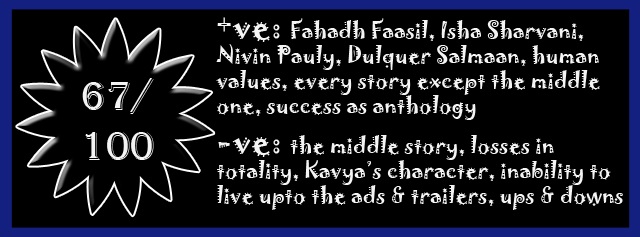
5 Sundarikal which can be translated as 5 Beauties, is that romantic anthology film which might have had its existence to thank the 2009 anthology movie Kerala Cafe. There were ten stories in that one and here it is cut to half with five, and only Anwar Rasheed doing a story in both the anthologies. The Vampire Bat would not agree to the title though, as it would be left to him to say which one is the beauty and which one is the beast. The only suitable title would have been 5 Females, and fighting with three other movies which has interested the crowds, even the name of a movie has to add to the total interest generated. Even in my case, this is the first time I get a Malayalam movie with a Malayalam name to review, and the “5” is to be read as Malayalam “anchu” and not “five” as far as I know. Watching stupidity like Raanjhanaa is clearly out of the equation and this movie having five stories instead of one increases the probability of getting at least two good ones; so there is no doubt which Indian movie one is supposed to go this week. There is the power of five compared to the power of six in ASK a.k.a Aaru Sundarimaarude Katha, and the obsession with beauties continue, this time with more success, and one beauty judged less is always the truth gained further. Whether it should be “sundarikal” or “sundarimaar” is a question to be asked to satisfy the quest to find grammatical errors, and I would go with the former.

Sethulakshmi: directed by Shyju Khalid :: [59/100] :: No, there isn’t going to be a total score based on the average of these stories, as that should annihilate the purpose of this movie as an anthology as well as this review as a subjective reality. There would be separate worlds for each story and for the movie, there would be another reality of totality, to which this simple story adds on first coming as an adaptation of M. Mukundan’s short story, Photo. The story of two school kids is shown in its own natural innocence until their world-changing event happens. The simplicity turns itself into the tough theme which the story has to deal with, and that is the place and may be where it scores. There is the depth of evil portrayed in a way that will haunt one with innocence. But the question remains if this belongs to this movie, as the presence of a beauty or even pseudo-beauty here itself negates the need for this story in the movie and all the purpose it would have served, and however one tries to look at this, a more deserving platform for this one would have been Kerala Cafe, and might have been the second best story in that movie after Anjali Menon’s Happy Journey. It is kind of misplaced here, and this might have been added here to arouse the curiosity of the viewers as well as to create that new generation element – otherwise this among the other stories is like Roger Federer guarding the goal post for the Spanish national football team.

Isha: directed by Sameer Thahir :: [79/100] :: Along with the former one, this story also has the scope of becoming a one and half to two hours of good cinema. It stars Nivin Pauly as the thief a.k.a the Santa, and Isha Sharvani who makes her debut as the beauty of this segment, and undoubtedly the smartest and the most charming of them all. They start off as two strangers and with many things in common, and the question would be what they end up to be, and that is the surprise, that twist of plot which raises the story from its existence just inches about the average level. Nivin Pauly has remained similar to what we saw in Thattathin Marayathu, as this time he has another Isha, Isha Sharvani instead of Isha Talwar, another lady from the North, and this female lead does a lot more than the other one did. This story and what is to follow are the only two segments which are actually centered on the beauties, and this is the only segment in which the beauty is in control and remains so throughout most of the story. One has to say that this one has the best of the lighter moments too, and the claps which came after this segment are well deserved. The whole story is centered on the two leading characters, and there we see the most beautiful lady and the one romantic hero; they make this work like nobody else could have.

Gouri: directed by Aashiq Abu :: [10/100] :: This is the weak link in the whole movie, and without this, the movie could have been declared the best anthology in Malayalam movie industry ever. This is Aashiq Abu’s worst so far, and from what we have seen of him already, it might remain his worst. Biju Menon is there as the husband with nothing to do that really matters to the story. Tini Tom and Rimi Tomy makes an unnecessary visit, as Kavya Madhavan who plays the wife expresses her need to have a kid. Kavya is there as if she is to be that strange character who is more unsure about herself and the world around her than Popeye without his spinach. Jayasurya also makes a small appearance thus making this one the most powerful segment in terms of celebrity power, but in performance, it is a dynamite of the next generation which failed to blow. This is a painfuel half an hour of torture, which could have been avoided or may be replaced. It is surprising that it came from the same director who gave us Da Thadiya in the same year. This might even make Estragon and Vladimir say that there is something to be done – sorry, Samuel Beckett. Kammath and Kammath and Lokpaal were not that bad now, as you go through this one. This story in the middle shows us the middle finger, but fortunately it was preceded and followed by brilliant segments.

Kullante Bharya: directed by Amal Neerad :: [84/100] :: This is the moment which strikes you hard. Amal Neerad has come up with a story which is narrated by Dulquer Salmaan who sees everything from the top floor of a group of apartments. The awesome presentation and the story’s ability to relate with the contemporary society of Kerala, and may be even India as a whole, has helped this one to get the most claps in the theatre, and remain the highlight of this five star experiment. Dulquer Salmaan has eased through this segment, and even as a person moving on wheelchair, there is so much of impact with every word he says. Reenu Mathews leaves an imprint without even a word said. The newcomer Jinu Ben brings tears to the audience with no direct revelation. The story also works as a satire on the self-proclaimed righteous, highly moral society which considers itself as the role-model, and has a lot of prejudice against the people whom they are not familiar with, and those who think or act different. If there has been so much interest in this story which has only one actor who has performed in a leading role in more than one movie, it shows how much impact this one has created, and how much it could relate with its audience.

Aami: by Anwar Rasheed :: [61/100] :: This might be the most awaited story of the movie, with a businessman, Ajmal (Fahadh Faasil), who travels from Malappuram to Kochi and vice versa. His too much affectionate wife who is known only by her nickname (Asmitha Sood) keeps asking tricky questions to him and leaves him puzzles to solve – a strange abnormal habit, to which anybody would agree. The night journey then transforms into something that changes his life. The presence of Honey Rose and Vinayakan just adds to powerful cast of this segment which is already the talking point due to Fahadh Faasil’s presence and his new looks. It is him who excells in this story, and everything else is a little let down. With meaningless puzzles and strange happenings, this is not something which the viewers can relate with, but thanks to the leading actor and some interesting dialogues, this one lets the movie with its head held high, not annihilating the world which was created by the second and the fourth segments. As Fahadh Faasil fights extreme anger, greed for money, violence and his own old relationships and gets back to his beloved, the whole thing ends happily. This is surely better than the highly predictable Bridge segment in Kerala Cafe by the same director.

The movie is that roller coaster ride of Final Destination 3, in which death tries to pull the movie down, as some of the stories lose charm, and suddenly a story comes up which changes the things around. It is the advantage of having five different stories directed by five different people, and this is well done, and it would live on as long as this theme doesn’t come up with a overdose, either with the stories or with the concept of pseudo-beauty. To be frank, there is nothing in this which binds this collection together, as same was the case with Kerala Cafe, and it doesn’t give that much of anything that Cloud Atlas gave its viewers. This movie uses the concept of enchanting viewers with its title and the trailer, and tries to undo the failure of Poppins which had its own wrecked set of anthologies in which only the story of Kunchako Boban and Nithya Menon made any impact, with Indrajith-Padmapriya and Jayasurya-Meghna stories staying there not without troubles. Still, the question remains, who is the beauty? If they were all eligible for the same title, won’t they be good enough for that word which comes as just the opposite? Why would we be forced to believe with that willing suspension of disbelief that they are all beautiful? Will Isha Sharvani and Kavya Madhavan look like beauties to two people who have different concepts of beauty? Even myself is clearly sceptical about the latter; but leave that for the intellectuals, and concentrate on the medium for now.

Release date: 20th June 2013
Running time: 145 minutes (estimate)
Directed by: Amal Neerad, Anwar Rasheed, Sameer Thahir, Shyju Khaled, Aashiq Abu
Starring: Isha Sharvani, Asmitha Sood, Reenu Mathews, Honey Rose, Kavya Madhavan, Baby Anika, Nivin Pauly, Dulquer Salmaan, Biju Menon, Fahadh Faasil, Jayasurya, Master Chethan, Tini Tom, Rimi Tomy, Jinu Ben, Vinayakan

5sundarikal copy

@ Cemetery Watch
✠ The Vampire Bat.

Immanuel

immanue

There has been a certain absence of goodness in most of the movies of the last few years of new generation stuff; this absence which has been reclaimed more by another experimental movie which was Amen, and it is once again regained by this world full of goodness in the middle of evil in this movie Immanuel. The word “Immanuel” or “Emmanuel” has been a common Biblical name meaning “God is with us”. This presence of God and His Word happens to have an influence on this movie, which is more powerful than what is seen at first sight, as the strength lies in what is less noticed, and this strength powers the natural world that is conveyed to the audience; for even without them knowing, there is the power of divinity behind the seemingly ordinary goodness. The belief in essential goodness of man has been clearly broken with those movies which glorified pure evil. But this is not something which needs a theory to support the fact, as it has been proven by mankind by centuries of wars, brutal murders and destruction. The global presence of this evil is unquestionable. William Golding had made us believe the same with his Lord of the Flies which powers the belief in inherent evil in man. That tendency to sin innate in all human beings, held to be inherited from Adam and Eve.

As the “Fall of Man” has become more of an excuse for sins rather than something which acts as an influence, this movie comes up with one man who keeps his alignment towards the good. The mankind might be still inherently evil and this evil resides within everyone and could be unleashed at any moment as long as the situation is suitable, with no need for a Hannibal Lector. The dark side of human nature could be as vicious and as terrifying as the evil that exist unknown to man, and even the most innocent of mankind are vulnerable to it – but not our hero, as we welcome the man of goodness, Immanuel. He is no fairy king, halfling, hobbit or anything, but as human as one can be, in a world of lost humanity. He is the biggest surprise in the movie named after himself, and he is no lesser wonder in a world of utter chaos & misery, as the humane nature of humanity survives through him and runs his sacred endurance to the limits. Immanuel is not just a character of Lal Jose’s imagination, but a much needed reason for the salvation of human race – for the saved are less and the damned are many; for the greatest of the fallen ones has multiplied, not by breeding, but by intellect of the wrong kind calling it science and technology; profit and success.

The movie starts with the character of Immanuel working in a small book publishing firm. When the small company is forced to shut down due to the owner having heavy debts and going on a vanishing act, Immanuel and his family find it difficult to go through their regular lives. There are the usual requirements of a home as well as the needs of his son which makes life uneasy for the family. The difficulties he faces forces him to get a job which is not really suitable for someone like him. For a honest, good hearted person like Immanuel, the corporate world is nothing less than the inferno of the deepest level. He is forced completely out of his comfort zone, but he is also not able to quit the job as his family desperately needs the money. Thus he decides to go on as long as he can, and one day he might be able to find enough money to buy a home and get himself and the family out of the rented house. Most of his co-workers are of not much help to him, as they are all competitors in the same field and would use treachery if necessary to keep their levels high. His boss, Jeevan proves to be the biggest problem, as the cruel corporate master and oppressor, nothing less than a feudal lord or a colonizer. The boss’s aim is only to gain maximum profit, even as he talks about the customer being the king.

Remembering The Pursuit of Happyness, it was a movie which glorified this type of life, and the ultimate aim was to meet the deadline and get the target, but this one takes it upside down. Maximizing the client contacts and thus the profits doesn’t really get the job done for Immanuel. He is the kind of person who is ready to give up all of them as a sacrifice for leading a life of truth and sincerity. May be “happyness” was not what Immanuel was looking for, as it was “happiness” in its most stable form. Immanuel always had the needs, but he never over-valued money over the human relations, a total opposite to Jeevan, the latter who is more suitable to be included in the pursuit of “happyness” than “happiness”, more of a pseudo-happiness which takes a physical appearance rather than mental – for it is of this world in all its limited environment. Such a position wouldn’t create anything more than a void within a void, a point which is made clear through the lives of the two main characters in this movie. But the question would be about the point where humanity ends and divinity starts for Immanuel; and that other point where humanity ends and damnation starts for Jeevan, even if it is not a complete process. Such a question creates more doubts than solutions.

Mammootty’s Immanuel is more of a flawless creature of divinity. Even with contradicting philosophical problems created by the man of goodness, there is so much simplicity in his depiction of the character. There is so much ease around this performance, as the character undergoes heavy transformation from his early troubles to corporate frauds and to the final realization that not all dreams come true and most of them really needn’t. Dreams are also meant to stay as they are, and ambition is just another name for greed triggered by vanity and jealousy. There are two sides to everything, and as long as the black and the white are considered, there are Jeevan and Immanuel respectively, but the white always have the option to walk away from the black, not without loss though. Immanuel still doesn’t loss his qualities that makes him what he is, as he helps two characters played by Sukumari and Mukhta, the first one getting the much needed money for her daughter’s marriage after her husband’s death, and the second one for the treatment of cancer. His help extend beyond the office though, with the poor workers from outside the state, all of these creating more rift with Jeevan and making his staying on the job even more risky. But he continues to stay as himself.

Fahadh Faasil’s Jeevan is never outside the game. He is the boss of the game of sales, as well as the brain in a smaller ship of the corporate world. He is never in good terms with Immanuel, who seems to him as his nemesis from the moment he gets his job under him. Caught between profit-making in his job, loving his family and reading the Holy Bible, he is neither here nor there, but manages to keep his dark side going with his attitude towards those who works under him. It is a fantastic performance, even as the character has less screentime compared to Immanuel. Jeevan is also the exact opposite of those characters we saw in Red Wine and Amen, and a comparison to Solomon takes this further down to the abyss reserved for extreme opposites. Reenu Mathews who plays Immanuel’s wife has come up with another performance which is above the line, and really good for a beginner. Devan plays a role like he played in Gulumaal, and it is easy to connect with the role in this one; Mukesh’s role is also a cameo and the same can be said about that of Balachandran Chullikkadu. It can be said that Muktha Elsa George plays an extended cameo with a few appearances.

Bijukuttan, Salim Kumar and Guinness Pakru provides the lighter moments in the movie, and its comedy is all sensible. There is no stupidity or vulgarity associated with it. All these funny elements are not of lower standards either. Thus it moves on as a movie suitable for all, not just for the fans or the family. But it never runs out of its slowness, and never tries to have a look outside the ordinary. If it had done so, this might have reached a new level. But it may still be more comfortable in its own territory which is in this case, the normal side. There is nothing here like what kept the audience glued to Diamond Necklace – instead, this is just the story of one good human who managed to keep his goodness even as there were so many opportunities for him to lose it along with his soul. This movie is also a story of morality – it preaches and it does so with perfection; not as perfect as one would expect in theory, but as perfect as a human with all its imperfections could manage to do. The goodness needs to be generated in a society which is plagued by lies, and may Immanuel be a good model for the people who fails to deliver truth when it is most needed. The movie’s alignment towards pure goodness is to be appreciated. God is with this movie for sure.

Release date: 5th April 2013
Running time: 150 minutes (estimate)
Directed by: Lal Jose
Starring: Mammootty, Fahadh Faasil, Reenu Mathews, Sukumari, Salim Kumar, Guinness Pakru, Sunil Sukhada, Ramesh Pisharody, Bijukuttan, Balachandran Chullikkadu, Muktha Elsa George, Mukesh, Devan

immanuel copy

@ Cemetery Watch
✠The Vampire Bat.

Amen

amen0

There are few movies which the Vampire Bat would watch a few thousand times other than the horror flicks and the Malayalam movies of the 1980s. The end of this movie was that moment when the Vampire Bat actually felt the same – that moment when he was light enough to fly. It was the moment this bat felt that he was that feather which felt the wind lifting one’s self towards the starry sky. It is not exactly the feeling he had after watching Celluloid, as it is more comparable to that status where he was, after watching Pranchiyettan and the Saint. This rarely happens to the Vampire Bat, for this one has the status of being the second. With its visual beauty of nature, it is comparable to Ordinary, as this one highlights the backwaters while the Kunchako starrer had concentrated on the hills, mountains and the related greenery with fog. There is thunder, dark clouds, water bodies in its maximum body – how can one person do justice to this movie with a subjective review is a question which might remain answered; but what would an objective review do other than being too scientific and technical? This soul would keep closer to the former as possible, and in that way find himself in the process. Here, we have the story of an ancient church parish and the people, a love story and a band’s struggle for survival. The whole story can be read better from the beautiful characterization rather than as a plot.

Swati Reddy as Sosanna – such a character and so much of wonder in that performance! I can’t remember seeing such a female character on screen in any Malayalam movie. One has to wonder who she really is! The first guess would be that of a Keralite Juliet who comes out to the balcony (here, as the house is more of a traditional style, looking through the window) listening to the divine music by the artist that is Solomon (Fahadh Fazil). Well, they don’t die and so lets leave the tragic side of Romeo and Juliet behind. They can still have the title in the name of divine love, but on second thoughts, Sosanna is more of Rapunzel, imprisoned in a tower by the evil ones; her use of frying pan even bring the memory of the newer Rapunzel of Tangled (please avoid the hair details). Her character is the centre, around which the whole movie is built, even if our heroes get more screentime. Each and every second of her presence indicates something which is to happen, and the whole divinity rests on herself and the music. She, the angel in white dress, the absence of black and greyness. She is complexity in simplicity – all in one; more than one simple village damsel – lovable and admirable with all her positives and negatives.

She is no different from the Rapunzel of Tangled on most of the occasions – she pushes the kapyar into water and asks her lover if he wants to be the Father in a church or her children’s father; she pours chicken curry over a gunda and hits him with a frying pan; she eats “naranga mittayi” with that happiness which William Wordsworth might have felt after seeing Daffodils; she uses paper rockets as love letters; she reads only from Solomon’s Song of Songs when asked to read the Bible; she talks about love in a cemetery (the Vampire Bat’s recommndation for this one) – the saga continues for Sosanna is not the weaker one to be subdued; for she is the frying pan fighter striking fear in the minds of the most powerful gundas. She is the passionate lover, the advisor, the fighter, the damsel in distress and still in lesser distress than her lover who is the man in distress. She is our blessed damozel; of this world and not the other, not the one Dante Gabriel Rossetti pictured in heaven, but the one person who continues to bless this movie with her presence. How can one not consider this one as a non-animated character at any stage? The words describe less and the scenes visualize more.

Fahadh Faasil as Solomon – he has done it again, and I might end up using this same sentence for the same actor for so many occasions that I would lose count of it. This is not brilliance unexpected, and I would always keep the expectations high on one actor. Fahadh in that Christ costume for the festival was something which made divinity come down from heaven. All the jokes related to his character and Sosanna are so genuine and wonderful – or even beautiful, if jokes could be termed “beautiful” with all its aspects. Here is a character of simplicity, lack of self-confidence and unparallel love. He is the new Romeo in many aspects, and he is the Jack of his ever-sinking Titanic that is a life of poverty which can only be made to be of any hope by getting himself into the music band sponsored by the local parish church. This character’s life surely is a divine comedy as it is subtitled, as the title character travels through his own inferno, purgatorio & finally the paradiso achieved by his merit. He is our own Dante Alighieri. Hell, purgatory, and heaven – they are all in this world for Solomon, the ultimate underdog. If Sosanna is more of an unpredictable character than her lover, Solomon steals the show by being predictable and still rising to the occasion. This might be Fahadh’s best performance ever, even as I am sure that I will be forced to say that again on another occasion.

Indrajith Sukumaran as Father Vincent Vattolli – always been in my list of favourite actors, and I am short of words for talking about this one – no do not bring me the dictionary, for I have word substitutes working for me. He is the exact opposite of the Vicar Father Abraham Ottaplakal (Joy Mathew). While the former tries to save the band, unite the two lovers and keep the church as the ancient structure, the latter tries to dismantle the band, separate the two lovers and rebuild the church. Both have brought the levels to new heights as one becomes so likable and the other detestable – the two characters are played with such perfection that one can’t resist believing them as what they are. There are times when one has to wonder how close to evil and away from the neutrality of the beginning, the Vicar happens to be as the second half progresses. The big paradox here is that the revolutionary new entrant is the stronger believer and the traditional, orthodox Vicar is the lesser believer who has his own agenda. Their church at Kumaramkari is not just a simple old structure, as they say that the legend is that Saint George had made Tipu Sultan’s attempt to raze the church a failure. This belief is what runs in the veins of the parishers and this is where Father Vattolli has reached – this is also where Father Ottaplakal makes his own decisions with no divine intervention; not a desired situation for sure. But there is more to Father Vattoli than it would seem to be, as the end twist would create that dream climax.

Saint George and the church are more like characters in the movie, but more shall not be talked about that divinity. Kalabhavan Mani’s Looyi pappan is a very powerful character throughout the movie; someone who fails to accept defeat – the man who wins the war even as he loses most of the battles. He seeks redemption after the death of his best friend who was the soul of the band – a music band which has been continuously on the losing side for a long time after the tragedy. Rachana Narayanankutty as Solomon’s sister and Natasha Sahgal was Father Vattoli’s admirer, joins the cast’s beautiful performance. Makarand Deshpande’s nemesis character is immensely powerful and Sunil Sukhada’s Kapyar works in more than one way. Lijo Jose Pellissery has given the viewers an early Easter gift, and it might be the best in the theatres right now. What else could be said about such a performance? But it is surely not free from the slightest of negatives – even among the best of jokes, lie the totally unnecessary, ridiculous jokes which tends to take away some of its beauty. But they could be avoided and the movie could be continued to be watched as the divine comedy as it is, for there is more to it than just the usual stuff. No, this is not the typical new generation either – for this is typical divinity, if one could call it so.

This exuberance is magic, and that is just to give the movie its due. But the truth is much better; for exuberance is just a word and so is magic. Amen is something which has dropped from the firmament, not like the fallen angel Lucifer, but as the medium of divinity which the world of the upper level has provided us with. Can you find faults within the story? If yes, isn’t there the flurry of intelligence and brilliance to cover them all? That would be a clear yes for an answer. No, the movie still doesn’t pretend, and it never needed to. It never needed to wear a mask like Annayum Rasoolum; a mask of goodness and reality which that one dragging movie has been wearing! But this one wears its own skin as a mask – no fake faces to cover its simplicity. Everyone has been incredibly good at what they were doing with this movie, both outside and inside – even the songs and the movie posters have contributed in such a way as to make this movie one of its kind – something which can lead and not follow; bring that thunder of wonderful change. I felt the magic realism and dream visions as well as its re-assertion of faith, belief and hope with divine intervention. Oh beauty of a movie, thy name is Amen – anything else would be so inappropriate right now. If I am to die after watching a movie, this might be one of them worth dying for!

Release date: 22nd March 2013
Running time: 160 minutes (estimate)
Directed by: Lijo Jose Pellissery
Starring: Fahadh Faasil, Indrajith Sukumaran, Swati Reddy, Rachana Narayanankutty, Natasha Sahgal, Joy Mathew, Kalabhavan Mani, Makarand Deshpande, Sunil Sukhada

amen copy

@ Cemetery Watch
✠The Vampire Bat.