Apothecary

apothecary (4)

Vampire Owl :: My owlification procedure didn’t work yesterday.

Vampire Bat :: Why? You fell into one of those holes which used to be a part of what used to be our roads?

Vampire Owl :: That was last week. This time, I was trying to pronounce the name of this movie so that I can say that correctly at the ticket counter.

Vampire Bat :: The movie name is one of its kind. I don’t think you will need to pronounce it. They will just give you the tickets.

Vampire Owl :: It is okay then. I can’t pronounce it yet. Still working on it.

Vampire Bat :: Never mind. I call it Eco-Pathiri.

Vampire Owl :: That reminds me, I need pathiri.

Vampire Bat :: You need a blood shake.

Vampire Owl :: Yes, that too. Then I will pronounce it correctly.

Vampire Bat :: May that happen in this century.

[Goes to the ticket counter].

What is it about? :: The movie has the protagonist Dr. Vijay Nambiyar (Suresh Gopi) leading a wonderful life as a neurosurgeon and one of the most respected employees of Apothecary Hospital – a super speciality hospital intended for the high class people which charges an incredibly heavy price for the service that it provides. He is known to be someone who is able to have the grace of God in healing people, and has saved the lives of many people who had lost hope. He is married to Nalini Nambiyar (Abhirami), a gynaecologist working at the same hospital and with two kids. Subi Joseph (Jayasurya) is one of the poor and illiterate patients admitted to the hospital, and along with a few others, he is also a contendor for being a guinea pig for illegal drug tests which are going on in the hospital. Dr. Vijay is also forced to agree to the management’s demands for illegal drug tests on patients, but as he himself is admitted in the same hospital after an accident, things change. There will be a lot happening in one man’s mind – no doubt.

The defence of Apothecary :: Along with the wonderful performances from the cast, this movie can also boast about a straight-forward approach in its path. It doesn’t add any masala in its realistic world and keeps things as it should be. As Kung-fu Panda already found out with the dragon scroll, there is no secret ingrediant in this movie, and it is simple noodles. Every extra masala that you add to the movie noodles won’t always give the result that it is expected to give, and there are times when it has to stay real, and even in the imaginations, the movie achieves the same. Its social relevant theme and the message that it carries with pride are among the things that its makers can be proud about. It leaves the audience with thoughts far above what meets the eye, and this stimulation of the intellect should be made mandatory in the movies which end up crossing the limits of buffoonery and they should be chained to the pillar of sense at some point. The whole thing might have been a risk, but it is good to see that the director has chosen this theme and has given out the right message. It might not have been easy, but it is done. The end dialogues are excellent, even when preachy.

The claws of flaw :: The movie drags, and it does so for quite a long time. The movie can be considered too long for its theme and it stretches itself with repetitions which could have been something else. For someone who gave us Melvilasom on his directorial debut, this is a letdown. That movie was something special, one of the best ever made in the history of Malayalam movie industry, and measuring from that perspective, this movie has gone down. Such a comparison was expected as there was the line “from the director of Melvilasom” on the poster, and even as it can be avoided, the hopes remain partially crushed. Then there is that sentimental background music which runs through the movie and keeps coming out of nowhere to make us irritated. It should have been made shorter and to be capable of connecting better with the audience. There had to be a little more clarity on a few things related to the hallucinations and thoughts of our protagonist. There was to be some better editing too. The first part of the second half seems to drag the most, and almost makes this just an art movie.

Performers of the soul :: Suresh Gopi plays the protagonist and easily steals the show in a character that seemed to work for him like a beautiful dream sponsored by a genie. His moments of emotions as well as the preachy side are very much nicely handled. Jayasurya is also there giving life to a character which is simple and at the same time touching for the audience. Subi Joseph is a representative of the common man who comes to the universe of the elite, and it is well done. Asif Ali has a lesser job to do, but he finishes that well. Meera Nandan’s role is also small, but she is very good as Daisy, and the sadness that she displays is so effective for everyone who watches her on the screen. Abhirami has so less to do, as most of the time, she remains crying, but that is still not that much of a lesser job to do. The supporting cast is mostly okay even as there seemed to be some trouble with it as the characters of the doctors were a little too much on the same side which could have been avoided to add some neutrality. In total, it is good to be part of this movie.

Soul exploration :: Here is a special movie for the viewers. Unlike the usual expectation, this is not a medical thriller, but more of a medical drama. It is meant to make people think and there is no doubt about its success in the same. The whole movie is set inside a hospital and a lot of it inside the ICU, like the director’s last movie was completely shot inside a courtroom. It has been all about one building till now. As the earlier movie had talked about the prejudice that was there among the equals, this one talks about the patients’ existence as commodities as hospitals turn into big business ventures looking just for profit. That one had absolutely no drag though. But here, the relevance of the topic is much higher, as it is something of contemporary nature a lot more than anything else. It is just the same as educational institutions becoming places for business – there are always the hospitals. There are basically two types of commodities in our world – the student and the patient, both being good for business, and to be used as a medium to extract money from their loved ones.

How it finishes :: The movie is incapable of surviving in the theatre of much time, and it was evident from the expressions of the common people who were watching it. Surprisingly, they will like fake movies like Bangalore Days, 1983 and Neelakasam Pachakadal Chuvanna Bhoomi is rather a surprise for me though. After the box-office reports come, lets hope that truth won’t have to take that much of a fall, but the sad and depressing fact is that it will. There is no hope for movies like Apothecary in our theatres. It is not because of any other reason – it is because of the attitude of our own audience who are looking for just stupid fun, not even some intelligent entertainment. People ask for entertainment and they are provided the same, most of the time in a very low quality, but surprisingly, people are more than happy with the same. They come and see their favourite stars, sons of the stars or any relative of their favourite superstar on the screen and watch all the nonsense and clap like there is no tomorrow. The hope is just not there for the meaningful movies.

Release date: 7th August 2014
Running time: 150 minutes (estimate)
Directed by: Madhav Ramadasan
Starring: Suresh Gopi, Jayasurya, Abhirami, Asif Ali, Meera Nandan, Thampy Antony, Indrans, Kavitha Nair, Neeraj Madhav, Seema G. Nair

apothecaryy copy

@ Cemetery Watch
✠ The Vampire Bat.

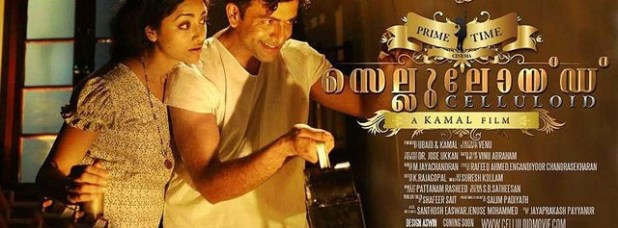
Celluloid

Celluloid_film

The Vampire Bat didn’t really have much of a luck to witness awesomeness for sometime; and he has been so disappointed that he wished to let the Vampire Crocodile do the rest of the movie watching and reviewing. But the twist of fate which followed him for centuries has struck one more time. The movie was Celluloid and the Vampire Bat was more than just impressed. He felt the 2008 movie Thalappavu again; the same feeling of Raama Raavanan and Melvilasom – he was at that moment, not sure whether to be in pain with the protagonist or to feel the strength and power of what was created by the life and fate of the central characters of these movies. Now one more movie joins this group of three – the trilogy of awesomeness got transformed into the fabulous four today; something which should have happened long ago, but was delayed by some horrible intrusion of new generation movies and the prejudice by a few very old generation fans.

Kamal’s Celluloid is not an entertainer for the mindless, but it is not an art cinema either. It has its moments of fun and tears, never dragging too much to bring the element of boredom. The result is a beautiful tribute to J. C. Daniel, now realized as the father of Malayalam cinema and Vigathakumaran a.k.a The Lost Child, the first Malayalam feature film. It is not a lesser tribute to the first Malayalam heroine P. K. Rosie either. It also has the reference to the second feature film in Malayalam, Marthanda Varma – the first Malayalam movie based on a literary work and history. Even as the movie travels through the ages, there is no loss of flow and there is no appearance of flaws. All the ages are represented with their suitable features, not exaggerating at any moment. There is visible presence of truth and sincerity throughout the depiction of pre-independence and post-independence India – these elements have been clearly lacking in most of the self-proclaimed realistic movies.

There is also the mention of the Lumiere Brothers – Auguste and Louis; their L’Arrivée d’un Train en Gare de la Ciotat or Arrival of a Train at a Station; that short silent film with no intentional camera movement and powered by one continuous real-time shot. It surely made itself realistic, but not the self-glorified new generation movies. Celluloid might be more old generation than the most, but it has enough to make one feel and follow its path. While the hyped new generation movies claim the same, and gives fake emotions powered by stylish camera shots and bad language, the fact is that it is not everyone’s reality. When they do so, it is the complete rejection of the common man. As they might not have done the earliest filmmakers in history proud with the absence of substance and the presence of nonsense, there is another particular addition to it, as the quick impact on their fate is much less an impact compared to the deep impact which is to come. As the world didn’t end in 2012, there might be many generations to follow, and they are going to use “what Prometheus gave them” on many movies, and among the movies which will have honour and glory instead – there will be Celluloid.

Coming back to the movie of the year so far; it is the story of J. C. Daniel, the man who wished to make the first Malayalam cinema. He is seen as a determined young man who has set out with a clear aim in his mind. With the help of his wife Janet and his friends, he sets out on a mission which is made nearly impossible as there are not many heroines available unless they try a man in a female role. Even the available actresses would be from Bombay or other parts of India who would charge so much for him to provide. He does try one of them, but the demands are found to be too much. Finally, they end up casting a lower caste woman – an act which doesn’t interfere with the quality of the movie, but does affect the minds of the upper caste orthodox people who couldn’t digest such a woman doing the role of an upper caste lady. This happens to be a huge turning point – a decision which would affect the progress of the movie in the theatres of 1920s and begin the troubles. The reaction of the influential upper caste would be too hostile for Daniel to handle.

The unavailability of female cast to act in movies and the caste based attitude would continue while Daniel goes off to live in Tamil Nadu after selling off most of his assets including his own house and there is no clue about Rosie whose hut was burned by the hooligans forcing her to run away. The dream had lost its wings. He starts a new life as a dentist, but that too is shattered due to his love for movies which continued to follow him. His practice as a dentist soon ends, making the situation worse. There is the mention of movies which followed during the later periods, like Chemmeen, Achanum Bappayum and Narasimham. As time moves on, it is Daniel’s later struggles and the attempts of Chelangatt Gopalakrishnan to bring the government’s attention to the situation of the pioneer of Malayalam movies which take the centre stage. But the absence of the film reels of the movie and his stay in Tamil Nadu was not to make the situation easier.

Prithviraj has come up with a brilliant performance – his best since Thalappavu. He has fitted so well into the young protagonist, his older self and the son of the protagonist. There is no point where he failed to impress. Chandni, who has debuted as Rosie, Mamta Mohandas as Janet , Sreenivasan as Chelangatt Gopalakrishnan – all of them have fit into the characters so well; even considering the movie in movie which looked like a realistic recreation of what the first Malayalam feature film might have been. The number of real-life movie figures are numerous; Dadasaheb Phalke – the father of Indian cinema, R. Nataraja Mudaliar who made the first silent film in Tamil (Keechaka Vadham) and so on. Another notable person mentioned in the movie is D. W. Griffith, the American film director. Charlie Chaplain is also frequently mentioned, and his movie The Kid is seen to be shown at the theatre which seemed like the most powerful of the inspirations. But Daniel’s work became a social drama which wouldn’t be acceptable to the society which was rooted in orthodoxy.

In simple words, what is Celluloid? It is the history of Malayalam cinema from its humble beginning to what it is now. It is also the story of one person who tried so hard to make this dream happen. Malayalam movie industry which had such humble beginnings has the big responsibility to carry on that legacy. The first Malayalam feature film was a revolution; it was the silent movie which gave life to Malayalam on the screen even with no single word spoken. It was also a voice of the change which was to come in the caste system; that feature film was an indirect voice of the subaltern which was silent; a contradiction for sure. But all these were submerged; like the legendary island of Atlantis. But now we know the person. As Paulo Coelho has let us know through his Alchemist, “It’s the possibility of having a dream come true that makes life interesting.”. He had his dreams and he fought for it. This tribute has been overdue for such a long time, and this movie has finally brought justice. One can’t help not being without pain for J. C. Daniel, but its time to take a bow. Its an honour to have known you – thank You Kamal. The experience is divine for a movie fan, especially if you watch that many Malayalam movies.

Release date: 15th February 2013
Running time: 130 minutes (estimate)
Directed by: Kamal
Starring: Prithviraj, Mamta Mohandas, Chandni, Sreenivasan, T. G. Ravi, Nedumudi Venu, Siddique, Sreejith Ravi

celluloid copy

@ Cemetery Watch
✠The Vampire Bat.