5 Sundarikal

5 sundarikal1

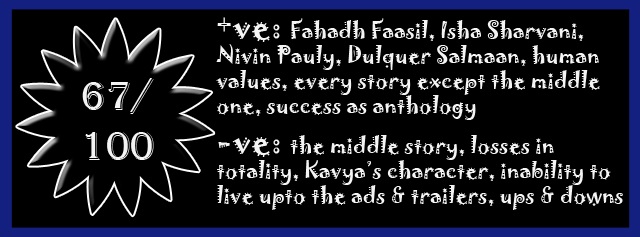
5 Sundarikal which can be translated as 5 Beauties, is that romantic anthology film which might have had its existence to thank the 2009 anthology movie Kerala Cafe. There were ten stories in that one and here it is cut to half with five, and only Anwar Rasheed doing a story in both the anthologies. The Vampire Bat would not agree to the title though, as it would be left to him to say which one is the beauty and which one is the beast. The only suitable title would have been 5 Females, and fighting with three other movies which has interested the crowds, even the name of a movie has to add to the total interest generated. Even in my case, this is the first time I get a Malayalam movie with a Malayalam name to review, and the “5” is to be read as Malayalam “anchu” and not “five” as far as I know. Watching stupidity like Raanjhanaa is clearly out of the equation and this movie having five stories instead of one increases the probability of getting at least two good ones; so there is no doubt which Indian movie one is supposed to go this week. There is the power of five compared to the power of six in ASK a.k.a Aaru Sundarimaarude Katha, and the obsession with beauties continue, this time with more success, and one beauty judged less is always the truth gained further. Whether it should be “sundarikal” or “sundarimaar” is a question to be asked to satisfy the quest to find grammatical errors, and I would go with the former.

Sethulakshmi: directed by Shyju Khalid :: [59/100] :: No, there isn’t going to be a total score based on the average of these stories, as that should annihilate the purpose of this movie as an anthology as well as this review as a subjective reality. There would be separate worlds for each story and for the movie, there would be another reality of totality, to which this simple story adds on first coming as an adaptation of M. Mukundan’s short story, Photo. The story of two school kids is shown in its own natural innocence until their world-changing event happens. The simplicity turns itself into the tough theme which the story has to deal with, and that is the place and may be where it scores. There is the depth of evil portrayed in a way that will haunt one with innocence. But the question remains if this belongs to this movie, as the presence of a beauty or even pseudo-beauty here itself negates the need for this story in the movie and all the purpose it would have served, and however one tries to look at this, a more deserving platform for this one would have been Kerala Cafe, and might have been the second best story in that movie after Anjali Menon’s Happy Journey. It is kind of misplaced here, and this might have been added here to arouse the curiosity of the viewers as well as to create that new generation element – otherwise this among the other stories is like Roger Federer guarding the goal post for the Spanish national football team.

Isha: directed by Sameer Thahir :: [79/100] :: Along with the former one, this story also has the scope of becoming a one and half to two hours of good cinema. It stars Nivin Pauly as the thief a.k.a the Santa, and Isha Sharvani who makes her debut as the beauty of this segment, and undoubtedly the smartest and the most charming of them all. They start off as two strangers and with many things in common, and the question would be what they end up to be, and that is the surprise, that twist of plot which raises the story from its existence just inches about the average level. Nivin Pauly has remained similar to what we saw in Thattathin Marayathu, as this time he has another Isha, Isha Sharvani instead of Isha Talwar, another lady from the North, and this female lead does a lot more than the other one did. This story and what is to follow are the only two segments which are actually centered on the beauties, and this is the only segment in which the beauty is in control and remains so throughout most of the story. One has to say that this one has the best of the lighter moments too, and the claps which came after this segment are well deserved. The whole story is centered on the two leading characters, and there we see the most beautiful lady and the one romantic hero; they make this work like nobody else could have.

Gouri: directed by Aashiq Abu :: [10/100] :: This is the weak link in the whole movie, and without this, the movie could have been declared the best anthology in Malayalam movie industry ever. This is Aashiq Abu’s worst so far, and from what we have seen of him already, it might remain his worst. Biju Menon is there as the husband with nothing to do that really matters to the story. Tini Tom and Rimi Tomy makes an unnecessary visit, as Kavya Madhavan who plays the wife expresses her need to have a kid. Kavya is there as if she is to be that strange character who is more unsure about herself and the world around her than Popeye without his spinach. Jayasurya also makes a small appearance thus making this one the most powerful segment in terms of celebrity power, but in performance, it is a dynamite of the next generation which failed to blow. This is a painfuel half an hour of torture, which could have been avoided or may be replaced. It is surprising that it came from the same director who gave us Da Thadiya in the same year. This might even make Estragon and Vladimir say that there is something to be done – sorry, Samuel Beckett. Kammath and Kammath and Lokpaal were not that bad now, as you go through this one. This story in the middle shows us the middle finger, but fortunately it was preceded and followed by brilliant segments.

Kullante Bharya: directed by Amal Neerad :: [84/100] :: This is the moment which strikes you hard. Amal Neerad has come up with a story which is narrated by Dulquer Salmaan who sees everything from the top floor of a group of apartments. The awesome presentation and the story’s ability to relate with the contemporary society of Kerala, and may be even India as a whole, has helped this one to get the most claps in the theatre, and remain the highlight of this five star experiment. Dulquer Salmaan has eased through this segment, and even as a person moving on wheelchair, there is so much of impact with every word he says. Reenu Mathews leaves an imprint without even a word said. The newcomer Jinu Ben brings tears to the audience with no direct revelation. The story also works as a satire on the self-proclaimed righteous, highly moral society which considers itself as the role-model, and has a lot of prejudice against the people whom they are not familiar with, and those who think or act different. If there has been so much interest in this story which has only one actor who has performed in a leading role in more than one movie, it shows how much impact this one has created, and how much it could relate with its audience.

Aami: by Anwar Rasheed :: [61/100] :: This might be the most awaited story of the movie, with a businessman, Ajmal (Fahadh Faasil), who travels from Malappuram to Kochi and vice versa. His too much affectionate wife who is known only by her nickname (Asmitha Sood) keeps asking tricky questions to him and leaves him puzzles to solve – a strange abnormal habit, to which anybody would agree. The night journey then transforms into something that changes his life. The presence of Honey Rose and Vinayakan just adds to powerful cast of this segment which is already the talking point due to Fahadh Faasil’s presence and his new looks. It is him who excells in this story, and everything else is a little let down. With meaningless puzzles and strange happenings, this is not something which the viewers can relate with, but thanks to the leading actor and some interesting dialogues, this one lets the movie with its head held high, not annihilating the world which was created by the second and the fourth segments. As Fahadh Faasil fights extreme anger, greed for money, violence and his own old relationships and gets back to his beloved, the whole thing ends happily. This is surely better than the highly predictable Bridge segment in Kerala Cafe by the same director.

The movie is that roller coaster ride of Final Destination 3, in which death tries to pull the movie down, as some of the stories lose charm, and suddenly a story comes up which changes the things around. It is the advantage of having five different stories directed by five different people, and this is well done, and it would live on as long as this theme doesn’t come up with a overdose, either with the stories or with the concept of pseudo-beauty. To be frank, there is nothing in this which binds this collection together, as same was the case with Kerala Cafe, and it doesn’t give that much of anything that Cloud Atlas gave its viewers. This movie uses the concept of enchanting viewers with its title and the trailer, and tries to undo the failure of Poppins which had its own wrecked set of anthologies in which only the story of Kunchako Boban and Nithya Menon made any impact, with Indrajith-Padmapriya and Jayasurya-Meghna stories staying there not without troubles. Still, the question remains, who is the beauty? If they were all eligible for the same title, won’t they be good enough for that word which comes as just the opposite? Why would we be forced to believe with that willing suspension of disbelief that they are all beautiful? Will Isha Sharvani and Kavya Madhavan look like beauties to two people who have different concepts of beauty? Even myself is clearly sceptical about the latter; but leave that for the intellectuals, and concentrate on the medium for now.

Release date: 20th June 2013
Running time: 145 minutes (estimate)
Directed by: Amal Neerad, Anwar Rasheed, Sameer Thahir, Shyju Khaled, Aashiq Abu
Starring: Isha Sharvani, Asmitha Sood, Reenu Mathews, Honey Rose, Kavya Madhavan, Baby Anika, Nivin Pauly, Dulquer Salmaan, Biju Menon, Fahadh Faasil, Jayasurya, Master Chethan, Tini Tom, Rimi Tomy, Jinu Ben, Vinayakan

5sundarikal copy

@ Cemetery Watch
✠ The Vampire Bat.

Immanuel

immanue

There has been a certain absence of goodness in most of the movies of the last few years of new generation stuff; this absence which has been reclaimed more by another experimental movie which was Amen, and it is once again regained by this world full of goodness in the middle of evil in this movie Immanuel. The word “Immanuel” or “Emmanuel” has been a common Biblical name meaning “God is with us”. This presence of God and His Word happens to have an influence on this movie, which is more powerful than what is seen at first sight, as the strength lies in what is less noticed, and this strength powers the natural world that is conveyed to the audience; for even without them knowing, there is the power of divinity behind the seemingly ordinary goodness. The belief in essential goodness of man has been clearly broken with those movies which glorified pure evil. But this is not something which needs a theory to support the fact, as it has been proven by mankind by centuries of wars, brutal murders and destruction. The global presence of this evil is unquestionable. William Golding had made us believe the same with his Lord of the Flies which powers the belief in inherent evil in man. That tendency to sin innate in all human beings, held to be inherited from Adam and Eve.

As the “Fall of Man” has become more of an excuse for sins rather than something which acts as an influence, this movie comes up with one man who keeps his alignment towards the good. The mankind might be still inherently evil and this evil resides within everyone and could be unleashed at any moment as long as the situation is suitable, with no need for a Hannibal Lector. The dark side of human nature could be as vicious and as terrifying as the evil that exist unknown to man, and even the most innocent of mankind are vulnerable to it – but not our hero, as we welcome the man of goodness, Immanuel. He is no fairy king, halfling, hobbit or anything, but as human as one can be, in a world of lost humanity. He is the biggest surprise in the movie named after himself, and he is no lesser wonder in a world of utter chaos & misery, as the humane nature of humanity survives through him and runs his sacred endurance to the limits. Immanuel is not just a character of Lal Jose’s imagination, but a much needed reason for the salvation of human race – for the saved are less and the damned are many; for the greatest of the fallen ones has multiplied, not by breeding, but by intellect of the wrong kind calling it science and technology; profit and success.

The movie starts with the character of Immanuel working in a small book publishing firm. When the small company is forced to shut down due to the owner having heavy debts and going on a vanishing act, Immanuel and his family find it difficult to go through their regular lives. There are the usual requirements of a home as well as the needs of his son which makes life uneasy for the family. The difficulties he faces forces him to get a job which is not really suitable for someone like him. For a honest, good hearted person like Immanuel, the corporate world is nothing less than the inferno of the deepest level. He is forced completely out of his comfort zone, but he is also not able to quit the job as his family desperately needs the money. Thus he decides to go on as long as he can, and one day he might be able to find enough money to buy a home and get himself and the family out of the rented house. Most of his co-workers are of not much help to him, as they are all competitors in the same field and would use treachery if necessary to keep their levels high. His boss, Jeevan proves to be the biggest problem, as the cruel corporate master and oppressor, nothing less than a feudal lord or a colonizer. The boss’s aim is only to gain maximum profit, even as he talks about the customer being the king.

Remembering The Pursuit of Happyness, it was a movie which glorified this type of life, and the ultimate aim was to meet the deadline and get the target, but this one takes it upside down. Maximizing the client contacts and thus the profits doesn’t really get the job done for Immanuel. He is the kind of person who is ready to give up all of them as a sacrifice for leading a life of truth and sincerity. May be “happyness” was not what Immanuel was looking for, as it was “happiness” in its most stable form. Immanuel always had the needs, but he never over-valued money over the human relations, a total opposite to Jeevan, the latter who is more suitable to be included in the pursuit of “happyness” than “happiness”, more of a pseudo-happiness which takes a physical appearance rather than mental – for it is of this world in all its limited environment. Such a position wouldn’t create anything more than a void within a void, a point which is made clear through the lives of the two main characters in this movie. But the question would be about the point where humanity ends and divinity starts for Immanuel; and that other point where humanity ends and damnation starts for Jeevan, even if it is not a complete process. Such a question creates more doubts than solutions.

Mammootty’s Immanuel is more of a flawless creature of divinity. Even with contradicting philosophical problems created by the man of goodness, there is so much simplicity in his depiction of the character. There is so much ease around this performance, as the character undergoes heavy transformation from his early troubles to corporate frauds and to the final realization that not all dreams come true and most of them really needn’t. Dreams are also meant to stay as they are, and ambition is just another name for greed triggered by vanity and jealousy. There are two sides to everything, and as long as the black and the white are considered, there are Jeevan and Immanuel respectively, but the white always have the option to walk away from the black, not without loss though. Immanuel still doesn’t loss his qualities that makes him what he is, as he helps two characters played by Sukumari and Mukhta, the first one getting the much needed money for her daughter’s marriage after her husband’s death, and the second one for the treatment of cancer. His help extend beyond the office though, with the poor workers from outside the state, all of these creating more rift with Jeevan and making his staying on the job even more risky. But he continues to stay as himself.

Fahadh Faasil’s Jeevan is never outside the game. He is the boss of the game of sales, as well as the brain in a smaller ship of the corporate world. He is never in good terms with Immanuel, who seems to him as his nemesis from the moment he gets his job under him. Caught between profit-making in his job, loving his family and reading the Holy Bible, he is neither here nor there, but manages to keep his dark side going with his attitude towards those who works under him. It is a fantastic performance, even as the character has less screentime compared to Immanuel. Jeevan is also the exact opposite of those characters we saw in Red Wine and Amen, and a comparison to Solomon takes this further down to the abyss reserved for extreme opposites. Reenu Mathews who plays Immanuel’s wife has come up with another performance which is above the line, and really good for a beginner. Devan plays a role like he played in Gulumaal, and it is easy to connect with the role in this one; Mukesh’s role is also a cameo and the same can be said about that of Balachandran Chullikkadu. It can be said that Muktha Elsa George plays an extended cameo with a few appearances.

Bijukuttan, Salim Kumar and Guinness Pakru provides the lighter moments in the movie, and its comedy is all sensible. There is no stupidity or vulgarity associated with it. All these funny elements are not of lower standards either. Thus it moves on as a movie suitable for all, not just for the fans or the family. But it never runs out of its slowness, and never tries to have a look outside the ordinary. If it had done so, this might have reached a new level. But it may still be more comfortable in its own territory which is in this case, the normal side. There is nothing here like what kept the audience glued to Diamond Necklace – instead, this is just the story of one good human who managed to keep his goodness even as there were so many opportunities for him to lose it along with his soul. This movie is also a story of morality – it preaches and it does so with perfection; not as perfect as one would expect in theory, but as perfect as a human with all its imperfections could manage to do. The goodness needs to be generated in a society which is plagued by lies, and may Immanuel be a good model for the people who fails to deliver truth when it is most needed. The movie’s alignment towards pure goodness is to be appreciated. God is with this movie for sure.

Release date: 5th April 2013
Running time: 150 minutes (estimate)
Directed by: Lal Jose
Starring: Mammootty, Fahadh Faasil, Reenu Mathews, Sukumari, Salim Kumar, Guinness Pakru, Sunil Sukhada, Ramesh Pisharody, Bijukuttan, Balachandran Chullikkadu, Muktha Elsa George, Mukesh, Devan

immanuel copy

@ Cemetery Watch
✠The Vampire Bat.

Amen

amen0

There are few movies which the Vampire Bat would watch a few thousand times other than the horror flicks and the Malayalam movies of the 1980s. The end of this movie was that moment when the Vampire Bat actually felt the same – that moment when he was light enough to fly. It was the moment this bat felt that he was that feather which felt the wind lifting one’s self towards the starry sky. It is not exactly the feeling he had after watching Celluloid, as it is more comparable to that status where he was, after watching Pranchiyettan and the Saint. This rarely happens to the Vampire Bat, for this one has the status of being the second. With its visual beauty of nature, it is comparable to Ordinary, as this one highlights the backwaters while the Kunchako starrer had concentrated on the hills, mountains and the related greenery with fog. There is thunder, dark clouds, water bodies in its maximum body – how can one person do justice to this movie with a subjective review is a question which might remain answered; but what would an objective review do other than being too scientific and technical? This soul would keep closer to the former as possible, and in that way find himself in the process. Here, we have the story of an ancient church parish and the people, a love story and a band’s struggle for survival. The whole story can be read better from the beautiful characterization rather than as a plot.

Swati Reddy as Sosanna – such a character and so much of wonder in that performance! I can’t remember seeing such a female character on screen in any Malayalam movie. One has to wonder who she really is! The first guess would be that of a Keralite Juliet who comes out to the balcony (here, as the house is more of a traditional style, looking through the window) listening to the divine music by the artist that is Solomon (Fahadh Fazil). Well, they don’t die and so lets leave the tragic side of Romeo and Juliet behind. They can still have the title in the name of divine love, but on second thoughts, Sosanna is more of Rapunzel, imprisoned in a tower by the evil ones; her use of frying pan even bring the memory of the newer Rapunzel of Tangled (please avoid the hair details). Her character is the centre, around which the whole movie is built, even if our heroes get more screentime. Each and every second of her presence indicates something which is to happen, and the whole divinity rests on herself and the music. She, the angel in white dress, the absence of black and greyness. She is complexity in simplicity – all in one; more than one simple village damsel – lovable and admirable with all her positives and negatives.

She is no different from the Rapunzel of Tangled on most of the occasions – she pushes the kapyar into water and asks her lover if he wants to be the Father in a church or her children’s father; she pours chicken curry over a gunda and hits him with a frying pan; she eats “naranga mittayi” with that happiness which William Wordsworth might have felt after seeing Daffodils; she uses paper rockets as love letters; she reads only from Solomon’s Song of Songs when asked to read the Bible; she talks about love in a cemetery (the Vampire Bat’s recommndation for this one) – the saga continues for Sosanna is not the weaker one to be subdued; for she is the frying pan fighter striking fear in the minds of the most powerful gundas. She is the passionate lover, the advisor, the fighter, the damsel in distress and still in lesser distress than her lover who is the man in distress. She is our blessed damozel; of this world and not the other, not the one Dante Gabriel Rossetti pictured in heaven, but the one person who continues to bless this movie with her presence. How can one not consider this one as a non-animated character at any stage? The words describe less and the scenes visualize more.

Fahadh Faasil as Solomon – he has done it again, and I might end up using this same sentence for the same actor for so many occasions that I would lose count of it. This is not brilliance unexpected, and I would always keep the expectations high on one actor. Fahadh in that Christ costume for the festival was something which made divinity come down from heaven. All the jokes related to his character and Sosanna are so genuine and wonderful – or even beautiful, if jokes could be termed “beautiful” with all its aspects. Here is a character of simplicity, lack of self-confidence and unparallel love. He is the new Romeo in many aspects, and he is the Jack of his ever-sinking Titanic that is a life of poverty which can only be made to be of any hope by getting himself into the music band sponsored by the local parish church. This character’s life surely is a divine comedy as it is subtitled, as the title character travels through his own inferno, purgatorio & finally the paradiso achieved by his merit. He is our own Dante Alighieri. Hell, purgatory, and heaven – they are all in this world for Solomon, the ultimate underdog. If Sosanna is more of an unpredictable character than her lover, Solomon steals the show by being predictable and still rising to the occasion. This might be Fahadh’s best performance ever, even as I am sure that I will be forced to say that again on another occasion.

Indrajith Sukumaran as Father Vincent Vattolli – always been in my list of favourite actors, and I am short of words for talking about this one – no do not bring me the dictionary, for I have word substitutes working for me. He is the exact opposite of the Vicar Father Abraham Ottaplakal (Joy Mathew). While the former tries to save the band, unite the two lovers and keep the church as the ancient structure, the latter tries to dismantle the band, separate the two lovers and rebuild the church. Both have brought the levels to new heights as one becomes so likable and the other detestable – the two characters are played with such perfection that one can’t resist believing them as what they are. There are times when one has to wonder how close to evil and away from the neutrality of the beginning, the Vicar happens to be as the second half progresses. The big paradox here is that the revolutionary new entrant is the stronger believer and the traditional, orthodox Vicar is the lesser believer who has his own agenda. Their church at Kumaramkari is not just a simple old structure, as they say that the legend is that Saint George had made Tipu Sultan’s attempt to raze the church a failure. This belief is what runs in the veins of the parishers and this is where Father Vattolli has reached – this is also where Father Ottaplakal makes his own decisions with no divine intervention; not a desired situation for sure. But there is more to Father Vattoli than it would seem to be, as the end twist would create that dream climax.

Saint George and the church are more like characters in the movie, but more shall not be talked about that divinity. Kalabhavan Mani’s Looyi pappan is a very powerful character throughout the movie; someone who fails to accept defeat – the man who wins the war even as he loses most of the battles. He seeks redemption after the death of his best friend who was the soul of the band – a music band which has been continuously on the losing side for a long time after the tragedy. Rachana Narayanankutty as Solomon’s sister and Natasha Sahgal was Father Vattoli’s admirer, joins the cast’s beautiful performance. Makarand Deshpande’s nemesis character is immensely powerful and Sunil Sukhada’s Kapyar works in more than one way. Lijo Jose Pellissery has given the viewers an early Easter gift, and it might be the best in the theatres right now. What else could be said about such a performance? But it is surely not free from the slightest of negatives – even among the best of jokes, lie the totally unnecessary, ridiculous jokes which tends to take away some of its beauty. But they could be avoided and the movie could be continued to be watched as the divine comedy as it is, for there is more to it than just the usual stuff. No, this is not the typical new generation either – for this is typical divinity, if one could call it so.

This exuberance is magic, and that is just to give the movie its due. But the truth is much better; for exuberance is just a word and so is magic. Amen is something which has dropped from the firmament, not like the fallen angel Lucifer, but as the medium of divinity which the world of the upper level has provided us with. Can you find faults within the story? If yes, isn’t there the flurry of intelligence and brilliance to cover them all? That would be a clear yes for an answer. No, the movie still doesn’t pretend, and it never needed to. It never needed to wear a mask like Annayum Rasoolum; a mask of goodness and reality which that one dragging movie has been wearing! But this one wears its own skin as a mask – no fake faces to cover its simplicity. Everyone has been incredibly good at what they were doing with this movie, both outside and inside – even the songs and the movie posters have contributed in such a way as to make this movie one of its kind – something which can lead and not follow; bring that thunder of wonderful change. I felt the magic realism and dream visions as well as its re-assertion of faith, belief and hope with divine intervention. Oh beauty of a movie, thy name is Amen – anything else would be so inappropriate right now. If I am to die after watching a movie, this might be one of them worth dying for!

Release date: 22nd March 2013
Running time: 160 minutes (estimate)
Directed by: Lijo Jose Pellissery
Starring: Fahadh Faasil, Indrajith Sukumaran, Swati Reddy, Rachana Narayanankutty, Natasha Sahgal, Joy Mathew, Kalabhavan Mani, Makarand Deshpande, Sunil Sukhada

amen copy

@ Cemetery Watch
✠The Vampire Bat.

Red Wine

redw

This wine is not that powerful as a thriller even with its moments of suspense, as the killer is kind of known right from the beginning itself – there is still a possiblity of expecting more twists over twists, but there is none in the end. The movie progresses slowly, unlike the traditional thrill infected flicks. Still, it has a beautiful philosophical touch and an embedded social message. The movie is surely worth watching for the performance of the leading actors, especially Fahadh Fazil & Mohanlal. There seems to be no stopping the former from his awesomeness and the latter proves why he is still considered to be at his best. The support cast has also been significant. A routine investigation movie is told in a different way this time. It is supported by another experimentation with its narratives without losing its simplicity and the path towards goodness. This can be hailed not for the chills and thrills, but for those who can make a philosopher’s stone out of the darkest and the dirtiest of metals, this might be something else.

Mohanlal’s Assistant Commissioner of Police reminds more of the cop from Grandmaster than anything else. This time, the police officer is even more philosophical. He is not a person who look for action all the time, but a slow and steady officer who understands both the victim and the murderer, and knows with ease that both are the victims of circumstances, one of his own ideals of truth, justice and equality which is despised by the land mafia, while the other of his evil past and the need to pay off his loans. He understands the complicated human minds just as the Wayanad’s twists and turns on the way up. The movie is shot at Wayanad and Kozhikode, and the stories of the subaltern of the heights of Wayanad and that of the opposite side of the evil from civilized world also creeps in. This is where Mohanlal’s character has his magnificience – to balance the characters from both sides, pure good, righteous good, forced evil and pure evil, all of them making frequent appearances as significant parts of the movie at parts. He understands the two men he is searching for, as well as the ones he is not directly searching for, as he progresses through his investigation.

Fahadh Fazil carries the movie with such an ease which makes the whole movie a simple, poetic experience. This is very unlike his performances in his recent flicks – there is no strangeness like in Annayum Rasoolum, Chappa Kurisu and Natholi Oru Cheriya Meenalla; there is no shades of darkness or even greyness as in 22 Female Kottayam; or that confusion and uncertainty of life as in Diamond Necklace and Friday. Here, we have a good man, of only good intentions towards the fellow humans, and with the desire to do good to the society and his people. He is an Engineering graduate who passed out of college with good marks and was good enough to get a fine job with an attractive salary at home or abroad. But he chooses to work for his people as the Local committee secretary for the left. His portrayal of the victim Anoop has given the audience his most lovable character ever; that is one character on the side of pure, unadulterated political man who stands between the modern and the traditional world, having the elements of both, in such a way that he stands between the two, understanding and interpreting both with significant ease.

As the movie revolves around the life of three characters, one can’t avoid not fail to sympathize on the third important character, played by Asif Ali. Even as he is the least likable of the three and has less time on the screen, Ramesh is a character of circumstances. He is not someone who is a remorseless man of pure evil like Django. He is not for the depths of hell nor the upper most of firmament. His life is not to be seen separate from his wife Deepthi, played by Mia George. Both of them blends into their characters well enough, and more of the sad situation is conveyed more through their looks and expressions rather than the words. This is that part of the story which is more touching in terms of a common man. Ramesh is a man with an evil past, who has turned good after marrying his lover who is from a rich family, which has lead to their isolation from their relatives. Now, as Ramesh has taken loans over loans, this is his moment where he has to choose between the good which is poverty and the lack of provisions for his family which would soon include a newborn child, as well as the evil which is security of good life for his loved ones. There is choices for him to make and whatever choice he makes, there would be a payment in blood or cash.

Well, the human life itself is like that road to Wayanad, and all these characters fit into those twists and turns. For some of them, death might be the relief and for the others, life is all that matters. Where heaven and hell fits in between them is a matter of debate, in the life which is mixed with so much of good and evil. The strength of the movie is still its cast and their performances. Meera Nandan, Meghna Raj and Kailash comes in smaller roles, as a skilled drama actress, an RDO and a cyber cell officer respectively. Meanwhile, Saiju Kurup comes up with an inspiring performance as the protagonist’s friend Navas. The debutant Maria John and Anusree also fits in, as the lover and the best friend of the protagonist. Suraj Venjaramoodu has a more serious role to play in this one, as the one who benefit the most with the protagonist’s death, a person with hidden agendas, another suspect for the investigating officer. T. G. Ravi has another lovable character, a righteous socialist worker of the party who earns the respect of the viewers right from the beginning. Still, the one who steals the show is Fahadh Fazil, and he seems to do that with such an ease that surprises the audience.

The way in which the movie is narrated gives it more life in spite of it being slow and ordinary in the first look. There is regular breaking of narratives, not in space, but in time – from the death of the protagonist to the life of another man to the progress of the investigation and then back to the protagonist’s ideologies during his lifetime. The space changes, but is still confined to Wayanad and Kozhikode. The movement is like wine poured out of the bottle, some of it which goes into the bottle, some of it to the floor, a little of it in the table and the remaining in the bottle. This is the philosophy of life, for not all can be the same, physically, intellectually, or spiritually. To be frank, the choice to go for this one ahead of 3 Dots and Amen was a big move. It was more for the love of the title and the image of the red wine in the bottle. No, it won’t replace the everlasting image of tea as the elixir of life, nor does it make a substitute for blood. The question would be about what the red wine symbolize and why is it the title of the movie. I have always been interested in the colour, my third favourite after black and blue. It is the colour of blood; that of all the martyrs and saints who died for the mankind. It was also used in the Roman and the Byzantine Empires, such was its honour. What about St George’s Cross and the Red Cross?

The human life has always been full of the colour red, also associated with, revolution, love, socialism, communism, passion, beauty. Lets leave its negative associations for this instance, for this one is everything except pessimism. The red wine itself is a symbol of humanity and their blood in a glass. Does this also symbolize the sacramental wine, the blood of Jesus Christ, for the blood of a modern age revolutionary which was to be shed? They were shown drinking the red wine and they were also shown talking about Christ being the revolutionary, and therefore this chance is surely there. The Red Wine is no Spirit; for it doesn’t glorify drinking or anything in the first half and oppose it in the second half; it sticks to its points – of humanity, right from the beginning to the end, for the red wine symbolizes the blood of a young, educated revolutionary which was shed as he stood for the righteousness. That makes a valid allusion and a wonderful imagery. Red Wine is not your typical murder mystery, for it is a philosophy; not a psychological thriller; never a supernatural thriller, as this one is of another genre and I would like to call it a philosophical thriller. If this was more powerful as a regular thriller, and if it could have conveyed the philosophy better, the movie would have been awesome, for sure.

Release date: 21st March 2013
Running time: 140 minutes (estimate)
Directed by: Salam Bappu
Starring: Mohanlal, Fahadh Fazil, Asif Ali, Saiju Kurup, Jayaprakash, Mia George, Meghana Raj, Anusree, Maria John, Meera Nandan, T. G. Ravi, Suraj Venjaramoodu, Kailash, Anoop Chandran

redwine copy

@ Cemetery Watch
✠The Vampire Bat.

Lucky Star

luck

The Vampire Bat had to fight off many bad omens before watching this movie. There were so many souls talking in his dreams that this is going to be a bad movie. To add to it, when the Vampire Bat was travelling on his medieval machine which ran at ten kilometres per hour, the fastest ever invented by a non-human, and there were traffic problems. In the end, the Vampire Bat reached the theatre thirty two seconds late – not too impressive for a creature well known for punctuality. I guess this reveals another thing about the Vampire Bat. He can’t fly – to be frank, it is more like he won’t fly. It is mainly because he is against it, not because he is like that bird in the movie Rio. He has decided not to fly, even if he is pushed off a cliff with non-vampire crocodiles underneath. He is so adamant, but he is no Meursault, for he is as much as a believer as any living soul in Noah’s Arc. Back to the omens, the vampire bat happened to see so much reckless driving and breaking of traffic rules; but if that is to be considered an omen, the Vampire Bat would have seen no other movie.

So the movie has Deepu Anthikkad in his directorial debut, starring Jayaram and Rachana Narayanankutty. It is the story of a small family of Ranjith, Janaki and their daughter Megha. Our hero is a man who always dreams of becoming rich, and the family as a whole has quite huge dreams, and there is a little boasting which results in no big evil. The hero is a tailor who stitches dresses mostly for movies – a random person who got stuck in the city of Chennai after coming there with big movie dreams which he still cherishes. As the couple had love marriage, they live far away from their relatives, both physically and mentally. Ranjith is looking forward to a big enterprise which he plans to start with a bank loan which seems too difficult to get. His desire to send his daughter to one of the best schools in the area, makes the financial situation even worse. He ends up facing an incredible shortage of cash for his liking, which has to be met one way or the other. This has no movement in the Swapna Sanchari direction, that is for sure, but a comparison at certain points might be worthwhile.

Continuing the sotry, the next important character, Doctor John comes up with an offer of ten lakhs for a surrogate mother for the child of an American based Indian couple who wants the mother to be good-looking. But he fails to find a woman of their liking. Janaki herself takes a decision to go for the money despite the initial refusal from her husband. The American couple pays them half the amount as advance and agrees to return to pay the remaining five lakhs after the birth of their child. But after the birth of the child, Ranjith and Janaki find that the parents of the new-born baby will not return as they have already divorced and started to live their own life. They could no longer be expected to have any interest in a child which belongs to both of them. The initial reaction was to abandon the child, but later the kid grows up as their son and their financial situation also improves – meanwhile, an incident causes the original mother of the boy to return and ask for her son – something which changes the situation completely.

The movie might bring back the memories of 1989 Malayalam movie Dasaratham and 2012 Hindi movie Vicky Donor, the former which was a classic and the latter the Vampire Bat knows not too much about other than what he heard from his noturnal allies. But the known facts tell the Vampire Bat to leave the second one further away. Well, this one is less emotional than the 1989 movie for sure, and they are surely not the same. This is more funny and without doubt, quite enjoyable, as they first half is not short of its funny moments. There might have not been many positive reviews about this one, but I would say that this is a highly under-rated movie. It has a debutant director and a debutant leading actress along with the supporting actress, but it never really losses its footing. The two leading actress and Jayaram has had a firm hold in the movie. There are moments where the story might have lost the soil under its feet, but it never really does – from what the Vampire Bat knows of the soil, he never really liked falling head first into the soil, something which happened only three or four times in his life time. In the end, the movie has strong pillars and is a job well done with its limited resources.

A good story presented in a nice package, which should be very attractive to the family audience, but still not so sure about the new generation lovers looking a continuous supply of that word which starts with the first letter of Fan, Freak, Frog prince, Fanny Browne, Faustus the doctor, Frozen dessert and Fool. For your need for everything evil and not-so-nice, find some other movie. There are enough of them with lip-locks, alchohol, drugs, cigarettes and sex; and leave this one alone, for this has goodness and it cherishes on it. The movie goes on and banks on its goodness and cast performances in a balanced manner. There is no overdose of anything, but simple dose of what would make a family-comedy-drama a success. The biggest advantage of this movie might be that it is light hearted and centred on family, the type of role in which we always wished to see Jayaram – like Veendum Chila Veetukaaryangal, Njangal Santhushtaraanu, Bhagyadevatha, Manasinakkare, Georgootty C/O Georgootty, Ayalathe Adheham, Meleparambil Aanveedu, Aadyathe Kanmani, Veruthe Oru Bharya and so many others.

T. G. Ravi and Mamukkoya have smaller, but noticeable roles to play in the movie. Even as there not that much power in any department to strengthen the movie, there is not much flaws around. To be frank, what might have affected the movie more might be the prejudices; the most significant of them might be based on the name – for a name like “Lucky Star” is a little unattractive for movie; a little closer to the first name of the Indian Premier League Cricket team from Cochin, IndiCommandos Kerala, and not that far away from the names like Chennai SuperKings and Sunrisers Hyderabad. Not that these names can be considered horrible, for they are all subjective – a name like “Lucky Star” would create less interest in Kerala than most of the other names. Its like when I say the name of the movie which I am going to watch, and people are like, what in this world is that? That is surely a cause of repulsion. If it also reminds you of the 2011 Malayalam movie, Lucky Jokers, does that help? Not for me to say.

The movie has the right cast and there is nothing wrong in the movie to have this much less reception, and the hope is for it to do better than how it is performing in the theatre right now. Family audience, this is your chance to bring goodness back to Malayalam movies. A must for anyone who wants to see a good world on the screen and the display of the power of family values compared to the world of separation and intolerance. Isn’t this more of humanity than random people wandering around having drugs, sex, alcohol and cigarettes? Isn’t humanity more of being good rather than gaining attention? Even the ambitions and desires which might have existed in the earlier parts of this movie makes way for the big sacrifice in the end. This is how righteousness should be running, not on a cart made of stone wheels created out of a heart of stone, but based on that delicacy which should be worth a whole human life.

Release date: 8th March 2013
Running time: 130 minutes (estimate)
Directed by: Deepu Anthikkad
Starring: Jayaram, Rachana Narayanankutty, Pooja Ramachandran, Mukesh, T. G. Ravi, Mamukkoya

luckystar

@ Cemetery Watch
✠The Vampire Bat.

Celluloid

Celluloid_film

The Vampire Bat didn’t really have much of a luck to witness awesomeness for sometime; and he has been so disappointed that he wished to let the Vampire Crocodile do the rest of the movie watching and reviewing. But the twist of fate which followed him for centuries has struck one more time. The movie was Celluloid and the Vampire Bat was more than just impressed. He felt the 2008 movie Thalappavu again; the same feeling of Raama Raavanan and Melvilasom – he was at that moment, not sure whether to be in pain with the protagonist or to feel the strength and power of what was created by the life and fate of the central characters of these movies. Now one more movie joins this group of three – the trilogy of awesomeness got transformed into the fabulous four today; something which should have happened long ago, but was delayed by some horrible intrusion of new generation movies and the prejudice by a few very old generation fans.

Kamal’s Celluloid is not an entertainer for the mindless, but it is not an art cinema either. It has its moments of fun and tears, never dragging too much to bring the element of boredom. The result is a beautiful tribute to J. C. Daniel, now realized as the father of Malayalam cinema and Vigathakumaran a.k.a The Lost Child, the first Malayalam feature film. It is not a lesser tribute to the first Malayalam heroine P. K. Rosie either. It also has the reference to the second feature film in Malayalam, Marthanda Varma – the first Malayalam movie based on a literary work and history. Even as the movie travels through the ages, there is no loss of flow and there is no appearance of flaws. All the ages are represented with their suitable features, not exaggerating at any moment. There is visible presence of truth and sincerity throughout the depiction of pre-independence and post-independence India – these elements have been clearly lacking in most of the self-proclaimed realistic movies.

There is also the mention of the Lumiere Brothers – Auguste and Louis; their L’Arrivée d’un Train en Gare de la Ciotat or Arrival of a Train at a Station; that short silent film with no intentional camera movement and powered by one continuous real-time shot. It surely made itself realistic, but not the self-glorified new generation movies. Celluloid might be more old generation than the most, but it has enough to make one feel and follow its path. While the hyped new generation movies claim the same, and gives fake emotions powered by stylish camera shots and bad language, the fact is that it is not everyone’s reality. When they do so, it is the complete rejection of the common man. As they might not have done the earliest filmmakers in history proud with the absence of substance and the presence of nonsense, there is another particular addition to it, as the quick impact on their fate is much less an impact compared to the deep impact which is to come. As the world didn’t end in 2012, there might be many generations to follow, and they are going to use “what Prometheus gave them” on many movies, and among the movies which will have honour and glory instead – there will be Celluloid.

Coming back to the movie of the year so far; it is the story of J. C. Daniel, the man who wished to make the first Malayalam cinema. He is seen as a determined young man who has set out with a clear aim in his mind. With the help of his wife Janet and his friends, he sets out on a mission which is made nearly impossible as there are not many heroines available unless they try a man in a female role. Even the available actresses would be from Bombay or other parts of India who would charge so much for him to provide. He does try one of them, but the demands are found to be too much. Finally, they end up casting a lower caste woman – an act which doesn’t interfere with the quality of the movie, but does affect the minds of the upper caste orthodox people who couldn’t digest such a woman doing the role of an upper caste lady. This happens to be a huge turning point – a decision which would affect the progress of the movie in the theatres of 1920s and begin the troubles. The reaction of the influential upper caste would be too hostile for Daniel to handle.

The unavailability of female cast to act in movies and the caste based attitude would continue while Daniel goes off to live in Tamil Nadu after selling off most of his assets including his own house and there is no clue about Rosie whose hut was burned by the hooligans forcing her to run away. The dream had lost its wings. He starts a new life as a dentist, but that too is shattered due to his love for movies which continued to follow him. His practice as a dentist soon ends, making the situation worse. There is the mention of movies which followed during the later periods, like Chemmeen, Achanum Bappayum and Narasimham. As time moves on, it is Daniel’s later struggles and the attempts of Chelangatt Gopalakrishnan to bring the government’s attention to the situation of the pioneer of Malayalam movies which take the centre stage. But the absence of the film reels of the movie and his stay in Tamil Nadu was not to make the situation easier.

Prithviraj has come up with a brilliant performance – his best since Thalappavu. He has fitted so well into the young protagonist, his older self and the son of the protagonist. There is no point where he failed to impress. Chandni, who has debuted as Rosie, Mamta Mohandas as Janet , Sreenivasan as Chelangatt Gopalakrishnan – all of them have fit into the characters so well; even considering the movie in movie which looked like a realistic recreation of what the first Malayalam feature film might have been. The number of real-life movie figures are numerous; Dadasaheb Phalke – the father of Indian cinema, R. Nataraja Mudaliar who made the first silent film in Tamil (Keechaka Vadham) and so on. Another notable person mentioned in the movie is D. W. Griffith, the American film director. Charlie Chaplain is also frequently mentioned, and his movie The Kid is seen to be shown at the theatre which seemed like the most powerful of the inspirations. But Daniel’s work became a social drama which wouldn’t be acceptable to the society which was rooted in orthodoxy.

In simple words, what is Celluloid? It is the history of Malayalam cinema from its humble beginning to what it is now. It is also the story of one person who tried so hard to make this dream happen. Malayalam movie industry which had such humble beginnings has the big responsibility to carry on that legacy. The first Malayalam feature film was a revolution; it was the silent movie which gave life to Malayalam on the screen even with no single word spoken. It was also a voice of the change which was to come in the caste system; that feature film was an indirect voice of the subaltern which was silent; a contradiction for sure. But all these were submerged; like the legendary island of Atlantis. But now we know the person. As Paulo Coelho has let us know through his Alchemist, “It’s the possibility of having a dream come true that makes life interesting.”. He had his dreams and he fought for it. This tribute has been overdue for such a long time, and this movie has finally brought justice. One can’t help not being without pain for J. C. Daniel, but its time to take a bow. Its an honour to have known you – thank You Kamal. The experience is divine for a movie fan, especially if you watch that many Malayalam movies.

Release date: 15th February 2013
Running time: 130 minutes (estimate)
Directed by: Kamal
Starring: Prithviraj, Mamta Mohandas, Chandni, Sreenivasan, T. G. Ravi, Nedumudi Venu, Siddique, Sreejith Ravi

celluloid copy

@ Cemetery Watch
✠The Vampire Bat.