Portrait of a Lady on Fire

Vampire Owl: Have you read The Portrait of a Lady by Henry James?

Vampire Bat: Yes, I had read that novel as a part of writing an assignment during my English Language and Literature post graduation.

Vampire Owl: What would adding some fire to the title mean?

Vampire Bat: I don’t think that this has any relation with it. This one is actually French. This is not Korean or Chinese for a change. Let this burn bright!

Vampire Owl: So, the portrait is not really the portrait that one might be led to believe it is. I would still choose a Polaroid camera instead.

Vampire Bat: It was about a young woman who inhered a large amount of money, and becoming prey to some scheming.

Vampire Owl: I have heard about the author, but most of the people I know haven’t.

Vampire Bat: Well, he hasn’t been writing the kind of works, the vampires have been reading, and so its natural not to know.

Vampire Owl: So, you are now choosing French.

Vampire Bat: Yes, we have been going further international these days.

[Gets a vancho cake and three cups of masala tea].

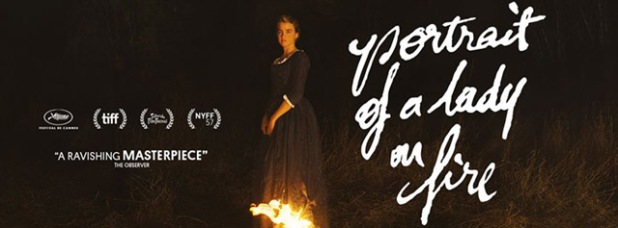
What is the movie about? :: The story is set at some time period during the end of the late eighteenth century. Marianne (Noemie Merlant) is a young painter who takes painting classes to her eager students. As she makes them paint her portrait, one of her students asks her about a special painting from her, which Marianne used to call Portrait de la jeune fille en feu. It takes us back to the origins of that particular painting, and the same has a close relationship with Marianne’s past and her emotional side. Once upon a time, Marianne was called to an isolated island in Brittany in the west of France, to paint a portrait of a young woman named Heloise (Adele Haenel) by her mother The Countess (Valeria Golino). Marianne struggles to reach there, as she herself, and the canvas falls into the sea on her way.

So, what happens with the events here? :: There, she meets Sophie (Luana Bajrami), a beautiful young girl who works as the servant to the Countess and her daughter. They become good friends, and comes to know that Heloise was at the convent, and was forced to come back to marry a wealthy Italian nobeleman because her sister had died, supposed to have jumped off a cliff. Now, this portrait is to be sent to that possible husband of Heloise as soon as possible. The Countess says that her daughter was not ready to pose in front of any painter, and so Marianne will have to pretend that she was someone who had come to accompany her during her walks, to get rid of her boredom. It seemed to be the only way for her, and Marianne started being friends with Heloise who arrived there. She also started observing Heloise enough to paint her in parts. But there will be more than just a painting that we will be having here.

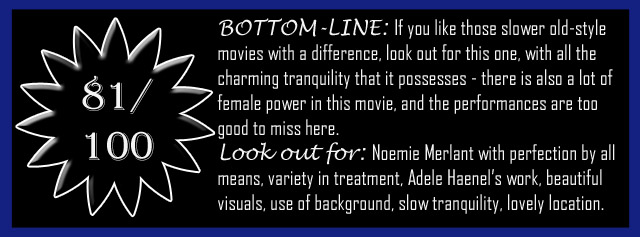
The defence of Portrait of a Lady on Fire :: There is some beautiful serenity that runs through this movie and its silence which serves more than anything else, as the main actresses really make a lovely impact with their expressions and body language itself, getting us immersed into this tale set in the late eighteenth century Brittany. The setting is incredibly beautiful, making you wish to make a visit, and one wonders where this particular island stands in history. This environment created as part of this movie is a charming one, but it is also a very simple one – it is not that usually colourful world from a grand historical past as we usually see in historical drama, action or thriller movies. We go through the eyes of an artist who is not just a painter, but someone with intimate feelings which she seems to have gained in connection to her work on the canvas – it reflects there as much as it shows up in her soul.

The claws of flaw :: Portrait of a Lady on Fire is a very slow movie, as you might have expected it from the talks about it, and also by what you have further read about the same. The movie also has some moments which are not utilized the best, especially related to the artistic work, the painting. The focus could have been more on that painting, and the artists feelings should have been above the person’s intimacy. There is also a lot of time taken in the beginning, and in between, which is felt more because of the movie’s slow pace. There could have also been some more characters to provide support, and this movie’s viewpoints are rather limited when you look at it. There is a lot of silence and a good number of dialogues, but there is less happening for the people who are looking for that as the thing which defines a movie – after all, this is close to being what you call the award movie in this part of the world. Two hours were not needed for this movie for sure.

Performers of the soul :: Portrait of a Lady on Fire is a movie nominated for Golden Palm, the highest prize awarded at the Cannes Film Festival, where it lost to the Korean Oscar Winner, Parasite, and so you know that this one had to score in its performances more than anything else. It has to be noted that all the main characters in this movie are female, and you see some men for that amount of time which can be better counted using seconds rather than minutes. The movie is that much dependent on its female characters, especially the two main ladies, with more to be added from a third young character, and a little more from the much older character who plays the mother. I haven’t watched many French movies, but Noemie Merlant is the one lovely actress who has come up with a perfect performance here which cannot be matched. She has been very expressive, and very much enchanting as the painter, closely followed by Adele Haenel who manages almost the same. Luana Bajrami, the next important character is done well, and Valeria Golino is there for less time, and does fine.

How it finishes :: The movie is not to be confused with The Portrait of a Lady by Henry James, as the title only has the addition of fire in the end, which might have been enough to prove its point. But people are more or less attracted into feeling that this is the same thing, and only the fact that this is not a British or American movie making them feel that this is something else. But the movie is not a lesser classic when you look at it, as it feels like an old-fashioned throughout its run. It is a slow-moving thing of charm, which makes sure that the moments are there to stay. Portrait of a Lady on Fire is more or less a feeling set in that historical period, and it has that delicate beauty with the realistic touch which is to stay for the beauty of tranquility, and not for what we usually remember a movie for. Portrait of a Lady on Fire takes you through the different, classic path.

Release date: 18th September 2019
Running time: 120 minutes
Directed by: Celine Sciamma
Starring: Noemie Merlant, Adele Haenel, Luana Bajrami, Valeria Golino
<— Click here to go to the previous review.

@ Cemetery Watch
✠ The Vampire Bat.
Descent into Darkness

Vampire Owl: Do you remember the famous quote which has been very much applicable to us?

Vampire Bat: There has been more than one of them that applied to us.

Vampire Owl: I am talking about the one which was regularly referred to, during our first few classes for vampire apprentices.

Vampire Bat: You are talking about one of those quotes about darkness, aren’t you?

Vampire Owl: Yes, it was also written on the first page of our vampire texts.

Vampire Bat: I didn’t realize that you actually read those books.

Vampire Owl: Yes, I read them when I want to sleep. Reading them gives me sleep at times when it evades me.

Vampire Bat: Now you are talking like one of those strange school kids.

Vampire Owl: Well, the quote was about the need for vampires to get into that darkness.

Vampire Bat: Yes, about descending into darkness.

[Gets three cups of masala tea with Arrowroot biscuits].

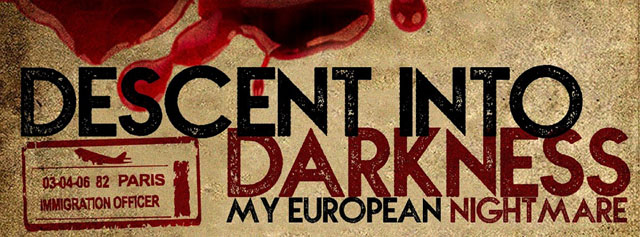
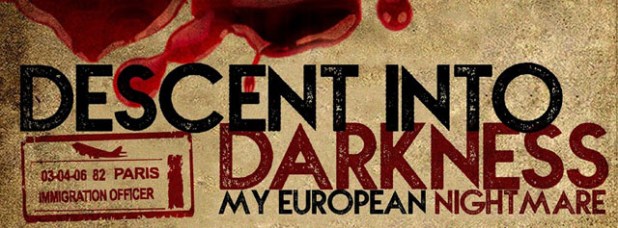
What is the movie about? :: Sorgoi Prakov (Rafael Cherkaski) arrives in Paris from an Eastern European country, to make a documentary about the European Dream, in the lines of the American Dream which is rooted in the Declaration of Independence, that proclaims that all men are created equal” with the right to life, liberty and the pursuit of happiness. In the beginning, his journey through the capital of France seems to be all going well, with wonderful places to visit and people being very nice to him. It seems to him that his European Dream is going to work so well. There seems to be happiness all around, and Paris seems to be the perfect place to begin his European Dream. It makes him believe that he has taken the right decision to go on this journey, and that things can only get better. But it turns out that it is the other way around.

And what is to follow in this particular adventure? :: Things were certainly not going to get any better for him, as there was always the chance for all going worse, with some bad decisions, and bad luck – being at the wrong place at the wrong time was just one of the villains. He does get beaten up by people who tries to steal his camera, which is broken, because of which he has to buy another one. He runs short of money, as he doesn’t hear from his producer, and has to adjust in many ways living in the city. He still thinks that everything is in control, but it turns out that not much remains in his hands. The artificial world of pubs and parties with drugs and alcohol adds to him being further away from the reality, creating one of his own, which includes brutality in his madness. His world changes, and he goes on becoming the exact opposite of what he was, bringing in a European Nightmare instead of European Dream.

The defence of Descent into Darkness :: The movie’s highlights come in the last few minutes, with the madness reaching a terrible level. The last scene at the house brings the best of them all. It deserves applause about how those scenes are managed in a realistic, but cruel manner. In the end, we realize how the world changes people, and the idea about hope is mostly that much of a lie, as this party culture with alcohol and drugs contribute to making a person worse through pubs and all their unnecessary additions to the life of youth. The performances are good, not just with the lead, who excels, the rest also follows up well even if they are only those smaller roles. The alternate title of the movie somehow reflects The European Dream: How Europe’s Vision of the Future Is Quietly Eclipsing the American Dream, a book, by Jeremy Rifkin. But in the end, we know that there is no big dream that can be achived by a common man all by himself.

The claws of flaw :: The accent used in this movie might feel a little difficult to understand for people at this part of the world at some points. There are moments in there which seems to be added for the sake of being there, or maybe to have the flick at a good length in totality. We also feel that the movie could have been really scary with its madness, and while some are surely part of the madness in a depressing manner, others are just funny – but it gets really better in the end. The dark humour is somewhat there, and the cultural differences might be bringing it down for our audience here. There is also the feeling of the need for more after we watch the trailer, and the expectations were surely bigger. The movie also misses out on having a memorable female character; even as the movie was based on one person in particular. Someone whom he meets in the city, maybe? Or someone whom he decides to murder?

The newfound love for the subgenre :: There are not many people who love to watch the found-footage horror around here, and I am myself a new person interested in the genre. When a found-footage horror movie can catch your attention, you know that it is going to get better for the genre here. There was The Last Witch being an interesting one made in low budget in the genre, and now there is this one. We remember the movies like Cannibal Holocaust, The Blair Witch Project, Paranormal Activity, [REC] and Cloverfield which were talked about a lot, with The Blair Witch Project and Paranormal Activity becoming the representations of the subgenre a lot. With this movie showing signs of some smart plans, maybe, we are awaiting more to come in the found-footage horror, and the best might be yet to come, as did horror with The Autopsy of Jane Doe, Lights Out and Don’t Breathe last year.

[Walks into the balcony with another cup of tea].

Vampire Owl: The strange things that humans do these days. Even Doctor Frankenstein is better.

Vampire Bat: Their control over their own mind and heart is rather questionable.

Vampire Owl: I am sure that most of these humans are already insane.

Vampire Bat: Well, they are better blood-suckers than vampires are, and they have proven the same with their wars.

Vampire Owl: There is the certainty of evil in them.

Vampire Bat: They possess inherent evil, and still call themselves to be of neutral alignment between good and evil, while holding that evil in mind.

Vampire Owl: I am pretty sure that they are more aligned to evil than our kind ever had been.

Vampire Bat: I would rank them with werewolves and dark elves, and at times with the zombies.

Vampire Owl: With their latest technology, they are already zombies enough.

Vampire Bat: Yes, more or less like your zombie minions.

[Walks into the silence of darkness].

Release date: 15th December 2017 (World-wide release on Amazon Video, POV Horror Roku, POV Horror Amazon Fire TV, and all Android devices)
Running time: 92 minutes
Directed by: Rafael Cherkaski
Starring: Simon-Pierre Boireau, Elodie Bouleau, Rafael Cherkaski, Roland David, Charles Dhumerelle, Xavier Kerf, Corentin Koskas, Denis Larzilière, Loïc Lefebvre, Philippe Pasquini, Omar Salim

<— Click here to go to the previous review. Movies of the Soul recommends Thor: Ragnarok as the movie not to be missed this year.

@ Cemetery Watch
✠ The Vampire Bat.