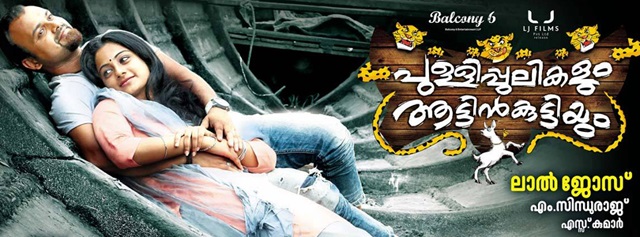
Pullipulikal and Aattinkutti

pullipulikalum aattinkuttiyum )

This is the season of the Malayalam movies, and what these movies have done with the help of Chennai Express, to keep the English movies away from the theatre is quite dissappointing, to be honest. The typhoon of Malayalam movies started off with Kadal Kadannu Oru Mathukutty, followed by Neelaakasam Pachakadal Chuvanna Bhoomi, Memories and Pullipulikalum Aattinkuttiyum. I am not in favour of such a week boasting the absence of the new English movie releases, at a time when they do get released in other countries. But as I know that there can be a great next week, and all the Malayalam movie titles are interesting enough, that should solve the problem up-to an extent. There is no surprise about so many movies releasing during the Eid after a long season of drought, as the people have already rushed to the multiplexes as well as the local theatres for these movies, and the malls, or at least some of them are so crowded that the Vampire Bat had doubts if there were free Blood Biriyani being supplied there. There is also the signs of the local theatres taking the effect of these new multiplexes, as the difference in the rates of tickets has become considerably small. We had such an option, and we had to choose the multiplex – there is the shift of the balance of power.

Literally translated as “Leopards and the Little Goat” had the first signs of vulnerability and a display of what kind of audience they were targeting, with their first promo in the theatres, which had a cartoon involving three leopards, one goat and a bull. Who are the people representing these characters, is something which should be revealed with ease as one watches the movie. Its target of the family audiences has surely been achieved with this one, but the question remains if it has achieved exactly what the movie lovers wished for, and another doubt would be about its power to match the other movies from Lal Jose – in that case, this should be closer in significance to Immanuel. Otherwise, this is a little bit of what should be termed as Elsamma Enna Aankutty meets Marykkundoru Kunjaadu at Kuttand setting, with a weaker second half and a forced ending. But it is not to be denied that the movie is fun, and the first half is close enough to a laugh riot. With the beautiful settings at Kuttanadu second only to Amen, and the melodious songs score to make all the absences transform into some kind of presence, and keep the viewers attached to the world of backwaters.

The movie set in the rural area of Kuttanad centers around one hardworking youth who tries in vain to pay off his loan to the bank by running a houseboat which he might lose in case of a failure to pay the same. Chakkattutharayil Gopan (Kunchako Boban), in short – Chakka Gopan a.k.a Aadu Gopan, is the goat-man as he is widely considered to be for his beard resembling a goat. There was that character in the movie Nee Ko Njaa Cha, and an allusion to that one with a background sound of the goat might help to figure out this appearance of our hero. This is the protagonist who gets beaten up almost every day due to the bad deeds of his three big brothers, as well as his own little problems. There comes the similarities with Marykkundoru Kunjaadu, and its just that this time, the protagonist is not lazy, and can beat a few people up rather than getting beaten up all the time. He has to feed three of his brothers and mother, as well as make sure that he earns enough to keep his houseboat floating. The three brothers are the type of people who takes money even from him to keep him safe, and they never miss an opportunity to take money from others or even lie, cheat and steal. The feeling of Elsamma Enna Aankutty also runs through, but more as an invisible force. But the fact remains that all the three movies were those which I liked, and therefore, there is nothing negative out there other than a little absence of innovation.

Along with dealing with his own lazy bully brothers and attempting to pay off his loans, Gopan faces the problem of not being able to attract enough tourists to his comparatively inferior houseboat, and asks the help of Mamachan (Suraj Venjaramoodu) for some attraction which could bring in more foreign tourists. The result comes in the form of Kainakari Jayasree (Namitha Pramod), a Mohiniyattam artist. With her assistance and also with the help of Suseelan (Harisree Asokan), his problems seem to get solved until his path crosses with that of Kavalykal Kuriyachan (Shammi Thilakan). While attempting to deal with his brothers’ unruly life and his love with Jayasree, he also has to deal with the rich businessman who seeks revenge on Gopan. At the same time, he comes up with some plans to deal with his brothers as well as to keep his love with Jayasree. Even as his and Kuriyachan’s path rarely crosses each other directly, there is always the unexpected harm that he would seem to give the man who would go on to become the villain whom he himself has to deal with, not as the goat which runs away, but as the super-goat-man if such a thing exists.

Kunchako Boban has come up with the comedy avatar again, and that should satisfy most of the fans. With his new looks and style, he has done complete justice to his role, and carries the whole world on screen with his shoulders. Namitha Pramod is also that good as Kainakari Jayasree, and never manages to move away from the character. It was nice to see her character, the other dynamic lovable one along with the character of the protagonist. Suraj Venjaramoodu and Harisree Asokan handles their own familiar territory with so much ease. We have been missing this Suraj for sometime, and the latter uses his home base of comedy to the efficiency of the movie. The three brothers might have carried on the legacy of Marykkundoru Kunjaadu‘s brother, but one might still miss Biju Menon. Shammi Thilakan’s Kavalykal Kuriyachan is a fine villain indeed, but not the scary, evil Satan or the one who sold his soul to the Devil, for he is the villain of circumstances, and the result of the people knowing about his own villainy. But the fact remains that he rises to this discovered throne of bad guy, and continues to do what he did with a mask, without any visage of artificially created vanity.

The movie’s success as a comedy movie is beyond doubt, and even with its lack of flow in the script, and an ending which was rather thrown into the middle of things, there is the beauty in simplicity, and the eventual victory of goodness portrayed without being preachy or pretending to be highly virtuous. There is the beautiful portrayal of nature which joins with the melodious songs to keep it working towards the end. The messages about the importance of goodness, hardwork and belief in oneself is asserted throughout the film in one way or the other. Marykkundoru Kunjaadu had the same, but some people just noticed the fear element in it. This movie is more logical in that case, making an attempt to touch the soul with a central character who is more useful to the family as well as the society, caring less about himself. He is another Elsamma in that case, and even his love interest is not of less significance in many ways. There has been an overflow of similar themes in the past, and this movie also reflects the same in such a way as to make an impact in a path more travelled. Whether it has made a difference or not is a question yet to be answered, and until now, the future looks bright enough for this goat-man and his own leopard people of the family.

This is recommended for those who loved Elsamma Enna Aankutty and even more recommended for those who loved Marykkundoru Kunjaadu, and even those viewers who loved both of these movies a little, might find this one impossible to run away from. Nature has been a great redeemer, and for some, there is music; for the missing laughter, the others need comedy. This movie has got them all, but while looking for the logically awesome movie with a great bowl of completeness delivered as a result of the horn of plenty, there is that awkward movie of detest. But, it is highly advised that such a cornucopia is not expected in the case of this movie – Amalthea, goat and nature; something should relate, but the release of Plenty might have served as nothing less than a Pandora’s box in the case of such a movie. Therefore, lets forget the little strange things which might give the indigestion of logic fed to your brain, and enjoy this movie for the little beautiful things it got, and flies directly to the heart. The movie shall win its battle with the titles which got bigger names associated with the cast, not by much, but by what is enough to make the lamb-sheep-goat-characters live on with their goodness, lack of violence and a certain amount of love which takes its own toll on the characters.  Meanwhile, the title of this review has been adjusted to make it short – kindly don’t feel strange, for it is Pullipulikalum Aattinkuttiyum indeed.

Release date: 9th August 2013
Running time: 140 minutes (estimate)
Directed by: Lal Jose
Starring: Kunchako Boban, Namitha Pramod, Shammi Thilakan, Suraj Venjaramoodu, Harisree Asokan, Shivaji Guruvayoor, Anusree, Irshad, K. P. A. C. Lalitha, Bindu Panicker, Reena Bhasheer, Thesni Khan, Seema G. Nair, Ponnamma Babu

PullipulikalumAattinkuttiyum copy

@ Cemetery Watch
✠ The Vampire Bat.

Red Wine

redw

This wine is not that powerful as a thriller even with its moments of suspense, as the killer is kind of known right from the beginning itself – there is still a possiblity of expecting more twists over twists, but there is none in the end. The movie progresses slowly, unlike the traditional thrill infected flicks. Still, it has a beautiful philosophical touch and an embedded social message. The movie is surely worth watching for the performance of the leading actors, especially Fahadh Fazil & Mohanlal. There seems to be no stopping the former from his awesomeness and the latter proves why he is still considered to be at his best. The support cast has also been significant. A routine investigation movie is told in a different way this time. It is supported by another experimentation with its narratives without losing its simplicity and the path towards goodness. This can be hailed not for the chills and thrills, but for those who can make a philosopher’s stone out of the darkest and the dirtiest of metals, this might be something else.

Mohanlal’s Assistant Commissioner of Police reminds more of the cop from Grandmaster than anything else. This time, the police officer is even more philosophical. He is not a person who look for action all the time, but a slow and steady officer who understands both the victim and the murderer, and knows with ease that both are the victims of circumstances, one of his own ideals of truth, justice and equality which is despised by the land mafia, while the other of his evil past and the need to pay off his loans. He understands the complicated human minds just as the Wayanad’s twists and turns on the way up. The movie is shot at Wayanad and Kozhikode, and the stories of the subaltern of the heights of Wayanad and that of the opposite side of the evil from civilized world also creeps in. This is where Mohanlal’s character has his magnificience – to balance the characters from both sides, pure good, righteous good, forced evil and pure evil, all of them making frequent appearances as significant parts of the movie at parts. He understands the two men he is searching for, as well as the ones he is not directly searching for, as he progresses through his investigation.

Fahadh Fazil carries the movie with such an ease which makes the whole movie a simple, poetic experience. This is very unlike his performances in his recent flicks – there is no strangeness like in Annayum Rasoolum, Chappa Kurisu and Natholi Oru Cheriya Meenalla; there is no shades of darkness or even greyness as in 22 Female Kottayam; or that confusion and uncertainty of life as in Diamond Necklace and Friday. Here, we have a good man, of only good intentions towards the fellow humans, and with the desire to do good to the society and his people. He is an Engineering graduate who passed out of college with good marks and was good enough to get a fine job with an attractive salary at home or abroad. But he chooses to work for his people as the Local committee secretary for the left. His portrayal of the victim Anoop has given the audience his most lovable character ever; that is one character on the side of pure, unadulterated political man who stands between the modern and the traditional world, having the elements of both, in such a way that he stands between the two, understanding and interpreting both with significant ease.

As the movie revolves around the life of three characters, one can’t avoid not fail to sympathize on the third important character, played by Asif Ali. Even as he is the least likable of the three and has less time on the screen, Ramesh is a character of circumstances. He is not someone who is a remorseless man of pure evil like Django. He is not for the depths of hell nor the upper most of firmament. His life is not to be seen separate from his wife Deepthi, played by Mia George. Both of them blends into their characters well enough, and more of the sad situation is conveyed more through their looks and expressions rather than the words. This is that part of the story which is more touching in terms of a common man. Ramesh is a man with an evil past, who has turned good after marrying his lover who is from a rich family, which has lead to their isolation from their relatives. Now, as Ramesh has taken loans over loans, this is his moment where he has to choose between the good which is poverty and the lack of provisions for his family which would soon include a newborn child, as well as the evil which is security of good life for his loved ones. There is choices for him to make and whatever choice he makes, there would be a payment in blood or cash.

Well, the human life itself is like that road to Wayanad, and all these characters fit into those twists and turns. For some of them, death might be the relief and for the others, life is all that matters. Where heaven and hell fits in between them is a matter of debate, in the life which is mixed with so much of good and evil. The strength of the movie is still its cast and their performances. Meera Nandan, Meghna Raj and Kailash comes in smaller roles, as a skilled drama actress, an RDO and a cyber cell officer respectively. Meanwhile, Saiju Kurup comes up with an inspiring performance as the protagonist’s friend Navas. The debutant Maria John and Anusree also fits in, as the lover and the best friend of the protagonist. Suraj Venjaramoodu has a more serious role to play in this one, as the one who benefit the most with the protagonist’s death, a person with hidden agendas, another suspect for the investigating officer. T. G. Ravi has another lovable character, a righteous socialist worker of the party who earns the respect of the viewers right from the beginning. Still, the one who steals the show is Fahadh Fazil, and he seems to do that with such an ease that surprises the audience.

The way in which the movie is narrated gives it more life in spite of it being slow and ordinary in the first look. There is regular breaking of narratives, not in space, but in time – from the death of the protagonist to the life of another man to the progress of the investigation and then back to the protagonist’s ideologies during his lifetime. The space changes, but is still confined to Wayanad and Kozhikode. The movement is like wine poured out of the bottle, some of it which goes into the bottle, some of it to the floor, a little of it in the table and the remaining in the bottle. This is the philosophy of life, for not all can be the same, physically, intellectually, or spiritually. To be frank, the choice to go for this one ahead of 3 Dots and Amen was a big move. It was more for the love of the title and the image of the red wine in the bottle. No, it won’t replace the everlasting image of tea as the elixir of life, nor does it make a substitute for blood. The question would be about what the red wine symbolize and why is it the title of the movie. I have always been interested in the colour, my third favourite after black and blue. It is the colour of blood; that of all the martyrs and saints who died for the mankind. It was also used in the Roman and the Byzantine Empires, such was its honour. What about St George’s Cross and the Red Cross?

The human life has always been full of the colour red, also associated with, revolution, love, socialism, communism, passion, beauty. Lets leave its negative associations for this instance, for this one is everything except pessimism. The red wine itself is a symbol of humanity and their blood in a glass. Does this also symbolize the sacramental wine, the blood of Jesus Christ, for the blood of a modern age revolutionary which was to be shed? They were shown drinking the red wine and they were also shown talking about Christ being the revolutionary, and therefore this chance is surely there. The Red Wine is no Spirit; for it doesn’t glorify drinking or anything in the first half and oppose it in the second half; it sticks to its points – of humanity, right from the beginning to the end, for the red wine symbolizes the blood of a young, educated revolutionary which was shed as he stood for the righteousness. That makes a valid allusion and a wonderful imagery. Red Wine is not your typical murder mystery, for it is a philosophy; not a psychological thriller; never a supernatural thriller, as this one is of another genre and I would like to call it a philosophical thriller. If this was more powerful as a regular thriller, and if it could have conveyed the philosophy better, the movie would have been awesome, for sure.

Release date: 21st March 2013
Running time: 140 minutes (estimate)
Directed by: Salam Bappu
Starring: Mohanlal, Fahadh Fazil, Asif Ali, Saiju Kurup, Jayaprakash, Mia George, Meghana Raj, Anusree, Maria John, Meera Nandan, T. G. Ravi, Suraj Venjaramoodu, Kailash, Anoop Chandran

redwine copy

@ Cemetery Watch
✠The Vampire Bat.