Diamond Necklace

diamondnecklace (4)

As they say in the movie Neram, there are two types of time, the good time and the bad time, and the good time of Fahadh Faasil had started from Chaappa Kurishu, with no disasters at the box office moving on to Immanuel. I didn’t really like what came later though, but as we know already, another thing about our versatile actor is that we can often identify his career with the quote from Charles Dickens’ A Tale of Two Cities too; “it was the best of times, it was the worst of times” and I would identify the same with his other movies, Annayum Rasoolum and Natholi Oru Cheriya Meenalla. Yes, Diamond Necklace was part of the good time, or the best of times, and it was the best from Lal Jose, no real doubt about that unless you bring Achanurangatha Veedu, Classmates or Arabikkatha into the picture with a handful of logic. Does any of these movies have this simple a plot set in too simple a world, and still come up with such an intriguing situation on screen? No, they were movies of incidents, revolving around one major incident or decision which set the events running while Diamond Necklace belongs to everyday life, and a collection of life; its celebration as the worlds of ups and downs which flows through our life, supported by beautiful songs, “Nilamalare”, “Thottu Thottu” and “Nenjinullil”.

Arun Kumar (Fahadh Faasil) is a docor who lives in Dubai and leads a life of luxury, supported by his wallet full of credit cards. He has no regret about the past or worries about the future, as he lives in the present, spending money lavishly with nobody to stop him from doing the same. His friends belong to higher league, and he shares apartment with his friend in the tallest buildig in the middle east and the world, Burj Khalifa. Savithri (Rohini), his boss in the hospital also seems to spoil him with her sisterly affection, but she is also unaware of how much of a debt Arun is putting himself into. He has acquaintances with labourers from Kerala, especially Venu (Sreenivasan) whom he tries to avoid in his stylish, high quality life which has no place for the lesser people of lower social status, even as he is still friendly with all on the outside. Driving the latest cars and enjoying life to the maximum, he meets Lakshmi(Gauthami Nair), a newly recruited Tamil nurse in his department. She is the first girl to whom he is seriously attracted. She had come to the middle east with a dream of making enough money for building a hospital in their village, so that no more people have to die there for having no facilities or money. Arun is impressed by her wits, attitude and dedication towards work.

Even as their relation blossoms, his chances of going through with it receives a serious blow, as he runs out of money and his car is towed away by the creditors. He is left with no way to go home and see his sick mother as the credits keep him in the country. He is helped by an influential man, Narayana Menon (Maniyanpilla Raju) who makes it possible for him to go back to Kerala, but at the same time, he is tricked into marriage with Narayanan’s niece, Rajasree (Anusree) who is a simple village girl who has absolutely no clue about city life nor life outside Kerala. Even as they are thought to be a rich family, Rajasree’s world is later known to be a small and simple one, not enough to pay back even a percent of Arun’s credits. When he comes back to Dubai, he is left with no place to stay, and as he doesn’t have enough advance to pay for any place, he stays in the labor camp with Venu. Lakshmi who comes to know about his marriage, ends their relationship and refuses to talk to him. Maya (Samvrutha Sunil), a relative of Savithri, is a fashion designer who was diagnosed with cancer, with a wish to start a boutique in Dubai. Her fiancee had left her due to her illness which had left her highly depressed. Arun ends up sharing her apartment and becomes very close to her.

Later, when she sees Rajasree with him, she is shocked as she didn’t know that he was married, and is admitted in the hospital. It leaves Savithri with lesser affection towards him. As he gathers her possessions, he notices a diamond necklace that she keeps with her, something which can save him from his problems. He decides to replace it with a fake one and does the same successfully. This is where the whole situation revolving around a necklace arises, as his wife finds the original necklace and wears it thinking that it is a birthday gift from him. Meanwhile, Maya almost dies due to an overdose of medicine. He is unable to get the necklace back from his wife who has shown the same to almost everyone including her foul-mouthed relatives of vanity. He often feels that he should return it to Maya and he can’t, and neither can he sell it. Caught between the worlds of greed, remorse and helpless, the only people who are with him consists of the simple labourers whom he once avoided. So, the plot still revolves around the ladies in his life, and how Arun comes out of this problem, not with any deus ex machina or a huge twist of fate, but rather with the simple things being the result of everyday happenings and common feelings makes the whole of the story. The artificial stuff has been kept out for good.

So, here is Fahadh Faasil showing his abilities as a versatile actor, moving away from the new generation trends of Chaappa Kurishu and 22 Female Kottayam, but coming up strong as an energetic youth who symbolizes the common young man of the century, with the usual attitude of “I will drink Life to the lees” which was said by the protagonist, the Ithacan king and the Greek hero, in the poem titled with his own name, Ulysses, by Alfred Lord Tennyson. That suspected hedonism in the face of our inescapable mortality found in The Rubáiyát of Omar Khayyám, the Edward FitzGerald translation, going back to the eleventh and the twelfth centuries has found ever increasing rhythm in this generation, but without the octopus hand of death and the ultimate end. “Carpe diem” as they can still say, from our own most mentioned ancient poet, Quintus Horatius Flaccus, known to most of us as Horace – “Seize the Day, putting as little trust as possible in the next day”, an idea which has developed into a liefstyle with loose morals leading to a life of unimaginable pleasure among the new generation. Epicureanism has made a more powerful entry to the new world, and as a kind of hedonism finding pleasure as the only intrinsic good, there is a new environment which is powerful and fast spreading. These, as I have already mentioned in my review of Spring Breakers, symbolizes the character Fahadh is playing in this movie.

But what does this hedonism, the power of “Carpe diem” bring to him? Does this help him to seize the day? Yes it does, but those days become long gone. I agree to the fact that we are all kind of hedonists in one way or the other, varying only in the degree. But considering the current world and the environment to which we are exposed, something which stays within the limits can rarely be interpreted as hedonism. But our protagonist belongs to the higher degree of “Carpe diem” as he puts as little trust as possible in the next day, as a man who is exposed to all the luxuries of the magical world of the city of Dubai, powered by oil, and highly influenced by modernity and science rather than antiquity, history or literature. For a man who comes the humble backgrounds of a small village, this might have been a big moment for him, being in Dubai and earning so much. It is evident in his relations with the labourers whom he consider as lesser people. But soon he realizes that they are the ones who are there to help him without asking anything in return, and it is his time to live like a common man rather than a hedonist, and live his life of responsibilities. Such a realization is supported by a beautiful ending which makes sure that his world remains one of beauty and goodness rather than crookedness and money. The movie itself is a message against irresponsible hedonism, and a support for unconditional love, responsibility and equality.

Once again, Fahadh Faasil is the man to watch out for, and I guess there is not much need to talk about the same, as it nothing unexpected. Samvrutha Sunil has a powerful role and she has done it with lots of life. Gauthami Nair makes a strong impact as the determined, powerful character. Anusree’s role is worth a lot of acclaim, and the funny moments come from her character’s stupidity, and still the goodness and love that the character exhibits makes this one quite a beautiful portrayal. Rohini and Sreenivasan have to play the roles of two seniors in the life of the protagonist who lends him advice and helping hand, and they form the world of light and goodness in his life. Diamond Necklace relates to its viewer with its tenderness and its high dose of objective correlative; with a reigning simplicity and reflections of the common incidents and random life events. It is the Malayalam movie of the year 2012, no matter how much anybody tries to prove that it isn’t. Also look out for the cinematography by Sameer Thahir; about our director Lal Jose, there is nothing more to say other than making a call to watch the movie. This was a movie which came into the theatres, disappeared, and came back again; such is awesomeness of this movie, even as only a few people recognized it during its first run, and myself came across the same during its comeback run in the local theatre.

Release date: 4th May 2012
Running time: 157 minutes
Directed by: Lal Jose
Starring: Fahadh Faasil, Samvrutha Sunil, Gauthami Nair, Anusree, Rohini, Sreenivasan, Maniyanpilla Raju, Kailash, Sukumari, Thesni Khan

diamondnecklce copy

@ Cemetery Watch
✠The Vampire Bat.

5 Sundarikal

5 sundarikal1

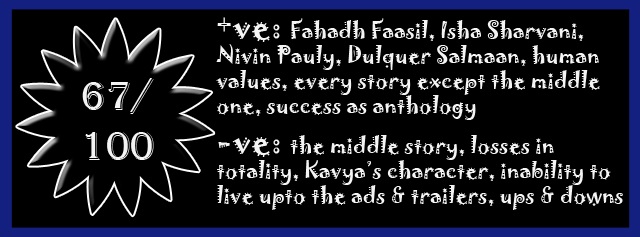
5 Sundarikal which can be translated as 5 Beauties, is that romantic anthology film which might have had its existence to thank the 2009 anthology movie Kerala Cafe. There were ten stories in that one and here it is cut to half with five, and only Anwar Rasheed doing a story in both the anthologies. The Vampire Bat would not agree to the title though, as it would be left to him to say which one is the beauty and which one is the beast. The only suitable title would have been 5 Females, and fighting with three other movies which has interested the crowds, even the name of a movie has to add to the total interest generated. Even in my case, this is the first time I get a Malayalam movie with a Malayalam name to review, and the “5” is to be read as Malayalam “anchu” and not “five” as far as I know. Watching stupidity like Raanjhanaa is clearly out of the equation and this movie having five stories instead of one increases the probability of getting at least two good ones; so there is no doubt which Indian movie one is supposed to go this week. There is the power of five compared to the power of six in ASK a.k.a Aaru Sundarimaarude Katha, and the obsession with beauties continue, this time with more success, and one beauty judged less is always the truth gained further. Whether it should be “sundarikal” or “sundarimaar” is a question to be asked to satisfy the quest to find grammatical errors, and I would go with the former.

Sethulakshmi: directed by Shyju Khalid :: [59/100] :: No, there isn’t going to be a total score based on the average of these stories, as that should annihilate the purpose of this movie as an anthology as well as this review as a subjective reality. There would be separate worlds for each story and for the movie, there would be another reality of totality, to which this simple story adds on first coming as an adaptation of M. Mukundan’s short story, Photo. The story of two school kids is shown in its own natural innocence until their world-changing event happens. The simplicity turns itself into the tough theme which the story has to deal with, and that is the place and may be where it scores. There is the depth of evil portrayed in a way that will haunt one with innocence. But the question remains if this belongs to this movie, as the presence of a beauty or even pseudo-beauty here itself negates the need for this story in the movie and all the purpose it would have served, and however one tries to look at this, a more deserving platform for this one would have been Kerala Cafe, and might have been the second best story in that movie after Anjali Menon’s Happy Journey. It is kind of misplaced here, and this might have been added here to arouse the curiosity of the viewers as well as to create that new generation element – otherwise this among the other stories is like Roger Federer guarding the goal post for the Spanish national football team.

Isha: directed by Sameer Thahir :: [79/100] :: Along with the former one, this story also has the scope of becoming a one and half to two hours of good cinema. It stars Nivin Pauly as the thief a.k.a the Santa, and Isha Sharvani who makes her debut as the beauty of this segment, and undoubtedly the smartest and the most charming of them all. They start off as two strangers and with many things in common, and the question would be what they end up to be, and that is the surprise, that twist of plot which raises the story from its existence just inches about the average level. Nivin Pauly has remained similar to what we saw in Thattathin Marayathu, as this time he has another Isha, Isha Sharvani instead of Isha Talwar, another lady from the North, and this female lead does a lot more than the other one did. This story and what is to follow are the only two segments which are actually centered on the beauties, and this is the only segment in which the beauty is in control and remains so throughout most of the story. One has to say that this one has the best of the lighter moments too, and the claps which came after this segment are well deserved. The whole story is centered on the two leading characters, and there we see the most beautiful lady and the one romantic hero; they make this work like nobody else could have.

Gouri: directed by Aashiq Abu :: [10/100] :: This is the weak link in the whole movie, and without this, the movie could have been declared the best anthology in Malayalam movie industry ever. This is Aashiq Abu’s worst so far, and from what we have seen of him already, it might remain his worst. Biju Menon is there as the husband with nothing to do that really matters to the story. Tini Tom and Rimi Tomy makes an unnecessary visit, as Kavya Madhavan who plays the wife expresses her need to have a kid. Kavya is there as if she is to be that strange character who is more unsure about herself and the world around her than Popeye without his spinach. Jayasurya also makes a small appearance thus making this one the most powerful segment in terms of celebrity power, but in performance, it is a dynamite of the next generation which failed to blow. This is a painfuel half an hour of torture, which could have been avoided or may be replaced. It is surprising that it came from the same director who gave us Da Thadiya in the same year. This might even make Estragon and Vladimir say that there is something to be done – sorry, Samuel Beckett. Kammath and Kammath and Lokpaal were not that bad now, as you go through this one. This story in the middle shows us the middle finger, but fortunately it was preceded and followed by brilliant segments.

Kullante Bharya: directed by Amal Neerad :: [84/100] :: This is the moment which strikes you hard. Amal Neerad has come up with a story which is narrated by Dulquer Salmaan who sees everything from the top floor of a group of apartments. The awesome presentation and the story’s ability to relate with the contemporary society of Kerala, and may be even India as a whole, has helped this one to get the most claps in the theatre, and remain the highlight of this five star experiment. Dulquer Salmaan has eased through this segment, and even as a person moving on wheelchair, there is so much of impact with every word he says. Reenu Mathews leaves an imprint without even a word said. The newcomer Jinu Ben brings tears to the audience with no direct revelation. The story also works as a satire on the self-proclaimed righteous, highly moral society which considers itself as the role-model, and has a lot of prejudice against the people whom they are not familiar with, and those who think or act different. If there has been so much interest in this story which has only one actor who has performed in a leading role in more than one movie, it shows how much impact this one has created, and how much it could relate with its audience.

Aami: by Anwar Rasheed :: [61/100] :: This might be the most awaited story of the movie, with a businessman, Ajmal (Fahadh Faasil), who travels from Malappuram to Kochi and vice versa. His too much affectionate wife who is known only by her nickname (Asmitha Sood) keeps asking tricky questions to him and leaves him puzzles to solve – a strange abnormal habit, to which anybody would agree. The night journey then transforms into something that changes his life. The presence of Honey Rose and Vinayakan just adds to powerful cast of this segment which is already the talking point due to Fahadh Faasil’s presence and his new looks. It is him who excells in this story, and everything else is a little let down. With meaningless puzzles and strange happenings, this is not something which the viewers can relate with, but thanks to the leading actor and some interesting dialogues, this one lets the movie with its head held high, not annihilating the world which was created by the second and the fourth segments. As Fahadh Faasil fights extreme anger, greed for money, violence and his own old relationships and gets back to his beloved, the whole thing ends happily. This is surely better than the highly predictable Bridge segment in Kerala Cafe by the same director.

The movie is that roller coaster ride of Final Destination 3, in which death tries to pull the movie down, as some of the stories lose charm, and suddenly a story comes up which changes the things around. It is the advantage of having five different stories directed by five different people, and this is well done, and it would live on as long as this theme doesn’t come up with a overdose, either with the stories or with the concept of pseudo-beauty. To be frank, there is nothing in this which binds this collection together, as same was the case with Kerala Cafe, and it doesn’t give that much of anything that Cloud Atlas gave its viewers. This movie uses the concept of enchanting viewers with its title and the trailer, and tries to undo the failure of Poppins which had its own wrecked set of anthologies in which only the story of Kunchako Boban and Nithya Menon made any impact, with Indrajith-Padmapriya and Jayasurya-Meghna stories staying there not without troubles. Still, the question remains, who is the beauty? If they were all eligible for the same title, won’t they be good enough for that word which comes as just the opposite? Why would we be forced to believe with that willing suspension of disbelief that they are all beautiful? Will Isha Sharvani and Kavya Madhavan look like beauties to two people who have different concepts of beauty? Even myself is clearly sceptical about the latter; but leave that for the intellectuals, and concentrate on the medium for now.

Release date: 20th June 2013
Running time: 145 minutes (estimate)
Directed by: Amal Neerad, Anwar Rasheed, Sameer Thahir, Shyju Khaled, Aashiq Abu
Starring: Isha Sharvani, Asmitha Sood, Reenu Mathews, Honey Rose, Kavya Madhavan, Baby Anika, Nivin Pauly, Dulquer Salmaan, Biju Menon, Fahadh Faasil, Jayasurya, Master Chethan, Tini Tom, Rimi Tomy, Jinu Ben, Vinayakan

5sundarikal copy

@ Cemetery Watch
✠ The Vampire Bat.