
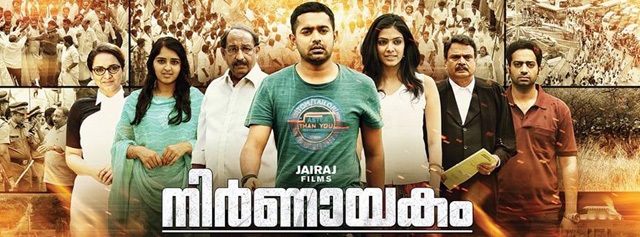
Nirnaayakam

nirnayakam (1)

Vampire Owl :: Do you know that I am still officially missing?

Vampire Bat :: Yes, it is actually the only thing that everyone clearly knows about you right now. Some people still say that you are dead. But I haven’t really believed it yet.

Vampire Owl :: Forget it; people are just crazy, especially the Vampire Crocodile and his long lost Ramesh-Suresh 5 Star brother, the Vampire Alligator. I have connected to you through telepathy to let you know that I can’t be here for this movie.

Vampire Bat :: Yes, everybody knows that already. When was the last time you were there for a Malayalam movie for first day first show? Seriously, you will only go for Bollywood and Hollywood these days?

Vampire Owl :: But I was planning to be there for this movie called Nirnaayakam which is supposed to be something special with a certain amount of social relevance.

Vampire Bat :: I thought you were looking forward to watch Premam instead.

Vampire Owl :: What did you just say? I don’t like such words. I declare them banned. No love stories for me in this life until further notification.

Vampire Bat :: Well, I thought so. And we can’ t watch Lukka Chuppi because it has too much of drinks, as it seems in the trailer. No romance, no drinks, no smoke – it is being recommended to be the next vampire policy against watching these sybaritic movies from humans.

Vampire Owl :: Humans will still watch them, but let’s go for those movies with social relevance then. You should go and watch this and movie and let me know more about it when I establish the next telepathic connection.

Vampire Bat :: Or may be you can use a mobile phone.

[Cuts the connection].

What is it about? :: Ajay (Asif Ali) is a young man who always wanted to be a soldier, even though he was never a person known for his courage. In the end, when he is going through the training at National Defence Academy, he decides to quit as he feels that it is not his purpose and can’t do it. As he returns to his home at Mysore, his father who had left the family long ago, calls and asks him to visit him as his health is pretty much bad. So he returns to Kerala for meeting his father, as he also feels that the change will only do him good. There he understands that his father is suffering from cancer and needs a bone marrow transplant from him. Another thing that he understands is that his father who is a lawyer has been working on a case which would do big changes to the life of the common man.

The defence of Nirnaayakam :: There was a definite opportunity to make this one a megalith among the stones even though it is not really taken. The social drama and the commentary do the work of the paladins of this collection of elements. They are the conquistadors of the heart and mind of the audience in the battle meant for vanquishing the rest of the material in the journey. The moments in the court remains the highlight of the movie, and there was the need for more of the same. When we realize where we are heading to, things get more interesting. The climax is nice, and the arguments are well done. May be the focus could have shifted to the social side rather than keeping it personal for too long – the movie’s genre should have been social drama or social thriller, and it was to be the cornerstone all the time instead of its late arrival here.

The claws of flaw :: Nirnaayakam‘s social message comes very late; we keep waiting and waiting, and by the time it arrives, a quarter of the second half of the movie had finished. The family drama is some real pain, and completely fails to connect with the audience. The romance is lost in the eternal abyss of hopelessness. A complete dose of social commentary which can keep running through full movie could have done the flick a lot of good. The socially relevant content should have been right there at the front rather than taking the backseat throughout a first half which fails to impress. It is a tiresome journey, and the end results might not be enough for some people. These are the reasons why the audience can question this movie, but they surely cannot doubt its intentions.

Performers of the soul :: Asif Ali remains strong throughout the movie, and he does make one feel those emotional moments closer and with depth. His direct influence on the strong point of the movie, the court-room drama is rather less though, and that denies him any gargantuan moment in the core of the movie, which is rather unfair. But the paramount skills of the veteran actor Nedumudi Venu comes to rescue there as he steals the climax, and Sudheer Karamana gets his chance with some nicely written lines. I would also like to add that Malavika Mohanan has improved from her disaster which was Pattam Pole; even in a smaller role, she leaves a mark as the heroine even though romance is dead in this movie – the Vampire Bat acknowledges that she is very pretty. Prem Prakash gets a fine role which he manages with efficiency. Rizabawa, Saiju Kurup, Ashokan, Sanusha Santhosh, Lena Abhilash, Hemanth Menon, Shanker Ramakrishnan and a lot of others can be seen in smaller roles.

Soul exploration :: It is the early reluctance in treatment of this subject of relevance that makes the soul go weaker in this movie. Even when this movie gets lost in the meaningless family drama, there is the hope for that social drama which is expected to come at any moment. We are given a chance to look at what happen with our lives due to the politicians getting the special treatment, and the police as well as the administrative service allowing the same. When the rich and those in power gets special treatment, the common man has less value. The story of the movie focuses on the incdient when a girl dies because she couldn’t get medical care when needed, as a political leader’s procession block the city and causes a heavy traffic congestion. The core of the movie which comes around in the second half deals with how the common people get the verdict in their favour.

How it finishes :: Nirnaayakam‘s trailer was interesting, and it gave the feeling of a thriller coming up with something of high social relevance and leaving behind a message, but in a number of sites, it is mentioned as a family drama or even romance which twists its case. There is a lot of court-room drama promised in the trailer, but the action there is also limited, and the romantic side is like now you see it, and then you won’t. Caught between its confusion of the genres, Nirnaayakam does fail to focus on what was its strength of Brobdingnagian proportions, the social commentary – the perfect opportunity to gain the support of the normal audience who were to give this movie all the needed support on the very first day is not really used. But still, if you are judging a movie by its intentions, this one has the heart and soul at the right place.

Release date: 5th June 2015
Running time: 112 minutes
Directed by: VK Prakash
Starring: Asif Ali, Malavika Mohanan, Tisca Chopra, Nedumudi Venu, Adil Ibrahim, Prem Prakash, Sanusha Santhosh, Lena Abhilash, Sudheer Karamana, Hemanth Menon, Saiju Kurup, Ashokan, Anoop Chandran, Krishna Prabha, Shankar Ramakrishnan, Rizabawa

nirnaayakam

@ Cemetery Watch
✠ The Vampire Bat.

Red Wine

redw

This wine is not that powerful as a thriller even with its moments of suspense, as the killer is kind of known right from the beginning itself – there is still a possiblity of expecting more twists over twists, but there is none in the end. The movie progresses slowly, unlike the traditional thrill infected flicks. Still, it has a beautiful philosophical touch and an embedded social message. The movie is surely worth watching for the performance of the leading actors, especially Fahadh Fazil & Mohanlal. There seems to be no stopping the former from his awesomeness and the latter proves why he is still considered to be at his best. The support cast has also been significant. A routine investigation movie is told in a different way this time. It is supported by another experimentation with its narratives without losing its simplicity and the path towards goodness. This can be hailed not for the chills and thrills, but for those who can make a philosopher’s stone out of the darkest and the dirtiest of metals, this might be something else.

Mohanlal’s Assistant Commissioner of Police reminds more of the cop from Grandmaster than anything else. This time, the police officer is even more philosophical. He is not a person who look for action all the time, but a slow and steady officer who understands both the victim and the murderer, and knows with ease that both are the victims of circumstances, one of his own ideals of truth, justice and equality which is despised by the land mafia, while the other of his evil past and the need to pay off his loans. He understands the complicated human minds just as the Wayanad’s twists and turns on the way up. The movie is shot at Wayanad and Kozhikode, and the stories of the subaltern of the heights of Wayanad and that of the opposite side of the evil from civilized world also creeps in. This is where Mohanlal’s character has his magnificience – to balance the characters from both sides, pure good, righteous good, forced evil and pure evil, all of them making frequent appearances as significant parts of the movie at parts. He understands the two men he is searching for, as well as the ones he is not directly searching for, as he progresses through his investigation.

Fahadh Fazil carries the movie with such an ease which makes the whole movie a simple, poetic experience. This is very unlike his performances in his recent flicks – there is no strangeness like in Annayum Rasoolum, Chappa Kurisu and Natholi Oru Cheriya Meenalla; there is no shades of darkness or even greyness as in 22 Female Kottayam; or that confusion and uncertainty of life as in Diamond Necklace and Friday. Here, we have a good man, of only good intentions towards the fellow humans, and with the desire to do good to the society and his people. He is an Engineering graduate who passed out of college with good marks and was good enough to get a fine job with an attractive salary at home or abroad. But he chooses to work for his people as the Local committee secretary for the left. His portrayal of the victim Anoop has given the audience his most lovable character ever; that is one character on the side of pure, unadulterated political man who stands between the modern and the traditional world, having the elements of both, in such a way that he stands between the two, understanding and interpreting both with significant ease.

As the movie revolves around the life of three characters, one can’t avoid not fail to sympathize on the third important character, played by Asif Ali. Even as he is the least likable of the three and has less time on the screen, Ramesh is a character of circumstances. He is not someone who is a remorseless man of pure evil like Django. He is not for the depths of hell nor the upper most of firmament. His life is not to be seen separate from his wife Deepthi, played by Mia George. Both of them blends into their characters well enough, and more of the sad situation is conveyed more through their looks and expressions rather than the words. This is that part of the story which is more touching in terms of a common man. Ramesh is a man with an evil past, who has turned good after marrying his lover who is from a rich family, which has lead to their isolation from their relatives. Now, as Ramesh has taken loans over loans, this is his moment where he has to choose between the good which is poverty and the lack of provisions for his family which would soon include a newborn child, as well as the evil which is security of good life for his loved ones. There is choices for him to make and whatever choice he makes, there would be a payment in blood or cash.

Well, the human life itself is like that road to Wayanad, and all these characters fit into those twists and turns. For some of them, death might be the relief and for the others, life is all that matters. Where heaven and hell fits in between them is a matter of debate, in the life which is mixed with so much of good and evil. The strength of the movie is still its cast and their performances. Meera Nandan, Meghna Raj and Kailash comes in smaller roles, as a skilled drama actress, an RDO and a cyber cell officer respectively. Meanwhile, Saiju Kurup comes up with an inspiring performance as the protagonist’s friend Navas. The debutant Maria John and Anusree also fits in, as the lover and the best friend of the protagonist. Suraj Venjaramoodu has a more serious role to play in this one, as the one who benefit the most with the protagonist’s death, a person with hidden agendas, another suspect for the investigating officer. T. G. Ravi has another lovable character, a righteous socialist worker of the party who earns the respect of the viewers right from the beginning. Still, the one who steals the show is Fahadh Fazil, and he seems to do that with such an ease that surprises the audience.

The way in which the movie is narrated gives it more life in spite of it being slow and ordinary in the first look. There is regular breaking of narratives, not in space, but in time – from the death of the protagonist to the life of another man to the progress of the investigation and then back to the protagonist’s ideologies during his lifetime. The space changes, but is still confined to Wayanad and Kozhikode. The movement is like wine poured out of the bottle, some of it which goes into the bottle, some of it to the floor, a little of it in the table and the remaining in the bottle. This is the philosophy of life, for not all can be the same, physically, intellectually, or spiritually. To be frank, the choice to go for this one ahead of 3 Dots and Amen was a big move. It was more for the love of the title and the image of the red wine in the bottle. No, it won’t replace the everlasting image of tea as the elixir of life, nor does it make a substitute for blood. The question would be about what the red wine symbolize and why is it the title of the movie. I have always been interested in the colour, my third favourite after black and blue. It is the colour of blood; that of all the martyrs and saints who died for the mankind. It was also used in the Roman and the Byzantine Empires, such was its honour. What about St George’s Cross and the Red Cross?

The human life has always been full of the colour red, also associated with, revolution, love, socialism, communism, passion, beauty. Lets leave its negative associations for this instance, for this one is everything except pessimism. The red wine itself is a symbol of humanity and their blood in a glass. Does this also symbolize the sacramental wine, the blood of Jesus Christ, for the blood of a modern age revolutionary which was to be shed? They were shown drinking the red wine and they were also shown talking about Christ being the revolutionary, and therefore this chance is surely there. The Red Wine is no Spirit; for it doesn’t glorify drinking or anything in the first half and oppose it in the second half; it sticks to its points – of humanity, right from the beginning to the end, for the red wine symbolizes the blood of a young, educated revolutionary which was shed as he stood for the righteousness. That makes a valid allusion and a wonderful imagery. Red Wine is not your typical murder mystery, for it is a philosophy; not a psychological thriller; never a supernatural thriller, as this one is of another genre and I would like to call it a philosophical thriller. If this was more powerful as a regular thriller, and if it could have conveyed the philosophy better, the movie would have been awesome, for sure.

Release date: 21st March 2013
Running time: 140 minutes (estimate)
Directed by: Salam Bappu
Starring: Mohanlal, Fahadh Fazil, Asif Ali, Saiju Kurup, Jayaprakash, Mia George, Meghana Raj, Anusree, Maria John, Meera Nandan, T. G. Ravi, Suraj Venjaramoodu, Kailash, Anoop Chandran

redwine copy

@ Cemetery Watch
✠The Vampire Bat.